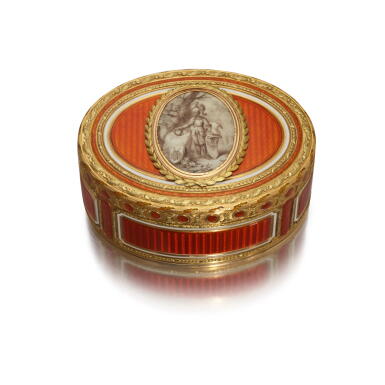
A Large Two-Colored Gold and Enamel Snuff Box, Esaias Fernau, Hanau, Circa 1780
Auction Closed
June 18, 05:01 PM GMT
Estimate
12,000 - 18,000 USD
Lot Details
Description
oval, the lid possibly later applied with an en grisaille enamel miniature of a knight flanked by two shields decorated with a coat of arms, within a chased laurel frame, on a translucent bright orange enamel ground over engine-turning, within chased acanthus frame between opaque white and orange borders, further chased gold foliate frame, the sides similarly decorated below a border of small orange enamel roundels over engine-turned flowerheads, Hanau marks including maker's mark EF and crowned F, Hanau bird head's control mark for 19 ct gold
Length 3 3/8 in.
8.5 cm
Christie's London, 10 December 2002, lot 54;
Sotheby's London, 23 November 2004, lot 32
Esaias Fernau (1734-1795) was one of the most important bijoutiers in Hanau, and a member of the group of prolific goldsmiths in the Neustadt who had formed a society in 1764, eight years before the Zeichenakademie (Drawing Academy) opened its doors for students wanting to learn the profession of the engine-turner, enameler, chaser, engraver etc. Together with Esaye Souchay, Marc-André Souchay, Charles Toussaint, Pierre Toussaint, Gutschmidt, Esaias Obicker, Daniel Marchand, the Colin brothers, and G. Bocquet, Fernau was a founding member of this so-called 'Bijoutier-Gesellschaft'. Among their aims was to establish certain rules and laws around the gold industry in terms of the gold standard, entry rules for foreign gold workers, apprenticeships etc, which already existed in other European centers of production, such as Paris and Berlin, and were supposed to align Hanau with these cities in order to be able to compete with them, which later turned out to be a very successful undertaking. (Lorenz Caspari, Die Entwicklung des Hanauer Edelmetallgewerbes von seiner Entstehung im Jahre 1597 bis zum Jahre 1873, Freiburg, 1916, p. 108-109).
Esaias Fernau first received tax freedom in 1761 and worked in partnership with Daniel Marchand between 1762 and 1780, and later again with his brother (Johann) Friedrich Fernau, under the name of 'E. Fernau et. Comp' or 'Gebrueder Fernau' (Lorenz Seelig, ‘Ignaz Peter Krafft und die Hanauer Luxuswarenproduktion‘, Neues Magazin für Hanauische Geschichte, Hanau: Hanauer Geschichtsverein, 2018, p. 92; Hesse State Archive, Marburg, HStAM, 80, 9497).
Several other versions of the mark exist, incorporating different first initials or even split initials, similar to the marks of Théremin. Caspari already complained in 1916 that it was nearly impossible to find out all the details of the makers and different companies and partnerships that were active in Hanau from the last third of the 18th century until the mid-19th century, and this becomes even more evident when considering the fact that goldsmiths could choose their (joint) marks as they pleased, without any formal regulations.
Examples of Esaias Fernau’s work can be found in most major collections, such as the Metropolitan Museum of Art, the Thurn and Taxis collection, the Musée du Louvre, which owns a gold box enameled in a slightly darker shade than the present lot, struck with the same set of marks (OA 7654).
You May Also Like