
PROPERTY FROM A GERMAN PRIVATE COLLECTION
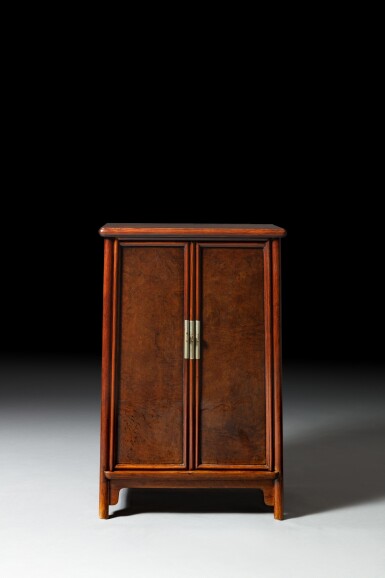
A 'huanghuali' and burlwood cabinet (Yuanjiaogui), Ming dynasty, Late 16th / Early 17th century
Auction Closed
June 11, 03:42 PM GMT
Estimate
100,000 - 150,000 EUR
Lot Details
Description
108 x 68 x 43 cm, 42½ by 26¾ by 16⅞ in.
Please note that this lot may contain restricted materials. Sotheby's is not able to assist buyers with the shipment of any lots containing restricted materials into the U.S.A. Buyer's inability to export or import these lots cannot justify a delay in payment or a sale's cancellation.
The Dr. S. Y. Yip Collection, Hong Kong.
Gallery Grace Wu Bruce, London / Hong Kong, 1998.
Acquired by the previous owner from the above in May 1999.
Gallery Grace Wu Bruce, London.
Acquired by the present owner from the above in 2001.
Min Chiu Society Thirtieth Anniversary Exhibition, Hong Kong Museum of Art, Hong Kong, 1990, cat. no. 267.
Art Gallery, The Chinese University of Hong Kong, Hong Kong, 1991.
Dream of Chu Tan Chamber and the Romance with Huanghuali Wood. The Dr. S. Y. Yip Collection of Classic Chinese Furniture, Grace Wu Bruce, 1991, pp 124 / 125, pl. 48.
"Dr. S. Y. Yip: Collecting Ming Furniture of Huanghuali wood", Arts of Asia, 1991, p. 121, fig. 10.
Burlington Magazine, November 1997, p. XIX.
This rare and masterfully carved cabinet, with its use of burl inlay and solid, square-membered frame of huanghuali, would not have been out of place in the studio of a scholar of the most refined taste, and was indeed likely commissioned by a wealthy official in the late Ming dynasty. As Wang Shixiang elucidates in Connoisseurship of Chinese Furniture, Hong Kong, 1989, p. 85, yuanjiaogui (round corner cabinets) derive their names from the projecting top frame of the cabinet, which typically have rounded corners and support projecting pivots at the top of the doors, allowing them to hinge. Square corner cabinets (fangjiaogui), in contrast, utilize metal mounted hinges, and as such the projecting top frame is not necessary. Wang Shixiang, ibid., p. 85, also states that medium-sized yuanjiaogui like the present example were known in Suzhou as shuchu (book cabinets) and were used by scholars and officials for storing books. Certainly the lavish use of the yingmu burl of the door panels is a hallmark of the scholarly taste associated with Suzhou in the Ming dynasty, as contrasts between light and dark, in this case the golden tones of the huanghuali members and the dark burl panels, were particularly appreciated by Ming furniture collectors. Due to the difficulty in procuring large panels of burlwood, cabinets inlaid with the material are relatively rare. A pair of cabinets of similar proportions to the present example is in the collection of the Nelson-Atkins Museum of Art (acc. no. F72-54/2), illustrated in Robert Hatfield Ellsworth, Chinese Furniture. Hardwood Examples of the Ming and Early Ch'ing Dynasty, 1997, pl. 122.
A single, round member example with burl limited to the doors is preserved in the collection of the Los Angeles County Museum of Art, Los Angeles (accession no. M.2005.169). Another similar cabinet is in the collections of the Musée National des Arts Asiatiques, Guimet, illustrated in Cécile and Michel Beurdeley, Le Mobilier Chinois. Le Guide du Connaisseur, Fribourg, 1979, cat. no. 128, p. 93. Compare also an example sold in our New York rooms, 19th April 2025, lot 269; and a pair of later square-membered burl-inset huanghuali cabinets sold in these rooms, 31st March 2005, lot 301, and again more recently at Christie’s New York, 22nd September 2023, lot 961.