
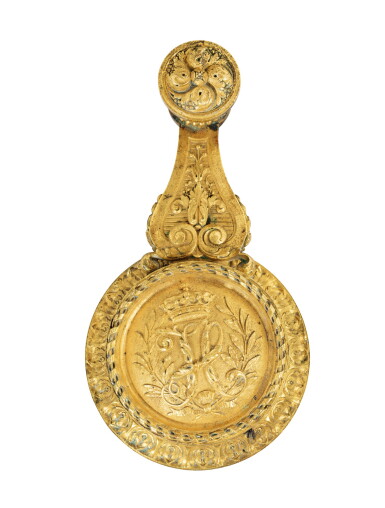
A rare gilt-bronze crémone bolt, French Restauration, circa 1820 | Rare poignée articulée en bronze ciselé et doré au chiffre couronné d'époque Restauration, vers 1820
Lot Closed
November 19, 03:55 PM GMT
Estimate
4,000 - 6,000 EUR
Lot Details
Description
A rare gilt-bronze crémone bolt, French Restauration, circa 1820
sculpted with the monogram "JC", surmounted by a crown marquis pair, corresponding to Jean-Baptiste Marie Frédéric, marquis of Chabannes (1770-1835).
---------------------------------------------------------------------------
Rare poignée articulée en bronze ciselé et doré au chiffre couronné d'époque Restauration, vers 1820
figurant le chiffre "JC" surmonté d'une couronne de marquis pair correspondant à Jean-Baptiste Marie Frédéric, marquis de Chabannes (1770-1835).
Haut. 20 cm; height 7¼ in
Due to the various measures taken to deal with the Covid-19 epidemic, property collection and shipment of this lot will be delayed until the offices where it is located are able to reopen. Please refer to the “auction details” tab. Thank you for your understanding
Please contact FRpostsaleservices@sothebys.com for any shipping inquiries.
[En raison des circonstances actuelles liées au COVID-19, la livraison de ce lot ne pourra intervenir qu’après la réouverture des locaux de Sotheby’s dans lesquels il se trouve. Nous vous remercions de votre compréhension et nous vous invitons à consulter l’onglet « auction details ».
Pour toute demande concernant le transport, veuillez contacter FRpostsaleservices@sothebys.com.]
The pair's encirclement which encloses this crown is enhanced with a golden tassel, an element found after the First French Restoration (usage adapted from English heraldry), enabling this bolt to be dated 1820. Accordingly, this insignia is the only one among the few Marquis-Peers from the Second Restoration (1815) which correspond to Jean-Baptiste Marie Frédéric, Marquis de Chabannes (1770-1835). He was the king's honorary kin, Captain of the Royal-Normandy regiment, fought with the counter-revolutionary Army of the Emigré, then in England. During the French Restoration, he was aide-de-camp to Louis XVIII in April 1814, and awarded knight of the Order of Saint-Louis. He was also responsible for certain negotiations relating to the return of the Bourbon family onto the throne. Notably, he obtained the quick allegiance of Count Maisons, Governor of Lille. Napoleon's entry to Paris from Elba forced de Chabannes to exile in England.
During the Second French Restoration, he was appointed to France's Chamber of Peer on 17 August 1815 (see reproduction of the privilege letters infra) and voted for the death verdict during Marshal Ney's trial. He was also general councilor of Nièvre. As a Legitimist royal follower, he refused to sit in the Chamber of Peers after the July Revolution of 1830.
---------------------------------------------------------------------------
Le bonnet de pair qui ferme cette couronne est rehaussé d'une houppe d'or, élément que l'on retrouve qu'à partir de la première Restauration (usage emprunté à l’héraldique anglaise), permettant de dater cette poignée de 1820. Corrélativement, ce chiffre est le seul des quelques marquis-pair de la seconde restauration (1815) qui correspondent à Jean-Baptiste Marie Frédéric, marquis de Chabannes (1770-1835). Il fut enfant d'honneur du roi, capitaine au régiment Royal-Normandie, émigré à l'Armée des princes puis en Angleterre. A la Restauration, il fut aide de camp de Louis XVIII en avril 1814, et chevalier de Saint-Louis. Il fut également chargé de certaines négociations relatives au retour des Bourbons : il obtient notamment la soumission immédiate du comte Maisons, gouverneur de Lille. Le retour de l'île d'Elbe l'obligea à regagner l'Angleterre.
À la Seconde Restauration, il fut nommé pair de France le 17 août 1815 (voir reproduction des lettres patentes infra) et vota la mort dans le procès du maréchal Ney. Il était également conseiller général de la Nièvre. Légitimiste, il refusa de siéger à la Chambre des pairs après la révolution de Juillet 1830.