
Pablo Picasso
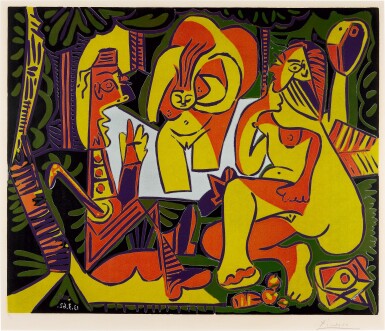
Le Déjeuner sur l'herbe, d'après Manet (B. 1027; Ba. 1287; PP. L-106)
Lot Closed
March 15, 04:00 PM GMT
Estimate
70,000 - 100,000 GBP
Lot Details
Description
Pablo Picasso
1881 - 1973
Le Déjeuner sur l'herbe, d'après Manet (B. 1027; B. 1287; P.P. L-106)
Linoleum cut printed in colours, 1962, signed in pencil, numbered 31/50 (total edition includes 20 artist's proofs), printed by Arnéra, Vallauris, published by Galerie Louise Leiris, Paris, on Arches wove paper, framed
image: 528 by 657mm 20¾ by 26¼in
sheet: 620 by 753mm 24⅜ by 29⅝in
Enthralled by Edouard Manet's Le déjeuner sur l'herbe, Picasso made a note in response to the painting at the Musée d’Orsay, “When I see Manet’s Déjeuner sur l’herbe, I tell myself: grief for later” (Picasso cited in B. Leal, C. Piot and M.-L. Bernadac, The Ultimate Picasso, New York, 2003, p. 430). Throughout the 1950s and 60s Picasso fulfilled this promise to himself by re-visiting the subject repeatedly, re-imagining it in various forms. In total, he created one hundred and forty drawings after Manet’s masterpiece, twenty-seven paintings, and four linoleum cuts – of which this is the only one printed in colours.
The present impression of this kaleidoscopic print conveys the joy Picasso took in re-working Manet’s painting, which itself was inspired by Titian’s Concert champêtre (formerly attributed to Giorgione). Conceived in 1962, this linoleum cut was created as Picasso turned seventy-five and became increasingly aware of his artistic legacy, particularly as Abstract Expressionism grew in popularity. While the Abstract Expressionists were inspired by the Spanish painter-printmaker, he was not motivated by the movement. Instead, Picasso increasingly looked to the past for inspiration, creating prints after the work of European masters, which in addition to Manet included Diego Velázquez, Lucas Cranach, and Rembrandt Van Rijn. By toying with their most recognizable compositions, he paid homage to his artistic predecessors while boldly challenging their canons and securing his own position as the premier artist of the twentieth century.