
Property from the Campbell Family Collection, Canada
Thomas Hart Benton
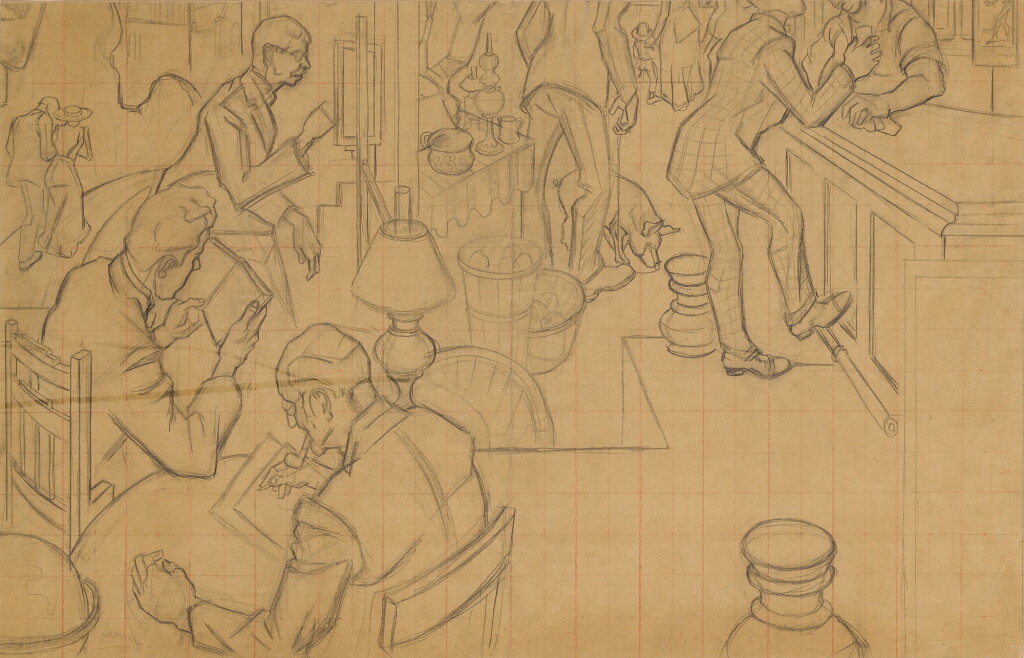
Study for Leisure and Literature
Lot Closed
March 3, 05:49 PM GMT
Estimate
6,000 - 8,000 USD
Lot Details
Description
Property from the Campbell Family Collection, Canada
Thomas Hart Benton
1889 - 1975
Study for Leisure and Literature
pencil and colored pencil on paper
sheet: 25 by 37 ⅜ inches (63.5 by 95 cm)
framed: 33 ½ by 37 inches (85.1 by 94 cm)
Executed in 1932.
We thank Dr. Henry Adams and Andrew Thompson for their help researching this lot.
The artist
Wallace Richards (probably gift of the above)
Gwin Richards (by descent)
Sid Deutsch Gallery, New York
Nardin Fine Arts, Ltd., Cross River, New York
Acquired by the present owner from the above, 1990
The present work is a study for Thomas Hart Benton's monumental mural A Social History of the State of Indiana. The artist was commissioned to paint the 250-foot mural in 1932 by the Indiana Commission for the Century of Progress Exposition which sought to illustrate the social and economic history of the state of Indiana. Benton completed the mural in 1933 and it consisted of two parallel, chronical sequences, categorized by either cultural or industrial imagery. The subject depicted in present work belonged to Cultural panel 8, Leisure and Literature, illustrating the state's development from small farming communities into larger cities and the evolution of the education system with established universities. Wallace Richards, the superintendent of the Indiana Pavilion, and the initial owner of the present work observed, "It was decided to do away with the conventional literary history in paint and to attempt something more fundamental--an economic and cultural history on Indiana's grown." (as quoted in Erika Doss, "Thomas Hart Benton's Indiana Murals at 75," Indiana Magazine of History, vol. 105, no. 2, June 2009, p. 131) After exhibition in Chicago at The World's Fair, the panels were eventually installed at the Indiana University Bloomington campus where they still reside today.