
Mauboussin
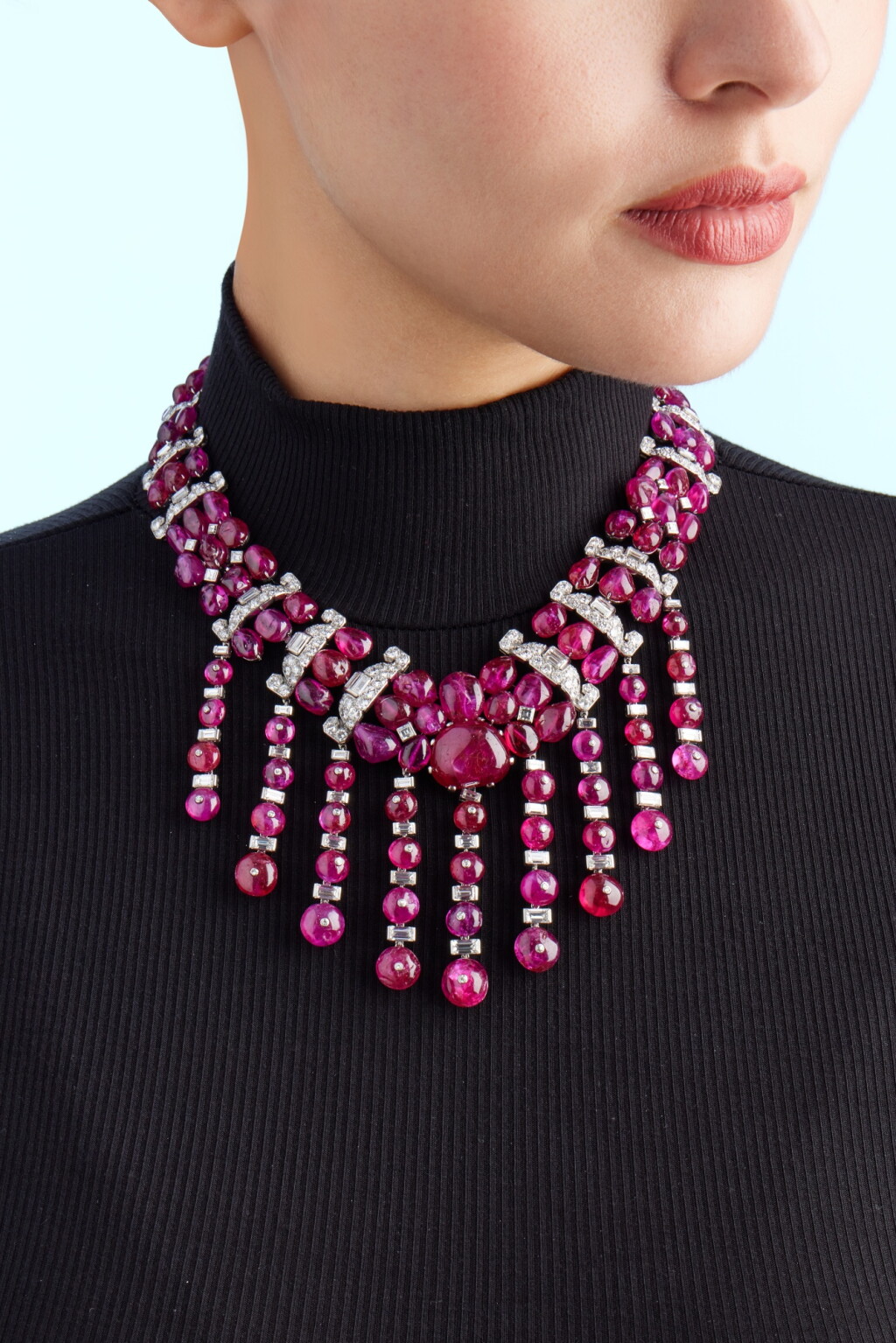
Art Deco Ruby and Diamond Necklace, Circa 1930s | 夢寶星 | 裝飾藝術風格 紅寶石 配 鑽石 項鏈, 約1930年代
Premium Lot
Auction Closed
September 17, 11:55 AM GMT
Estimate
9,500,000 - 11,000,000 HKD
Lot Details
Description
Set with tumbled rubies and ruby beads, brilliant- , old European-cut, square and baguette diamonds, necklace length adjustable, signed Mauboussin Paris, French assay mark for platinum, indistinct maker, circa 1930, with fitted case stamped Mauboussin.
Approximate Gross Weight: 264 grams
Approximate Length: 600 and 400mm
Certificate of Authenticity from Mauboussin
Gübelin report available in the condition report
Gemmological report available in the condition report
Cf. Marguerite de Cerval, Mauboussin, Editions Du Regard, page 89 for a black and white photo of this necklace.
Mauboussin: Masters of Art Deco
Bold, geometric and intensely colourful, this extraordinary ruby and diamond necklace encapsulates the spirit of Art Deco at its most sophisticated. Created in Paris in 1930 and signed Mauboussin Paris, it belongs to the great period in which the maison emerged as one of the most distinctive and inventive voices in modern jewellery. Founded in Paris in 1827, Mauboussin entered the twentieth century as an established French jewellery house. It was during the 1920s and 1930s, however, that it reached the height of its creative influence. In those remarkable decades, jewellery underwent a profound transformation. The delicacy and naturalism of the Belle Époque gave way to abstraction, geometry, volume and colour, and Mauboussin was among the houses that most confidently embraced—and ultimately helped define—this new visual language. Its importance was recognised almost immediately. Mauboussin received a major prize at the French Exhibition in New York in 1924, but it was in Paris the following year that the maison achieved its defining triumph. At the celebrated 1925 Exposition Internationale des Arts Décoratifs et Industriels Modernes—the exhibition from which Art Deco would later take its name—Mauboussin was awarded the Gold Medal for jewellery design. The distinction effectively anointed the house as one of the foremost exponents of the new style and established Mauboussin as a destination of choice for those seeking jewellery at the very forefront of Art Deco design. Further recognition followed at the Galliera exhibitions in Paris and at the 1931 Colonial Exhibition. By then, Mauboussin stood firmly among the great Parisian maisons of the period. Its clientele reflected the extraordinary cosmopolitanism of the age. Hollywood stars, European royalty, international society and the great Indian princely families came to Paris in search of jewels that expressed a new idea of glamour. Marlene Dietrich and Charlie Chaplin were among the celebrated names associated with the house, as were the Prince of Wales, later King Edward VIII, and Yashwant Rao Holkar II, Maharaja of Indore—perhaps the most sophisticated and uncompromisingly modern of the great Indian princely patrons. Paris itself provided the perfect setting. During the interwar years, the city became a meeting place of worlds: European aristocrats encountered artists and writers of the
avant-garde; American fortunes met old European society; Maharajas arrived with extraordinary gemstones and centuries-old traditions of ornament. Fashion, architecture, painting and the decorative arts were engaged in the same pursuit of modernity. Mauboussin absorbed these influences and translated them into jewels of striking originality.
The present necklace is a superb expression of this moment. Its strongly geometric construction is tempered by an almost sensuous materiality. Articulated sections of Burmese ruby beads are punctuated by scroll-form diamond-set elements, creating a brilliant architectural framework around the saturated colour of the stones. Against the precision and scintillation of the diamonds, the smooth surfaces of the ruby beads possess an extraordinary softness, their colour deep, concentrated and almost velvety. The choice of ruby is particularly evocative. Revered for centuries in India as ratnaraj, the “king of precious stones”, ruby was associated with power, protection and sovereignty. By the early twentieth century, the encounter between the great Parisian jewellers and their Indian princely patrons had become one of the most fertile exchanges in the history of jewellery design. Maharajas brought to Europe not only exceptional gemstones, but an entirely different understanding of colour, scale and ornament. Mauboussin responded with particular imagination. Beads and cabochons, carved stones, emphatic colour contrasts and rhythmic compositions entered the vocabulary of French Art Deco, transformed through Parisian craftsmanship and modernist geometry. The result was neither wholly Indian nor wholly European, but something entirely new: a sophisticated dialogue between two great traditions of jewellery.
That dialogue is beautifully expressed in this necklace. Its ruby beads bring colour, movement and tactility to an otherwise rigorously architectural composition, while its ingenious construction allows the jewel to be worn at two different lengths. Such versatility was itself characteristic
of the finest jewellery of the period, conceived for a modern woman whose clothes, surroundings and social life were changing with unprecedented speed. Worn long, the necklace acquires a dramatic verticality, its graduated ruby elements cascading over the décolletage and echoing the elongated silhouettes of 1930s evening dress. Shortened, the same jewel becomes concentrated and architectural, sitting close to the collarbone with the commanding presence of a jewelled collar. With remarkably few means, Mauboussin created two distinct compositions: one governed by length, movement and rhythm; the other by symmetry, density and form. The importance of the necklace is further reinforced by its publication in Marguerite de Cerval’s authoritative 1992 monograph Mauboussin, where it is reproduced in a period black-and-white photograph. This documentary record, together with the maison’s signature and accompanying certificate of authenticity, firmly places the jewel within the celebrated history of Mauboussin.
The Art Deco period did more than create a new aesthetic; it helped define our very idea of modernity. Its radical geometry, clarity of line and celebration of colour and form established a visual language whose lustre remains undiminished a century later. Its influence has proved indelible, continuing to resonate through jewellery, fashion, architecture and design, and shaping much of what we still instinctively recognise as modern. More than ninety years after its creation, the necklace itself has lost none of its audacity. It belongs to a brief and extraordinary moment when jewellery, fashion, architecture and the decorative arts spoke the same language of modernity—and when Mauboussin stood among its most brilliant interpreters. It is this combination of history, design and sheer beauty that makes the necklace so compelling today. A quintessential creation of the Art Deco age, it brings together the splendour of Burmese rubies, the precision of Parisian craftsmanship and the cultural exchange that produced some of the twentieth century’s greatest jewels. Above all, it represents Mauboussin at the height of its powers: bold, cosmopolitan and unmistakably modern.
You May Also Like


