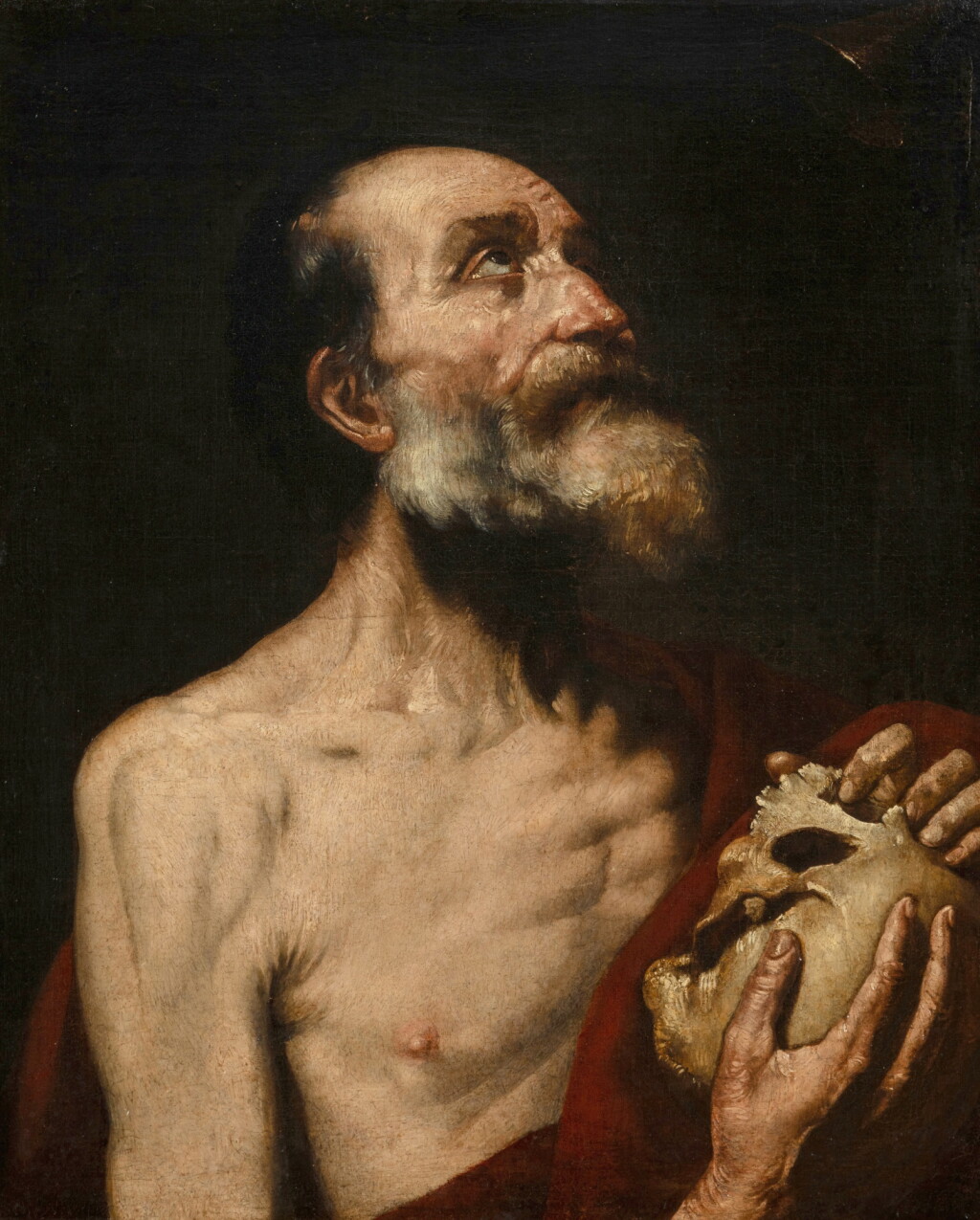
View full screen - View 1 of Lot 23. Saint Jerome.

Jusepe de Ribera

Saint Jerome

Estimate

100,000 - 150,000 EUR

Lot Details

Lire en français
Lire en français

Description

Jusepe de Ribera

Xàtiva 1591 - 1652 Naples

Saint Jerome


Oil on canvas

74,5 x 59,5 cm ; 29⅜ by 23⅜ in.


We are grateful to Prof. Nicola Spinosa and Prof. Riccardo Lattuada for having confirmed the authentication of this work, based on photographs.

Probably collection José Ramiro de la Puente y Gonzalez-Nandin, Marquis of Alta Villa (1845-1909);

Castle of Savigny-sur-Orge, belonging to the Marquis of Alta Villa between 1866 and 1883;

Sold by the Marquis of Alta Villa, together with the furniture of the castle, when selling the property to Alexis Duparchy, in 1882;

Collection Alexis Duparchy (1835-1907);

By descent to the present owner.

Never before published and owned by the same French family for nearly 150 years, this St Jerome by Jusepe de Ribera is an addition to the artist’s corpus of paintings. In accordance with an iconography that Ribera favoured throughout his career, it shows the saint as an ascetic, holding a skull and turning towards the trumpet of the Last Judgement, whose horn alone can be glimpsed in the top right corner of the composition.


According to Prof. Riccardo Lattuada, this work is comparable to the St Bartholomew in the collection of the Harrach family, in the Schloss Rohrau. The faces of the two saints do indeed seem very similar and it is possible that the same model was used. Several other ‘portraits’ of elderly saints can be compared, in both their approach and their pictorial technique, to the present St Jerome, including the St Onophrius in the Museum of Fine Arts in Boston (inv. 36.891; fig. 1), which is dated to 1642.

The painting’s unique status is reinforced by the absence of other workshop versions or copies of this composition by the artist.


The work’s history adds still further to its interest. It belonged to the Marqués de Alta Villa, José Ramiro de la Puente y Gonzalez-Nandin (1845–1909). A loyal supporter of Queen Isabella II of Spain, a refined man of letters and a musicologist, in 1866 he bought the Château de Savigny-sur-Orge. When he returned to Spain, the residence along with its contents passed to Jean-Alexis Duparchy (1835–1907), an important industrialist of the late nineteenth century, who was involved in major international projects such as the Suez Canal; the design of the ports at Sfax, Sousse, Porto and Montevideo; and the construction of railways in Portugal, Ethiopia and Puerto Rico.


Born in Jativa, near Valencia, Jusepe de Ribera was one of the most influential artists of the whole Baroque period. Based in Italy from 1611 onwards, he is mentioned as being in Rome in a document dated 27 October 1613, when he was admitted to the Accademia di San Luca. He left the Eternal City in the summer of 1616 and settled in Naples, where he remained for the rest of his career, receiving commissions from both Italian and Spanish clients.