Bartolomé Esteban Murillo and Workshop
Holy Family
Auction Closed
June 9, 01:57 PM GMT
Estimate
50,000 - 70,000 EUR
Lot Details
Description
Bartolomé Esteban Murillo and Workshop
Seville 1617 - 1682
Holy Family
Oil on canvas, in a painted tondo
122 x 118,3 cm ; 48 by 46⅝ in.
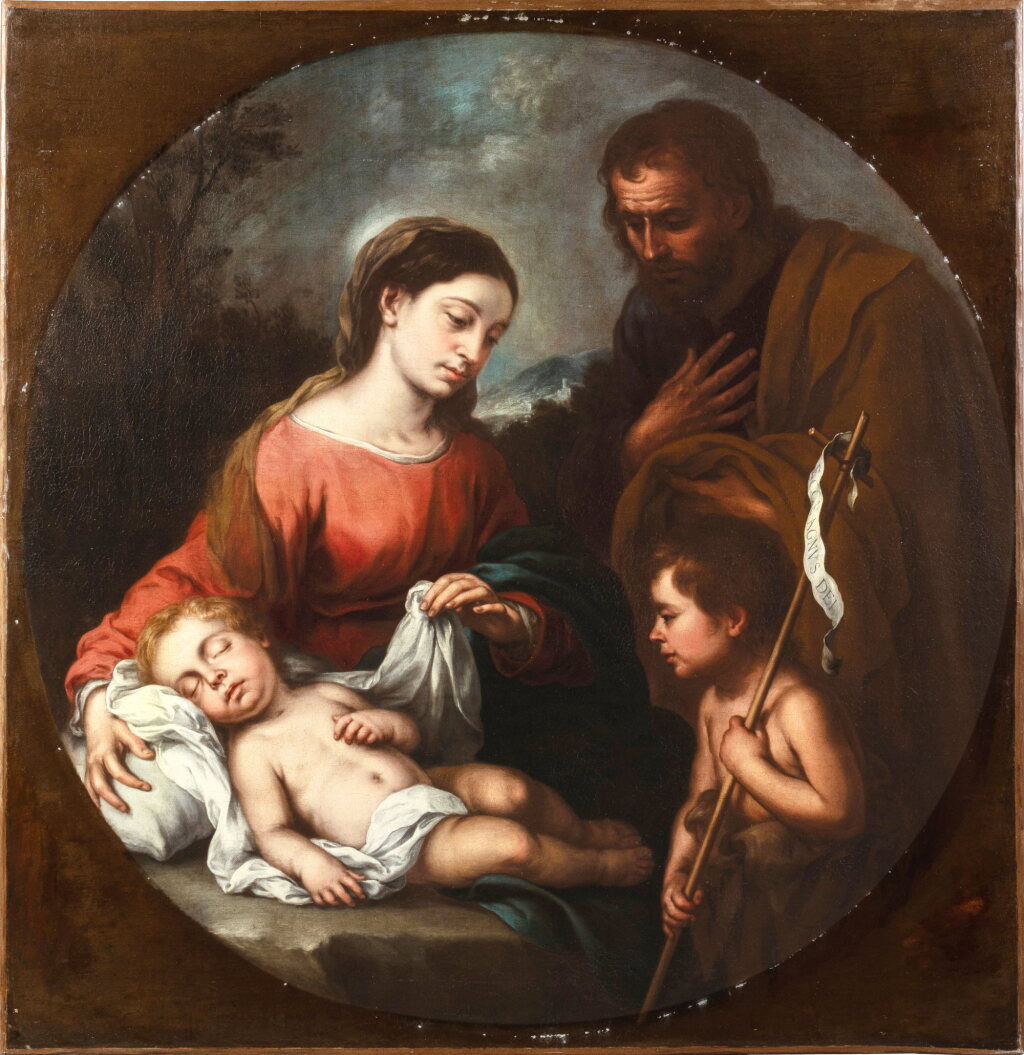
Murillo returned several times to the subject of The Holy Family with the young St John the Baptist. The original composition is only known to us today from the engraving in reverse by Antoine Louis Romanet, made in 1797 after a drawing that Juan Alonso del Canto had produced the same year (Calcografía Nacional, Madrid, inv. 160), itself based on a painting by Murillo at that time in the Royal Palace in Madrid. The drawing specifies that the painted composition ‘mesure quatre pieds et demi et quatre doigts de largeur, et quatre pieds et demi de hauteur’ (‘measures four and a half pieds and four doigts in width, and four and a half pieds in height) – it was therefore not a tondo.
Murillo’s original work seems to have been lost or destroyed during the Napoleonic invasion, unless it is the version now in the Museo Nacional de Bellas Artes in Havana (inv. 93-78), whose circular form could be the result of a later intervention rather than its original format.
However, it seems more probable that the painting in the Royal Palace has disappeared and that the Havana work is a replica by the artist, perhaps produced with the help of his workshop, as is also the case for the present version.
In a painted oval, the scene exactly reproduces the present framing of the Havana painting. Some very fine details, such as the drapery protecting the Christ Child and the Virgin’s delicate features, indicate an intervention by Murillo himself. However, a certain unevenness in the rendering and fluidity of the drawing betray the involvement of his workshop.
Approached with a very sweet simplicity, the religious nature of the scene is here almost secondary: this is above all an image of a mother tenderly cradling her child, watched fondly by Joseph and St John the Baptist.
Its classicism situates the work between 1665 and 1670, a time when Murillo was based at the Capuchin Convent in order to paint its polyptych.
You May Also Like