Prosper Georges Antoine Marilhat
The Return of the Prodigal Son
Auction Closed
June 9, 01:57 PM GMT
Estimate
30,000 - 50,000 EUR
Lot Details
Description
Prosper Georges Antoine Marilhat
Vertaizon 1811 - 1847 Thiers
The Return of the Prodigal Son
Oil on canvas
Signed lower left P. MARILHAT
65,3 x 100 cm ; 25¾ by 39⅜ in.
Collection Laurent-Richard;
His sale, Paris, 7 April 1873, lot 36 (titled L'Enfant prodigue);
Collection Count Daupias of Lisbon;
His sale, Me Chevallier, Galerie Georges Petit, Paris, 16-17 May 1892, lot 156 (titled Le Retour du Fils Prodigue) ;
Art market, Metz;
Where acquired, in 1993;
By inheritance to the present owner.
D. Menu, Prosper Marilhat (1811-1847). Essai de catalogue, master, Université de Dijon, June 1972, p. 1, no. 6.
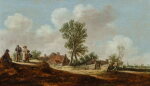
Marilhat sets the biblical scene in an imposing desert landscape. A rocky hillside, scattered with stones and dotted with cactus, occupies the whole of the left half of the painting. In the centre, a wide sandy path, leading to the ruins of an ancient town, provides the setting for the reunion between the prodigal son and his parents. On the right, a few figures in Eastern dress watch the moving scene, as the mother embraces her son and the father, a bearded old man supported by a youth, hurries toward him. The mineral harshness of the terrain is softened by the warm tones of red, yellow and beige ochre, illuminated by the sun – probably in the morning – which tints the colours with rose pink.
The biblical figures are not given a prominent place and seem to have been a pretext for painting the wild beauty of a vast Orientalist landscape, in which the group of local figures and camels are more conspicuously located. Marilhat has here used an arrangement that he would revisit often in his finest Orientalist works, in which the eye is chiefly drawn to the landscape.
Marilhat encountered the Middle East at the age of twenty, when he joined the scientific expedition led by Baron von Hugel, a wealthy Prussian aristocrat. He discovered Greece, Syria, Lebanon, Palestine and Egypt. He stayed there for two years, from April 1831 to May 1833, making his living from portrait commissions. He returned to France having accumulated ten books filled with sketches. His work, after this trip – which was the most important event of his life – was dedicated solely to rendering the impressions that had marked him during those two years, in paintings that almost exclusively consisted of Eastern views and scenes. After exhibiting Esbekieh Square and the Coptic quarter in Cairo at the 1834 Salon, he was ranked among the best Orientalist artists, alongside Alexandre-Gabriel Decamps, who had also just returned from travels in the East.
Shortly after his Eastern expedition, Marilhat briefly experimented with painting a few canvases (including history subjects) with spontaneity, vigour and a laden brushstroke full of energy, sometimes even with an agitated quality that approached Romanticism. The return of the prodigal son certainly belongs to this series. This style would soon give way to the refined and polished style, exhibiting flawless technical perfection, which typifies the work of the works of his maturity, if such a word can be used for an artist who died at the age of thirty-six.
You May Also Like