Property from a Private European Collection
French School, 18th century
Portrait of a Gentleman
Lot Closed
April 9, 12:13 PM GMT
Estimate
7,000 - 10,000 GBP
We may charge or debit your saved payment method subject to the terms set out in our Conditions of Business for Buyers.
Read more.Lot Details
Description
Property from a Private European Collection
French School, 18th century
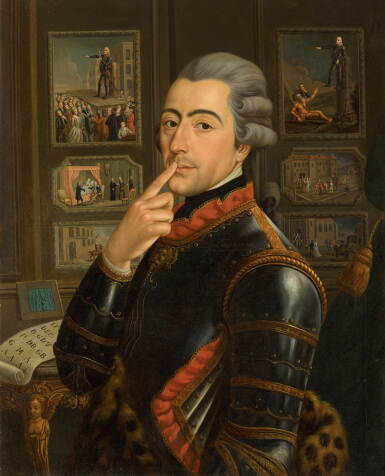
Portrait of a gentleman
inscribed lower left: LF / DBC. / B . GDV. / P. DB . G.B. / G . M . A . / A.A.A &.
oil on canvas
unframed: 81.6 x 65.2 cm.; 32⅛ x 25⅝ in.
framed: 99.3 x 82.7 cm.; 39⅛ x 32½ in.
Princess Margherita of Bourbon-Parma, Duchess of Madrid (1847–1893), Tenuata Reale, Viareggio, Italy;
From whom acquired by Bertram Ashburnham, 5th Earl of Ashburnham (1840–1913), Ashburnham Place, Sussex, by June 1886 (this and the above according to an inscription along the upper stretcher bar);
Art market, London;
Where acquired by the present owner in the 1970s.
C. Hussey, 'Ashburnham Place, Sussex – III', in Country Life, 30 April 1953, pp. 1335–36, reproduced fig. 7 (as 'A Mysterious Portrait').
This intriguing portrait is reminiscent of the rebus puzzle genre, which originated as a form of visual punning around 1600 in Picardy, northern France. Although this painting does not appear to use images to represent names, words or phrases, its letter code and imagery were clearly intended to be decoded by the viewer.
The nobleman at centre, who holds his right forefinger to his lips in a tantalizing manner, is depicted wearing cuirassier's armour. His suit is richly decorated with gold ornaments, including a lion's head symbolising strength and power, attesting to his military prowess. The edges of a cheetah fur coat, visible around his lower torso, identify this figure as a representative of the noblesse d'épée during the Ancien Régime. A comparable garment is donned by Pierre-Victoire, Baron of Besenval (1722–1791), in a portrait by Jean-Marc Nattier (1685–1766) that hangs today in the Hermitage Museum, St Petersburg.1
The framed scenes that fill the portrait's background are less straightforward in their interpretation. Interestingly, the sitter, who adopts the same pose with his finger to his lips, appears in four of the six images and thus occupies both past and present: in the paintings and in his likeness at the centre. Five of the six vignettes portray scenes of everyday life and are populated by figures wearing French High Rococo clothing. Perhaps the most interesting is the image at top right: Chronos, in the form of a winged old man with a scythe, surely personifying the transience of life, sits beside an open grave. He points upwards towards a man in armour – who likewise appears in the scene at top left, adopting the same position – standing on a column.
Other compositional elements provide further clues for solving this mystery. The table at lower left is topped by a panel with a drawn curtain, though it is not clear whether this is a real curtain, used to protect whatever lies beneath, or an illusion in the trompe-l'œil style. It is accompanied by a scroll of paper, which bears the following inscription: LF / DBC. / B . GDV. / P. DB . G.B. / G . M . A . / A.A.A &.
This portrait relates closely to a canvas of marginally smaller dimensions in the Letter Stiftung, Cologne.2 The inscription along the present work's upper stretcher bar clarifies the relationship between the two pictures: ‘This portrait was given to Lord Ashburnham in June 1886 by the Duchess of Madrid being a copy from the original inherited by her from her grandfather the Duke of Parma. Its history is unknown’.
Note on Provenance
Princess Margherita of Bourbon-Parma (1847–1893) was the eldest child of Charles III, Duke of Parma (1823–1854) and Princess Louise Marie Thérèse of France (1819–1864), the eldest daughter of Charles Ferdinand, Duke of Berry (1778–1820) and Princess Caroline Ferdinande Louise of the Two Sicilies (1798–1870). Margherita was thus a great-granddaughter of Charles X (1757–1836). In February 1867, Margherita married Carlos de Borbón y Austria-Este (1848–1909), who was the Carlist claimant to the throne of Spain from 1868. It must have been through Carlos that Margherita met Bertram Ashburnham, 5th Earl of Ashburnham (1840–1913), to whom she gave this portrait in June 1886. Bertram was the British agent for the Spanish Carlist cause and acted as spokesman for Carlos and later his son Jaime, Duke of Madrid (1870–1931).
1 Museum no. ГЭ-7488; oil on canvas, 80 x 63 cm.; https://www.hermitagemuseum.org/digital-collection/38117?
2 Inv. no. 2019.265.001; oil on canvas, 75 x 62.5 cm.; https://www.letter-stiftung.de/index.php/leser-84/items/edelmann-mit-bilderraetsel.html.
You May Also Like