Bernard Boutet de Monvel
Portrait of Count Edgard de Barral
Auction Closed
November 5, 09:38 PM GMT
Estimate
200,000 - 300,000 EUR
Lot Details
Description
Bernard Boutet de Monvel
Paris 1881 - 1949 Açores
Portrait of Count Edgard de Barral
Oil on canvas
Signed lower right BERNARD / B. DE MONVEL and dated lower left 1910
205,8 x 169,8 cm ; 81 by 66⅞ in.
Commissioned by Count Edgard de Barral in 1909 after visiting the exhibition at the Devambez Gallery in Paris;
Collection of Count Edgard de Barral;
Thence by descent in the family;
With Blondeau-Bréton, Paris, June 2008.
Salon de la Société Nationale des Beaux-Arts, Paris, 1910, no. 151 (as titled Portrait du comte E. de B.).
M. Valotaire, 'Bernard Boutet de Monvel', in The Studio, no. 416, November 1927, p. 312, repr.;
J. Louvet, Vie, œuvre et art de Bernard Boutet de Monvel, master thesis, Paris IV, 1979, pp. 36, 38, 60, pl. 31;
S.-J. Addade, Bernard Boutet de Monvel, Paris 2001, pp. 101-106;
Exhibition advert for Bernard Boutet de Monvel, Mona Bismarck Foundation, Paris, 27 April-30 June 2001, quoted p. 3;
S.-J. Addade, Bernard Boutet de Monvel, Paris 2016, pp. 116-121;
A. Bony, Alberto Pinto Signature, Paris 2016, pp. 44 and 49, repr.
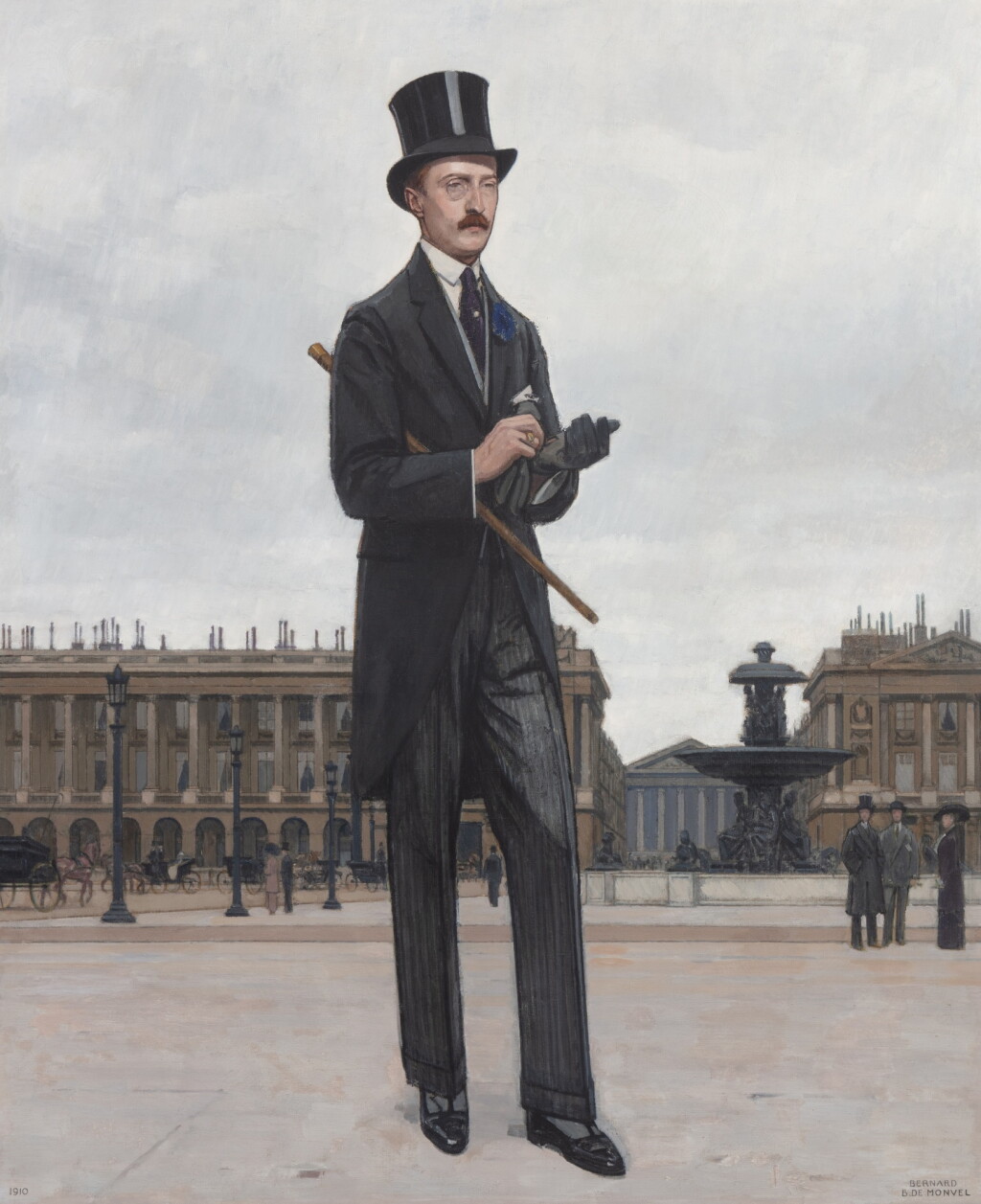
The painting, of spectacular dimensions, was commissioned by Count Edgard de Barral following his visit in 1909 to an exhibition at the Devambez gallery in Paris. There, he was struck by a painting by Bernard Boutet de Monvel, Esquisse pour un portrait, depicting the artist himself as a modern dandy confidently crossing the Place de la Concorde. The painter had already explored a similar subject in 1907 in Le Lion, sold at the Hôtel Drouot, Paris, 2 July 1991, lot 326, titled Dandy place de la Concorde. The work presented here, painted in 1910, reproduces almost identically the composition of Esquisse pour un portrait. As was his practice, the artist worked from photographs taken in his studio.
The Count, depicted life-size, very upright, slender and elegant, is dressed in a morning coat and striped trousers, and wears patent-leather ankle boots. The low-angle composition elongates his slender figure, further enhanced by the top hat. In the background, the scale of the magnificent buildings surrounding the Place de la Concorde is reduced, projecting the figure towards the foreground. The geometric alternation of vertical and horizontal lines structuring the architecture emphasises the verticality of the figure, tempered by a few diagonals. The Count is painted with the clarity, precision and attention to detail that would characterise the artist’s later portraits, although traces of the exuberant style of his early works remain. Carriages and passers-by enliven the Place de la Concorde. They recall the subject of several paintings executed in 1907, including, for example, La Rue de la Paix, in which a carriage passes before the illuminated windows of the jewellers Breguet and Boucheron (see Addade, 2016, op. cit., ill. pp. 108–109).
With the Portrait of Count Edgard de Barral, painted one year after Esquisse pour un portrait, Boutet de Monvel pursued “his investigations in the direction of synthetism and geometrisation” (Addade, 2016, op. cit., p. 116). While the sketch was criticised at the 1909 exhibition for “the avant-garde principles of geometrisation and monumentality created by the strong low-angle perspective, of rigour and austerity—which would, a few years later, become the foundations of the Art Deco aesthetic” (Addade, 2016, op. cit., p. 116), the portrait of the Count, exhibited at the Société Nationale des Beaux-Arts in 1910, was greatly admired. The boldness of the sketch was somewhat tempered here by a richer pictorial surface, which rendered the underlying geometric lines less apparent, and by the Count’s pose, which, less daring than that of the young dandy in Esquisse pour un portrait, possessed the distinction and reserve that appealed to the public.
Boutet de Monvel deliberately depicted the Count, an aristocrat and man of the world with a taste for luxury and pleasure, in the middle of the Place de la Concorde. The Hôtel de Crillon, the first luxury hotel in Paris, had just opened there in 1909. Rue Royale, seen in perspective in the background, was one of Paris’s centres of jewellery and haute couture, attracting wealthy women, crowned heads and leading figures of the day. It was also home to the famous restaurant Chez Maxim’s, where the Parisian elite gathered, including the Count and his friends Bernard and Roger Boutet de Monvel.
Through its composition, elegance and restrained palette, the work presented here anticipates, by some twenty years, the celebrated painting executed by Boutet de Monvel in 1932, Autoportrait Place Vendôme (included in the sale of the Boutet de Monvel Collection at Sotheby’s in Paris, 5–6 April 2016, lot 25, reproduced on the cover and pp. 46–47, 49). Stéphane-Jacques Addade’s description of it (2016, op. cit., p. 286) could almost equally apply to the Portrait of Count Edgard de Barral: “Entirely conceived around harmonies of blacks, whites and every imaginable shade of grey, the painting sets the realistic rendering of the sitter against such a graphic representation of the square that it might appear to have been taken from an architect’s drawing…”.
From his formative years onwards, Boutet de Monvel was interested in low-angle compositions, particularly for his portraits of men. Examples include, as early as 1904, the portrait of his brother, Roger Boutet de Monvel au molosse, reproduced—as are the portraits mentioned below—in Stéphane-Jacques Addade’s monograph (2016, op. cit., p. 73); Prince Léon Radziwill (1910, ill. p. 125); Georges-Marie Haardt (1924–1925), seen from a pronounced low angle (ill. p. 195); Maharajah d’Indore en habit du soir (1929, ill. p. 313); and many others.
Count Marie-Joseph-Charles-Eugène-Edgard de Barral (1882–1968) came from an old and noble family from the Dauphiné. He was the great-grandson of Anne-Amédée de Beauharnais, the future Viscountess de Barral and a cousin of Empress Joséphine, and the grandson of Octave, Viscount de Barral, a page to Napoleon I—family connections that explain the family’s Bonapartist sympathies.