
Bernard Boutet de Monvel
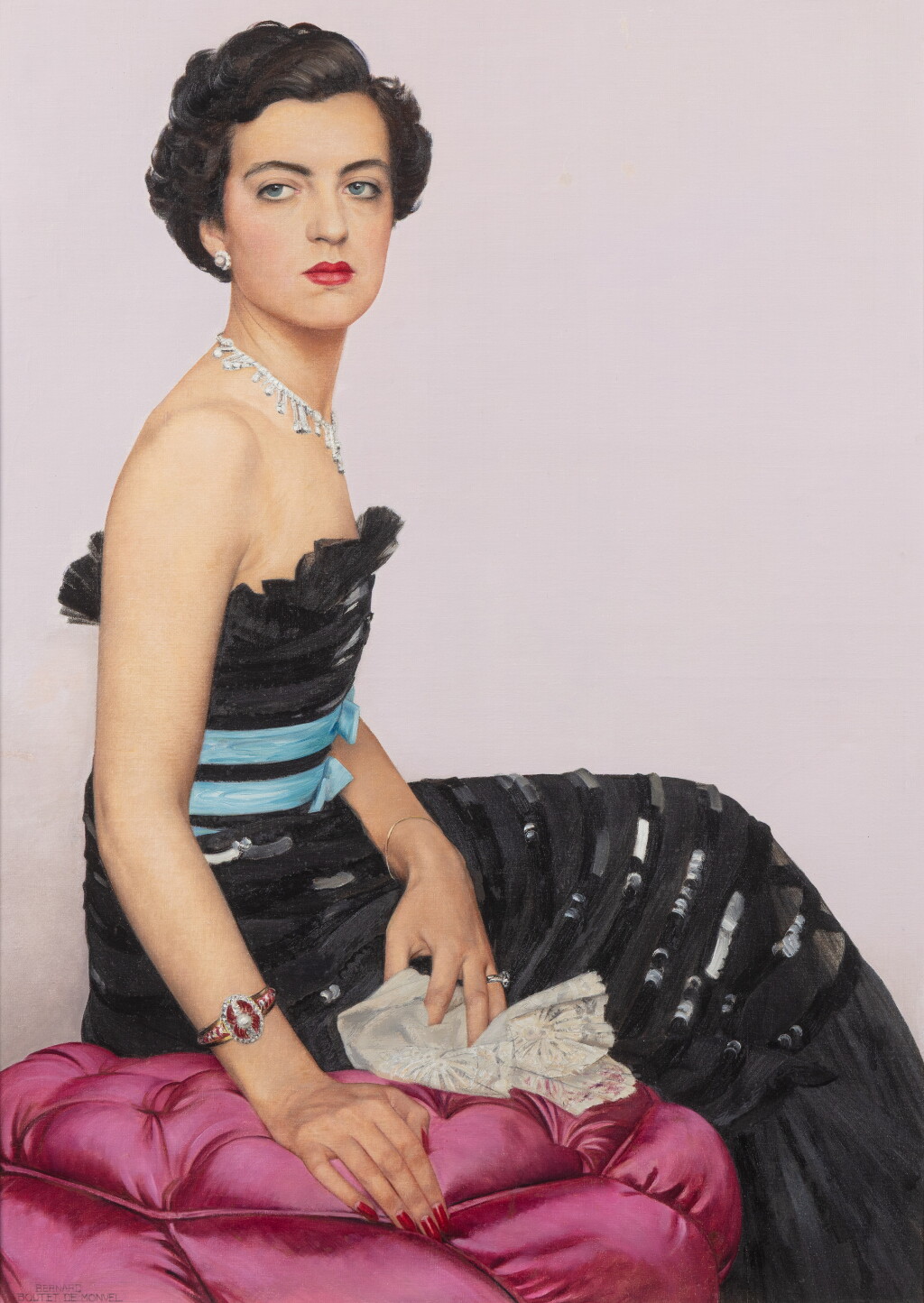
Portrait of Madame Pierre Champin
Estimate
80,000 - 120,000 EUR
Lot Details
Description
Bernard Boutet de Monvel
Paris 1881 - 1949 Açores
Portrait of Madame Pierre Champin
Oil on canvas
Signed lower left BERNARD / BOUTET DE MONVEL
99,7 x 72,9 cm ; 39¼ by 28¾ in.
Anonymous sale, Artcurial, Paris, 13 October 2011, lot 264.
S.-J. Addade, Bernard Boutet de Monvel, Paris 2001, p. 259, repr.;
S.-J. Addade, Bernard Boutet de Monvel, Paris 2016, p. 299, repr.;
A. Bony, Alberto Pinto Signature, Paris 2016, p. 45, repr.
Marguerite, or “Margot”, Champin (1907–2002) is seated very upright on a pink upholstered pouf, turning her face towards the viewer with a distant gaze. Her fitted black evening dress, signed by Lucien Lelong, accentuates the slenderness of her figure and the splendour of her diamond jewellery, which she also wears in the portrait included in the sale as lot 302.
Here, Boutet de Monvel asserts his commitment to sobriety and geometric simplification. The vertical lines created by the torso are counterbalanced by the horizontal line of the leg, which, from the knee onwards, inclines into a diagonal echoing those formed by the arms. The perfectly neutral background emphasises the rigour and firmness of the draughtsmanship.
The pictorial quality and extraordinary delicacy of the brushwork are remarkable, demonstrating the exceptional degree of perfection achieved through the painter’s exacting talent. Painted in 1937, the Portrait of Madame Champin is characteristic of the highly pronounced photographic realism that emerged in his work from the mid-1930s onwards, when “certain works attain such a degree of technical perfection that they no longer reveal the slightest trace of the brush… At times approaching a kind of avant la lettre hyperrealism, these works, possessing great descriptive power yet appearing cold and static, can more broadly be situated within the movement of returning as closely as possible to reality that characterised the decade. Yet their objectivity is only apparent, as Bernard Boutet de Monvel sought […] to rearrange the world he captured in order to achieve greater harmony.” (S.-J. Addade, 2001, op. cit., p. 250).
A prominent figure in Parisian society, Madame Champin was not a “socialite” seeking fame or publicity. She moved primarily within the highly exclusive circles of Parisian high society. Born Rodrigues Pereire, she belonged to the wealthy business bourgeoisie and was the great-granddaughter of Jacob-Émile Pereire (1800–1875), a prominent French financier, banker and politician who played a major role in the Industrial Revolution and the economy of the Second Empire. Her father, Maurice Pereire (1867–1946), an engineer and company director, was a renowned bibliophile and art collector. Among other pieces, he assembled an exceptional collection of works by Félicien Rops, now at the Rops Museum in Namur.
In 1926, Marguerite Rodrigues Pereire married Pierre Champin (1903–1986), a leading captain of industry. Following their divorce, she remarried in 1944 to Edmond-Jean-Marie Bory.