Lucio Fontana | Osvaldo Borsani
Nesting tables
Auction Closed
May 28, 05:43 PM GMT
Estimate
80,000 - 120,000 EUR
Lot Details
Description
Lucio Fontana and Osvaldo Borsani
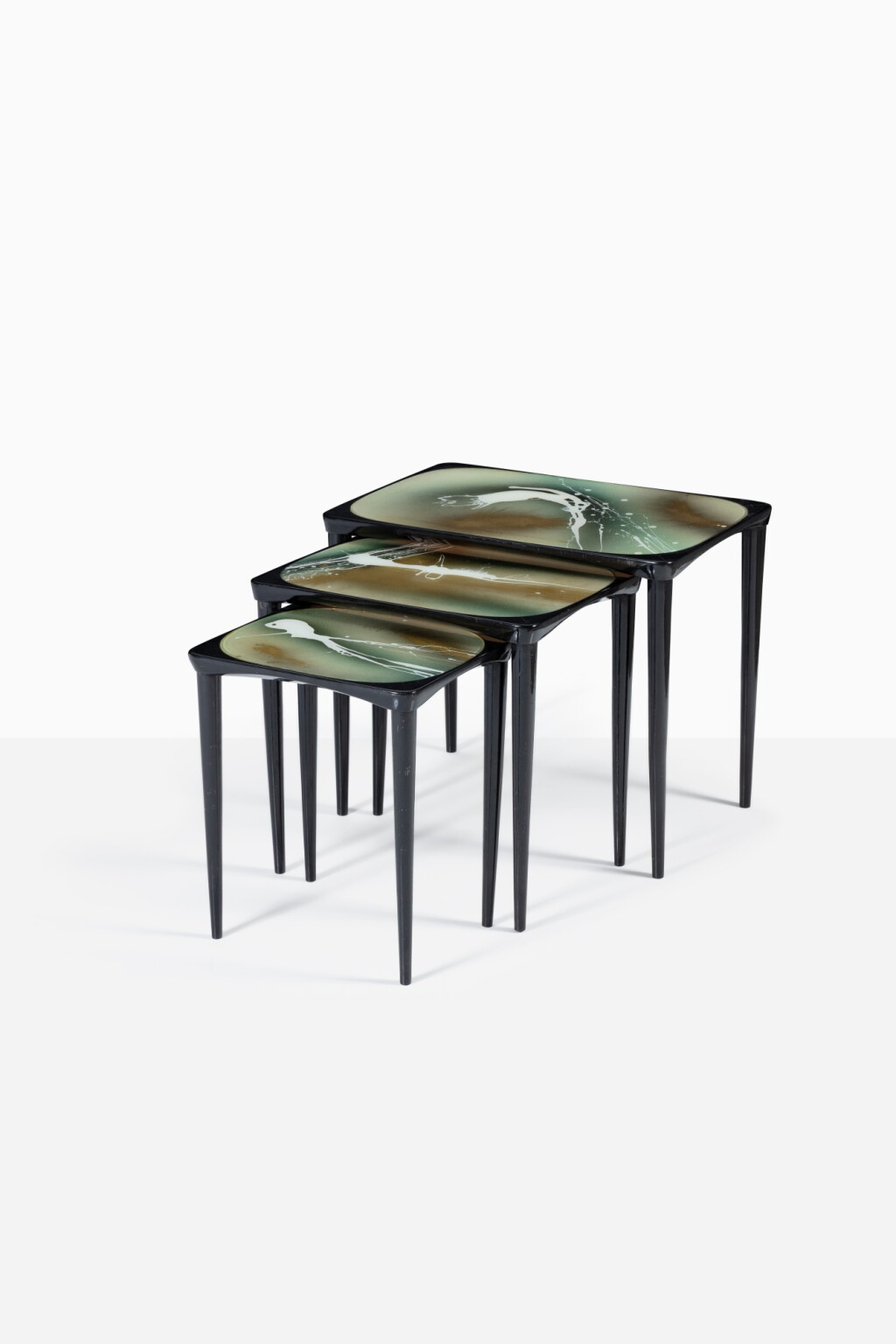
Nesting tables
Circa 1952-1953
Lacquered wood and mixed media on glass
Produced by Arredamenti Borsani, Milan
50 x 59,5 x 40 cm ; 19 ⅝ × 23 ⅜ × 15 ¾ in.
46,5 x 48 x 35 cm ; 18 ¼ × 18 ⅞ × 13 ¾ in.
43 x 46,5 x 30 cm ; 16 ⅞ × 18 ¼ × 11 ¾ in.
Galleria Cristiani, Turin
Private collection, Milano
Christie's, Milano, 10 May 2000, lot 223
Michael Werner Gallery, Cologne
Dorotheum, Vienna, 30 November 2023, lot 423
Acquired from the above by the present owner
Giuliana Gramigna and Fulvio Irace, Osvaldo Borsani, Milano, 1992, p. 198-199 for a similar model
Enrico Crispolti, Lucio Fontana, Catalogo ragionato di sculture, dipinti, ambientazioni, Tome II, Milano, 2015, p. 918, the model referenced under number 52-53 V 35
The collaboration between Osvaldo Borsani (1911–1985) and Lucio Fontana (1899–1968) ranks among the most fruitful in postwar Italian design and art. From the late 1940s onward, Fontana contributed to several interiors designed by Borsani, Casa Gentili (1949), Casa Melandri (1949–1950), and Casa Kramer (1951), creating painted decorations, sculpted ceilings, and pieces of furniture, thereby helping to turn each project into a total synthesis of art and architecture.
It was within this context that the series of furniture with églomisé glass tops, to which our nesting tables belong, was conceived. Fontana employed the technique of reverse glass painting: pigments, heightened with gilding, are applied to the underside of the glass panel. Seen through the glass from above, they acquire a depth and luminosity that no surface painting could achieve. Animated by white drips and golden streaks on a green-brown background with atmospheric resonances, these tabletops evoke a sense of vastness and infinity directly linked to the artist’s spatial explorations. The transparency of the glass plays a role analogous to that of the perforated canvas in the I Buchi series: suggesting a space beyond the surface.
For his part, Osvaldo Borsani designed the structure with restraint. The black lacquered wood, with its streamlined lines and tapered legs characteristic of his 1950s vocabulary, lends the ensemble an almost immaterial lightness. The contrast between the geometric rigor of the structures and the gestural energy of the painted surfaces expresses the balance sought by the two creators: that of an object poised at the tipping point between prewar artisanal tradition and the industrial ambition that would lead Borsani to found Tecno in 1953.
This lot is registered at the Fondazione Lucio Fontana of Milan under the n°2591/7.
You May Also Like