Property from an Important English Private Collection
A Framed Northern European tapestry cushion panel, probably Sweden, 18th century
Lot Closed
November 9, 02:10 PM GMT
Estimate
3,000 - 4,000 GBP
Lot Details
Description
Property from an Important English Private Collection
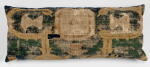
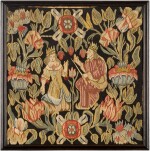
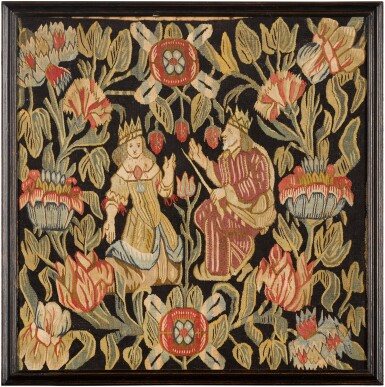
A Framed Northern European tapestry cushion panel, probably Sweden, 18th century
Woven with figures of a crowned King and Queen, with a tulip between them and three pendant strawberries, all surrounded by a wreath of flowers and foliage and some blue and white tied ribbons, all against a dark brown ground, within a later carved wooden frame
Frame: approximately 56cm by 56cm; 1ft. 10in., 1ft. 10in.
Textile: approximately 51.5cm by 51.5cm; 1ft. 8in., 1ft. 8in.
Please note that Condition 12 of the Conditions of Business for Buyers (Online Only) is not applicable to this lot.
Tapestry weaving in Sweden was a home industry before King Gustav Vasa (1523-1560) introduced Flemish weavers under his patronage to produce tapestry hangings for the royal palace. Many of the apprentices left after the required contractual time to work for noble families in the provinces, in their castles and manor houses, who also wished to commission tapestries for their homes. Although the large wall hangings went out of fashion to an extent over time, being replaced by wall painting and other fabrics. The expertise of tapestry techniques had however spread in the 18th century and upper and middle class women took up the pursuit of tapestry weaving, as land reforms increased the economic wellbeing for the population in areas. These luxury items which revealed status and prosperity, were sometimes designed with the assistance of the professional weaver's and their advice and expertise spread. The items produced pieces became dowry pieces and suitable decoration for homes, such as bed linens, bench covers, carriage cushions and table coverings, and often depicted biblical figures. The art form eventually became associated with folk art traditions and local population manufacture. The Swedish pieces, from Dalarna and Skane, have a distinct style and the technique used was the Flemish dovetail technique and Swedish weavers used the local wool for the wefts and linen for the warps. Denmark, Germany and Norway produced similar items with variation in the designs and styles used.