View full screen - View 1 of Lot 8. Hallesches Tor, Berlin (Halle Gate, Berlin) (recto); Zwei Badende am Strand (Two Bathers on the Beach) (verso).

The Cindy and Jay Pritzker Collection

Ernst Ludwig Kirchner

Hallesches Tor, Berlin (Halle Gate, Berlin) (recto); Zwei Badende am Strand (Two Bathers on the Beach) (verso)

Auction Closed

November 20, 11:43 PM GMT

Estimate

3,000,000 - 5,000,000 USD

Lot Details

Description

The Cindy and Jay Pritzker Collection

Ernst Ludwig Kirchner

(1880 - 1938)


Hallesches Tor, Berlin (Halle Gate, Berlin) (recto); Zwei Badende am Strand (Two Bathers on the Beach) (verso)

signed E L Kirchner. and dated 13 (lower left); dated again (on the reverse)

oil on canvas

28 ⅞ by 31 in.   71 by 78.8 cm.

Executed in 1913.


This work is listed in the Ernst Ludwig Kirchner archives, Wichtrach/Bern.

Dr. Victor Wallerstein, Berlin

Dr. Walter Feilchenfeldt, Berlin (acquired by 1923)

Klaus Gebhard, Munich and Wuppertal (acquired circa 1924 and until at least 1972)

Private Collection

Christie’s, New York, 28 November 1988, lot 41 (consigned by the above)

Acquired at the above sale by the present owner

Berlin, Brücke-Museum, Künstler der Brücke in Berlin 1908-1914, 1972, no. 2, n.p.; pl. 4, illustrated (titled Hallesches Tor)

Museum der Stadt Aschaffenburg; Karlsruhe, Staatliche Kunsthalle; Essen, Museum Folkwang and Kassel, Staatliche

Kunstsammlungen, E. L. Kirchner, Dokumente, Fotos, Schriften, Briefe gesammelt und ausgewählt von Karlheinz Gabler, 1980-81, p. 129, illustrated in color

Berlin, Brücke Museum, Ernst Ludwig Kirchner in Berlin, 2008-09, no. 92, pp. 132 and 382; p. 143, illustrated in color

Max Deri, Die Neue Malerei, Leipzig, 1921, no. 86, p. 139, illustrated; p. 140 (titled Hochbahn)

Will Grohmann, E.L. Kirchner, Stuttgart, 1958, p. 106, illustrated

Will Grohmann, Ernst Ludwig Kirchner, New York, 1961, p. 130, illustrated

Donald E. Gordon, Ernst Ludwig Kirchner, Cambridge, 1968, no. 305, p. 89; p. 309, illustrated

Georg Reinhardt, Die frühe "Brücke"—Beiträge zur Geschichte und zum Werkder Dresdner Künstlergruppe "Brücke" der Jahre 1905 bis 1908, Dissertation, Universität Bonn, 1976, p. 171, note 323; republished in Brücke-Archiv, nos. 9-10, 1977-78 (titled Hallesches Ufer)

Exh. Cat., Berlin, Nationalgalerie; Munich, Haus der Kunst; Cologne, Museum Ludwig and Kunsthaus Zürich, Ernst Ludwig Kirchner, 1979-80, p. 199

Roman Norbert Ketterer and Wolfgang Henze, eds., Ernst Ludwig Kirchner, Drawings and Pastels, New York, 1982, p. 237

Donald E. Gordon, Expressionism: Art and Idea, New Haven and London, 1987, pp. 135 and 139, illustrated; pp. 136-37

Thomas Anz and Michael Stark, Die Modernität des Expressionismus, Stuttgart, 1994, p. 118, note 21

Lucius Grisebach, Ernst Ludwig Kirchner, 1880-1938, Cologne, 1996, p. 80, illustrated in color

Magdalena M. Moeller, Ernst Ludwig Kirchner: Die Strassenszenen 1913-1915, Munich, 1993, pp. 37-38

Lucius Grisebach, Kirchner, Cologne, 1995, pl. 80, illustrated in color

Jürgen Döhmann and Gerd Presler, eds., Ernst Ludwig Kirchner: die Skizzenbücher, “Ekstase des ersten Sehens”, Karlsruhe and Davos, 1996, pp. 94-99, note 118

Tita Hoffmeister, ed., Werke der Brücke-Künstler, Kunst des 20. Jahrhunderts, vol. I, Munich, 1997, p. 167, note 11

Magdalena M. Moeller, Künstlergruppe Brücke, Munich, Berlin, London and New York, 2005, pl. 54, pp. 26 and 126; p. 127, illustrated in color and illustrated in color on the inside back cover

Exh. Cat., Wuppertal, Von der Heydt-Museum, Der expressionistische Impuls: Meisterwerke aus Wuppertals grossen Privatsammlungen, 2008, p. 28, note 32, and p. 118

Exh. Cat., Davos, Kirchner Museum, Ernst Ludwig Kirchner: Die Skizzenbücher, 2019-20, p. 134

Exh. Cat., New York, Neue Galerie, Ernst Ludwig Kirchner, 2019-20, fig. 7, p. 68, illustrated in color; p. 69
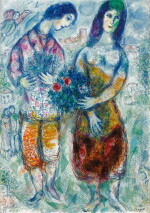
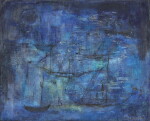
Executed in 1913, Hallesches Tor, Berlin (Halle Gate, Berlin) (recto); Zwei Badende am Strand (Two Bathers on the Beach) (verso) is a superlative example of Ernst Ludwig Kirchner’s 1912-15 Berlin paintings, a body of work considered the most celebrated of the artist’s Expressionist oeuvre. Held in The Cindy and Jay Pritzker Collection for nearly four decades, the present work is the largest among this corpus of twenty-four paintings to remain in private hands, with nineteen held in preeminent institutions including the The Museum of Modern Art, New York; Pinakothek der Moderne, Munich and Museo Nacional Thyssen-Bornemisza, Madrid.


Kirchner established himself among the vanguard of the European avant-garde in 1905 as a founder of the group Die Brücke. The first distinctly German modern artistic movement of the twentieth century, its close-knit members rejected the Jugendstil traditions that they encountered as art students in favor of a vigorous aesthetic reflective of the self-confidence of youth. In October 1911, Kirchner followed in the footsteps of fellow Die Brücke members Max Pechstein and Otto Mueller in relocating from the movement’s center in the Baroque city of Dresden to the vibrant metropolis of Berlin, first taking up residence alongside Pechstein at Durlacher Strasse 14.


Having swelled into the third-largest city in Europe under rapid modernization at the turn of the century, the German capital teemed with alluring energy and bustling crowds that catalyzed for Kirchner a profound transformation in both style and subject matter. Wolf-Dieter Dube expounds, “Soon he was carried away by the current of the city. His artistic sensibility, always alive to the fascination of movement, was seized by the dynamism of city life. Kirchner discovered new pictorial forms unique to himself and was the first to render the feel of a modern metropolis… He discovered its peculiar, malevolently glittering attraction. Herded along with the herd, he observed its people and developed a pictorial language for their denatured humanity, combining chronicle and allegory” (Exh. Cat., London, Marlborough Fine Art, Ernst Ludwig Kirchner, 1969, p. 10).


Just as Berlin’s vitality heralded a new phase of Kirchner’s ever-restless artistic ambition, it attracted Die Brücke members to divergent creative paths that prompted the dissolution of the group. Such autonomy—and isolation—spurred Kirchner’s dedication to rendering impressions of the city with a fervor yet unequaled in his output, resulting in the most important works in his career. He later remarked, “[The Street Scenes] originated in the years 1911-14, in one of the loneliest times of my life, during which an agonizing restlessness drove me out onto the streets day and night, which were filled with people and cars” (Exh. Cat., New York, The Museum of Modern Art, Kirchner and the Berlin Street, 2008, p. 29). The artist ineluctably gravitated towards Stadtansichten, or urban vistas, of the sites most symbolic of a modern Berlin: squares and streets where electric streetcars, trams, and railway lines—novel technologies built to accommodate the buzzing populace—converged.


Hallesches Tor, Berlin depicts the titular Halle Gate, a major entry point to Berlin’s city center, leading to the square of Belle-Alliance-Platz and the major boulevard of the Friedrichstrasse. 1902 marked the construction of a major railway station at the intersection of the new elevated subway line, which followed along the northern edge of the Landwehr Canal, and the Belle-Alliance Bridge. Kirchner mediates his visual perception of this setting through his emotive insight: pervading the scene is a dynamic torsion and thrust reflective of the vital energy—and precarity—of urban life. The artist uses a near-dizzying aerial perspective to create an elongated spatial depth that opens the canal and the undergirding of the viaduct into a profound expanse. This enlarged passage compresses the bridge, station and buildings on the periphery into a taut, encroaching surface that invokes the staggering density of the metropolis. In so doing, the present work radically unifies Kirchner’s longstanding interest in the perspectival advancements of the French Post-Impressionists with the Futurists’ fractured dissections of movement, which the artist had first encountered in Berlin the year prior (see fig. 2).


Marking Kirchner’s attentiveness to a novel form of urban beauty, the exaggerated arcs of the bridge, canal and embankment—hallmarks of a historic Berlin—counterpoise the rigid linear geometries of the modern built environment, which are rendered with a specificity reflective of Kirchner’s training in architecture. The human presence is suggested merely through minute, anonymizing silhouettes, reflecting the individual experience of being subsumed within the sheer magnitude of the city—a mood heightened by the monumentalized pillar emblems of the elevated railway line that stand sentry over the totality of the scene.


Hallesches Tor, Berlin typifies the unparalleled expressivity of color found in Kirchner’s Berlin paintings, deeply informed by the exuberance of hue found among the Fauves and Edvard Munch. Transitioning from the bold color contrasts of his prior output, Kirchner in his Berlin paintings developed palettes derived from combinations of two to three tertiary hues, experimenting with novel synthetic pigments and the superimposition of colors to conjure the vibrancy of the electrified city. Discussing the present work, Sherwin Simmons writes, “By extending the color of the railway’s steel framework to the stone surfaces of the bridge and the station’s facade, he emphasized the interlinked transportation system… The painting’s most unusual and beautiful feature, however, is its salmon pink and teal color harmony, the type of colors that gave rise to Carl Einstein’s observation: ‘Hardly any of the Brucke painters has found such subtle colors as Kirchner. His yellow, his bright salmon pink charm us through their passionate elegance.’ These changes of form and color emphasize the way the viaduct tip-toes along the canal bank, with pedestrians circulating underneath it, a train moving along it, and a bus crossing the bridge. The soft, rather pastel-like colors lend the site a delicate, although clouded, beauty” (Exh. Cat., New York, Neue Galerie, Ernst Ludwig Kirchner, 2019-20, pp. 68-70).


Revealing a compositional and formal complexity hitherto unseen in his Berlin cityscapes, Hallesches Tor, Berlin reveals Kirchner’s incessant experimentation in depicting his surroundings in order to reveal inherent truths of both his lived experience and the underlying nature of urban society on the cusp of World War I, affirming Donald E. Gordon’s assessment of this pivotal year: “Kirchner's 1913 style unifies into an integrated dynamic approach drawing upon earlier innovations in the handling of space, mass, brushstroke, color and compositional form. The 1913 style displays a mature equilibrium in the use of this widely varied formal vocabulary…Through its often monumental achievements, better than through the vision of any other twentieth century artist, we gain insight into a desperately diseased European metropolitan society whose few remaining days are numbered” (Donald E. Gordon, Ernst Ludwig Kirchner, Cambridge, 1968, рp. 86-90).


With the threat of war looming ever greater as the year progressed, the panoramic views like Hallesches Tor, Berlin narrowed in scope, culminating in Strassenszenen (Street Scenes) of street walkers strolling amidst Berlin’s clamorous crowds (see fig. 3). At once personifying the erotic underbelly of the city and Kirchner’s own growing sense of alienation and detachment, the Street Scenes would come to be considered among the most iconic images of twentieth century art.


The reverse of the present work bears an additional composition (see fig. 4), entitled Zwei Badende am Strand, depicting a pair of nude figures within a verdant setting and likely executed during one of the artist’s summer sojourns to the remote Baltic islands of Fehmarn or Moritzburger See. A counterpoint to the frenetic urban environs seen in Hallesches Tor, Berlin, the practice of Freikörperkultur, bathing and luxuriating with his companions and models in this remote setting, offered Kirchner solace. Since his Die Brücke period, the theme of the nude within nature formed a cornerstone of Kirchner’s oeuvre, charting his ongoing interest in the representation of the human body in its most uninhibited state through its spontaneous, joyful and unmediated depiction.