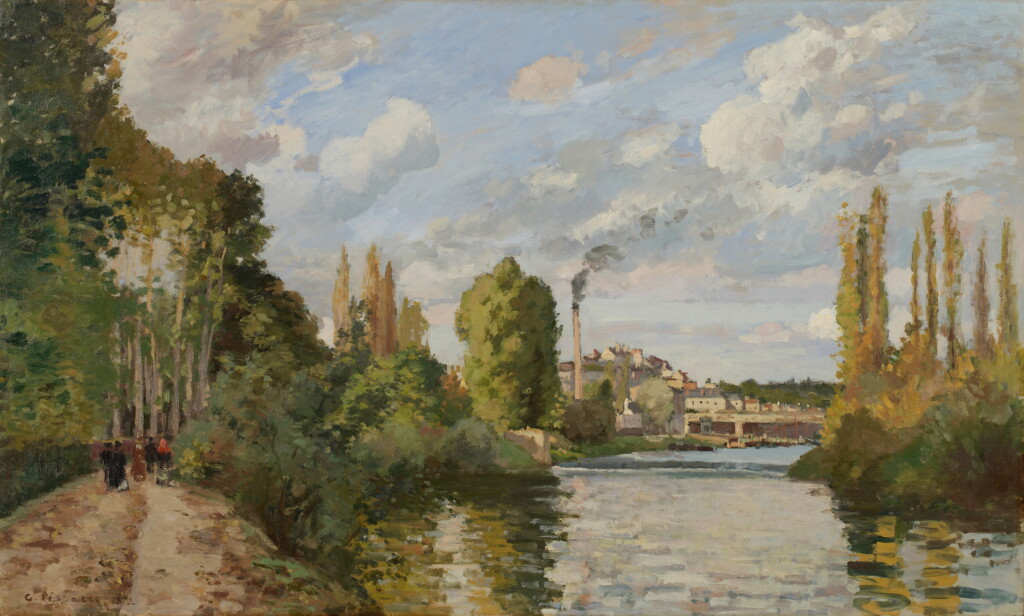
View full screen - View 1 of Lot 7. Bords de l’Oise à Pontoise.

The Cindy and Jay Pritzker Collection

Camille Pissarro

Bords de l’Oise à Pontoise

Auction Closed

November 20, 11:43 PM GMT

Estimate

1,200,000 - 1,800,000 USD

Lot Details

Description

The Cindy and Jay Pritzker Collection

Camille Pissarro

(1830 - 1903)


Bords de l’Oise à Pontoise

signed C. Pissarro and dated 1872 (lower left)

oil on canvas

21 ⅝ by 35 ⅞ in.   54.9 by 91.1 cm.

Executed in 1872.

Galerie Durand-Ruel, Paris (acquired directly from the artist on 12 November 1872)

Ernest Hoschedé, Paris (acquired from the above on 28 April 1873)

Hôtel Drouot, Paris, 13 January 1874, lot 60 (consigned by the above)

Galerie Durand-Ruel, Paris (acquired through Mr. Hagerman at the above sale)

Don José de Salamanca, Paris 

Hôtel Drouot, Paris, 25-26 January, 1875, lot 17 (consigned by the above)

M.L. Collection

Hôtel Drouot, Paris, 20 March 1880, lot 39 (consigned by the estate of the above)

Galerie Durand-Ruel, Paris (acquired circa 1884)

Alwin Schmid, Küsnacht (acquired from the above on 21 March 1928)

Irma C. Scharff (née Rosengart), Los Angeles

Wildenstein & Co. Inc., New York (acquired from the above in 1948)

Norton Simon, Los Angeles (acquired from the above on 22 March 1955)

Lucille Ellis Simon, Los Angeles (acquired by descent from the above on 24 July 1970)

Acquired from the above through Lionel Pissarro, Paris in 1997 by the present owner

New York, The Armory of the 69th Infantry, International Exhibition of Modern Art, 1913, no. 499, p. 40 (titled Pontoise)

Detroit Museum of Art, Exhibition of Paintings by French Impressionists, 1915, no. 35 (titled Pontoise)

New York, Durand-Ruel Galleries, Paintings by Camille Pissarro, 1916, no. 2

Boston, Brooks Reed Gallery, Exhibition of Paintings Lent by Durand-Ruel, 1916-17

Waterbury, Mattatuck Historical Society, Exhibition of Paintings Lent by Durand-Ruel, 1919 

The Dallas Art Association, Second Annual Exhibition: American and European Art, 1921, no. 207, illustrated (titled Pontoise)

The Art Gallery of Toronto, Paintings by French Artists, 1922, no. 71, illustrated (titled Pontoise)

Paris, Galerie Durand-Ruel, Tableaux par Camille Pissarro, 1928, no. 5 

Manchester, New Hampshire, The Currier Gallery of Art, Monet and the Beginnings of Impressionism, 1949, no. 16, p. 18; p. 33, illustrated (titled Bord de l’Eau à Pontoise)

Los Angeles County Museum of Art, A Selection from the Mr. and Mrs. Norton Simon Collection Honoring the College Art Association, 1965

Los Angeles County Museum of Art; The Art Institute of Chicago and Paris, Grand Palais, A Day in the Country: Impressionism and the French Landscape, 1984-85, no. 61 (Los Angeles and Chicago); no. 27 (Paris), pp. 14-15, illustrated in color (detail); pp. 179 and 336-37; p. 185, illustrated in color (Los Angeles and Chicago)

Los Angeles County Museum of Art, Monet to Matisse: French Art in Southern California Collections, 1991, pp. 2 and 34, illustrated (detail); p. 35; p. 52, illustrated in color

Charles Kunstler, “Camille Pissarro,” Le Figaro, supplément artistique, vol. 5, no. 184, 8 March 1928, p. 325 (titled Vue de Pontoise)

Ludovic-Rodo Pissarro and Lionello Venturi, Camille Pissarro, son art—son oeuvre, Paris, 1939, no. 158; vol. I, p. 101; vol. II, pl. 32, illustrated (titled Bords de l’eau à Pontoise)

Charles Kunstler, Pissarro, villes et campagnes, Lausanne, 1967, p. 20

Merete Bodelsen, “Early Impressionist Sales 1874-94 in the light of some unpublished ‘procès-verbaux’,” The Burlington Magazine, vol. 110, no. 873, June 1968, pp. 332-33 (titled Bords de l’eau à Pontoise)

Christopher Lloyd, ed., Studies on Camille Pissarro, London, 1986, pp. 66 and 71-72 (notes 4 and 6; titled Fabriques et barrage sur l’Oise)

Richard R. Brettell, Pissarro and Pontoise: The Painter in a Landscape, New Haven, 1990, fig. 141, p. 158, illustrated in color; p. 41

Joachim Pissarro, Camille Pissarro, New York, 1993, fig. 103, p. 110, illustrated in color; p. 111 (titled Riverbanks in Pontoise)

Suzanne Muchnic, Odd Man In: Norton Simon and the Pursuit of Culture, Berkeley, 1998, p. 36 (titled Pontoise, Bords de l’Oise)

John House, Impressionism: Paint and Politics, New Haven, 2004, pl. 56, p. 79, illustrated

Joachim Pissarro and Claire Durand-Ruel Snollaerts, Pissarro, Catalogue critique des peintures, Paris, 2005, no. 249, vol. I, pp. 369-72, 374, 392, 408, 414 and 427; vol. II, p. 203, illustrated in color

Richard R. Brettell and Stephen F. Eisenman, Nineteenth-Century Art in the Norton Simon Museum, vol. I, New Haven, 2006, fig. 23, p. 21, illustrated in color (titled Riverbanks in Pontoise)

Sara Campbell, Collector Without Walls: Norton Simon and His Hunt for the Best, New Haven, 2010, no. 8, fig. 4, pp. 19 and 244, illustrated in color; pp. 20, 24, 68 and 221 (titled Banks of the River at Pontoise)

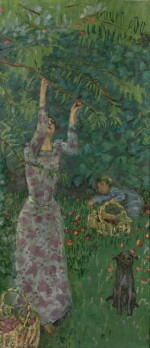
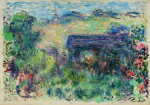
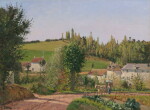
In its execution as it is in subject, Bords de l’Oise à Pontoise is a striking vision of modernity. Bords de l’Oise à Pontoise dates to the beginning of Pissarro’s second sojourn in Pontoise, a period considered among the most innovative of his oeuvre, and one which marks the dawn of stylistic experiments that would establish his standing as a pioneer within the Impressionist movement at large. The artist first moved to the French town in 1866 and would return there in August of 1872 following extended trips to London and Louveciennes. Located just 28 kilometers north of Paris, Pontoise was animated by the dialectic between the region’s burgeoning industry, and the patina of its rich history as a Medieval fortress and port town. In combination, these qualities provided Pissarro with a wealth of subject matter which he approached with an endlessly rejuvenated freshness (see figs. 1-3). So invigorated by the picturesque landscape and its plethora of painterly possibilities, he remained in Pontoise for the following decade.


While in Pontoise, Pissarro assiduously dedicated himself to portraying the town’s sites of labor and leisure—a subject which was among the most favored within the Impressionist lexicon at large.


The period of accelerated industrialization in the 1830s and 40s engendered the birth of a new middle class that now had both the means and the opportunity for recreation. With the expansion of the rail transport network throughout the country shortly thereafter, the suburbs of Paris and the countryside beyond them became widely popular destinations for social activities and for escaping the clamor of the city. It was during this very period that these towns began to transform from peaceful hamlets to Parisian suburbs, their life increasingly focused on serving the capital’s growing needs. Though the approaches to the subject were manifold and varied, these bucolic towns and the activities which filled them provided the Impressionists with both an essential source of inspiration and the raw material for their interest in the representation of modern, daily life.


The river was an enduring visual anchor within the theme. It in many ways became an embodiment of the interplay between the old and new—the man-made and natural—which came to characterize the condition of life within the French industrial landscape. In Claude Monet’s slightly later depiction of Le Pont d'Argenteuil (see fig. 4), he presents the river as one such site for leisurely and tourist activity. While Monet depicts a moment of tranquility, the two boats in the foreground, albeit at rest with their sails still rolled, allude to the popular waterside pastimes that would usually animate the scene. Their rudimentary wooden frames are poised in contrast with the heavy, metallic architecture of the wrought iron bridge, offering Monet's own approach to the dialectic between the bucolic and the urban.


Within the present work, the river plays something of an inverse role. Pissarro depicts the Oise River just downstream from this town, northwest of Paris, flanked by the towpaths of the river’s right bank and the l'île Saint-Martin. Undisturbed by any signs of human activity, the water’s beautifully articulated surface becomes a mirror to, and in turn an amplification of, the natural world around it. The reflection of the sky in particular confers on the composition an expanded sense of space, one which makes actual the sensation of looking at the scene itself, rather than a representation of it. As the river recedes into the background and tapers to its diminishing point, the viewer’s eye arrives at the town itself, and to the railway bridge, constructed less than a decade prior in 1863, which links Pontoise, both physically and symbolically, to Paris and Rouen.


Pissarro engages a striking conversation between these talismans of modernization and the bucolic French countryside. The smoke stack is juxtaposed against the magisterial poplar trees, the billows of black smoke against the diaphanous white clouds, the white facades and red roofs of the houses lining the hill in the distance against the topography of the tree line, and the fabric of the figures’ dress against the verdant greenery. Yet, at the same time, there is an enchanting sense of coexistence between these opposing pillars of modernity and the natural world. The figures seem to emerge from within the landscape, their presence a natural extension rather than an intrusion. Their leisurely amble likewise enlivens a sense of potential energy within the scene at large, one that is heightened by the staccato brushstrokes that describe the quiet water’s unbroken surface. The calm and repose of the scene appears as though in waiting for the engagement or the entrance of another life source which, upon further study, reveals itself to be the presence of Pissarro’s perspective itself.


A central tenet of Pissarro’s landscapes was the inclusion of the figure and the deeply felt humanism which it conferred on the scene. There is the unquestionable sensation when looking at Bords de l’Oise à Pontoise that it is painted from a lived point of view, one which, by virtue of its naturalism, the viewer can place themselves within. The distinctive horizontal length and orientation of the canvas likewise opens the scene into a panoramic expanse which transforms the mode of viewership from one of distanced observation to embodied immersion. Art historian Rachel Ziady DeLue expands upon Pissarro’s inimitable ability to engage this phenomenological effect: “The viewer encounters Pissarro in his pictures not because the artist implies that his body is actually, corporeally, in them but because he, the viewer, follows Pissarro’s visual traversal, his visual touching, in the artist’s laying on and working over of paint. We feel what the artist sees, touch by touch, stroke by stroke, in pictures so narrow as to allow only this kind of presence, a kind that can occupy, press itself into, a mere slice of… nature. Pissarro’s body locates itself in the optical effects of decoration, harmonious color, and nimble facture…” (Rachel Ziady DeLue, “Pissarro, Landscape, Vision and Tradition,” The Art Bulletin, vol. 80, no. 4, December 1998, p. 731).


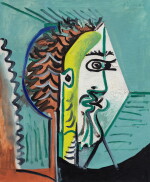
Beyond the modernity of Pissarro’s subject matter, his was an approach to painting which was wholly modern in and of itself. It is therefore fitting that Bords de l’Oise à Pontoise made its public debut as part of the seminal 1913 International Exhibition of Modern Art in New York, later known as the inaugural Armory Show (see figs. 5 and 6). The landmark exhibition is widely credited with introducing the American public to the art of the European avant-garde, thereby catalyzing the emergence of modernism in the United States. The brilliant fracture of light and atmosphere into articulated swaths of color and painterly brushstrokes positioned Pissarro’s work as a forefather to the evolutions within the avant-garde which took shape following the turn of the century. When placed in conversation, as they would have been in the 1913 exhibition, one can see how the revolution in perception and representation that Pissarro ignites within the present canvas was taken a step further in the hands of the Cubists and Fauvists who followed in his wake. Bords de l’Oise à Pontoise marks a pivotal turning point in the modern idiom, the marker of a decisive moment when the artist began to free his compositions from the more static, Corot-inspired landscapes of the 1860s.


While Bords de l’Oise à Pontoise speaks to Pissarro’s distinctive approach to the landscape he encountered there, it likewise speaks to the rich and formative artistic exchange which these edenic countryside escapes fostered among the artists of the French avant-garde who lived and worked there. Pissarro’s pioneering enterprise proved highly influential to the myriad artists who joined him in Pontoise, an influence perhaps most significantly felt in the work of his friend and fellow artist Paul Cézanne. During the two years that Cézanne and his family lived in the region, the painters worked side by side, pushing the boundaries of pictorial expression as they did each other. As Pissarro himself recalled, it marked the moment when Cézanne “came under my influence and I his” (quoted in Exh. Cat., New York, Museum of Modern Art, Pioneering Modern Painting: Cézanne and Pissarro, 1865-1885, 2005). In 1881, returning to the region to again work alongside his progenitor, Cézanne would execute a painting of the town of Pontoise from a vantage point just further down the path that Pissarro painted in the present work (see fig. 7). As Joachim Pissarro explains, “During Cézanne’s last prolonged sojourn in Pontoise, from May to October 1881, he lived only a few blocks away from L’Hermitage, where the Pissarros resided. There Cézanne began to ‘formulate’ his idea of an artistic truth or recipe, which he continued to develop until his death. … Cézanne's deference toward Pissarro's early works is evident in 1881. Every work produced by Cézanne at that point appears to refer to an earlier painting by Pissarro… At the end of their relationship, Cézanne bows to nostalgia and turns back to explore the beginnings of this extraordinary interrelationship.” (ibid., p. 187)


Among the greatest attestations to the representative significance of Bords de l’Oise à Pontoise within Pissarro’s canon, however, is the cherished place it held within some of the most esteemed private American collections of the twentieth century. In 1955 the present work was purchased by Norton Simon, marking one of the earliest acquisitions by the storied collector. It is perhaps understandable to the modern imagination that the prolific collection which Simon would go on to amass, peerless in its scope and uncontested in its influence, would have found its genesis in none other than this painting. Sara Campbell writes:


“These early acquisitions [the Pissarro and a work by Gauguin] represented a giant leap for the new collector,” writes Sara Campbell. “Early and noteworthy acquisitions, they stayed with the collector longer than any other pictures, which gave them added sentimental value. The Pissarro also represented the beginning of a long professional and personal relationship with the art historian and Pissarro expert Richard F. "Ric" Brown, the newly appointed chief curator and later director of the Los Angeles County Museum… When Brown walked into Simon's living room for the first time and saw the Pissarro, … as Simon’s family friend Lillian Weiner remembered, ‘Ric got down on his knees and paid homage to the fact that …lo and behold, here it was greeting him in Los Angeles, where he would never ever have expected it.’ Except for the few times [it was] lent to exhibitions, the Pissarro… always hung in the living room of the Simons' home on North Hudson Avenue.”

Sara Campbell, Collector Without Walls: Norton Simon and His Hunt for the Best, New Haven, 2010, pp. 19-20


Further attesting to its significance for Simon, Bords de l’Oise à Pontoise was included in the 1965 exhibition A Selection from the Mr. and Mrs. Norton Simon Collection Honoring the College Art Association, the first preview exhibition held at the Los Angeles County Museum of Art, which did not open until several months later. The work remained in Simon’s collection, and that of the Simon family, until 1970. It has remained in The Cindy and Jay Pritzker Collection for over twenty-five years.