
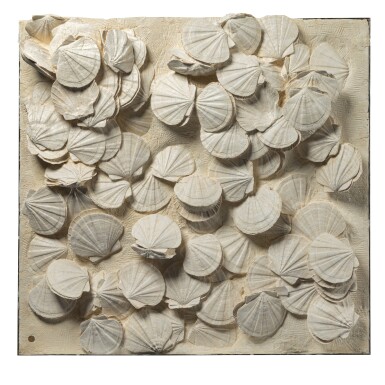
Large Mural of Giant Scallop Fossil Shells
Early Miocene, Burdigalian (approx. 20 - 16 million years ago), Lacoste Quarry, Vaucluse, France
Auction Closed
July 26, 08:15 PM GMT
Estimate
6,000 - 8,000 USD
Lot Details
Description
Large Mural of Giant Scallop Fossil Shells
Gigantopecten restitutensis
Early Miocene, Burdigalian (approx. 20 - 16 million years ago)
Lacoste Quarry, Vaucluse, France
43¾ x 41⅝ x 8 inches (111 x 106 x 20.3 cm). 385 pounds (175 kg).
Several dozen Gigantopecten specimens emerging from their natural limestone matrix. Gigantopecten, as the name of the genus indicates, is a very large species. The wide radial ribs on its thick shell distinguishes this extinct type of scallop or pectan. They are well-preserved intact shells with both halves mostly articulated.
Gigantopecten restitutensis — also known as a Saint-Jacques shell — is a species of scallop that thrived all over the world during the Early Miocene, from approximately 20 million to 16 million years ago.
Like today's extant scallops, Gigantopecten restitutensis was a saltwater mollusk that lived on the sea floor, filtering and eating plankton. These bivalves had relatively large shells, growing to heights of over 5 inches (13 cm) with widths topping 6 inches (15 cm). Because of the considerable size and fragility of Gigantopecten fossils, their removal from the surrounding rock matrix represents excavation and preparatory work of the highest caliber.

