
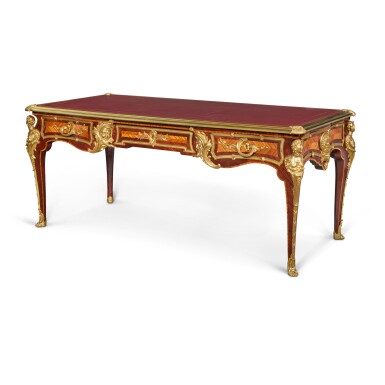
A Régence Style Gilt-Bronze Mounted Amaranth and Bois Satiné Bureau Plat, after the Model by Charles Cressent, Late 19th Century
Lot Closed
April 12, 02:33 PM GMT
Estimate
35,000 - 50,000 USD
Lot Details
Description
A Régence Style Gilt-Bronze Mounted Amaranth and Bois Satiné Bureau Plat, after the Model by Charles Cressent, Late 19th Century
with gilt-tooled red leather writing surface, the corners with foliate clasps above a shaped frieze with three drawers to the front and three simulated drawers to the reverse, the sides centred by masks, on cabriole legs centred by masks cast with female busts
height 33 1/4 in.; width 81 in.; depth 37 1/2 in.
84.5 cm.; 205.8 cm.; 95.3 cm.
Alexandre Pradère, Charles Cressent: sculpteur, ébéniste du Régent, Dijon 2003, pp.127-129 and cat. nos. 56-57, pp.267-68
The son of the sculpteur du roi François Cressent, Charles Cressent (1685–1768) trained as a sculptor himself and was one of the leading ébénistes of the late Régence and early Rococo periods, becoming a master sculptor in 1719 and also a member of the painters and sculptors guild, the Académie de Saint-Luc. He was recorded as the official cabinetmaker to the Duc d'Orléans, who served as Regent to the young Louis XV from 1715-23. Cressent's furniture was particularly noteworthy for its highly sculptural gilt bronze mounts that he designed and cast himself, often running foul of the strict guild regulations of the period. One of his particular specialties was the bureau plat, a new form of writing table traditionally said to have been invented by André-Charles Boulle at the beginning of the century.
The present lot is a superlative quality copy of a bureau plat by Cressent now in the Louvre, possibly from the collection of the tax farmer and guardian of Madame de Pompadour, Charles François Paul Le Normant de Tournehem (1684–1751). An identical desk is in a private collection, Paris. The model belongs to a category that has been described as 'bureaux à espagnolettes bouclées', referring to the angle mounts in the form of elegantly attired and bejewelled female busts with curled hair. Further versions of the model in smaller dimensions are in the Munich Residenz and the National Gallery of Art, Washington.
You May Also Like


