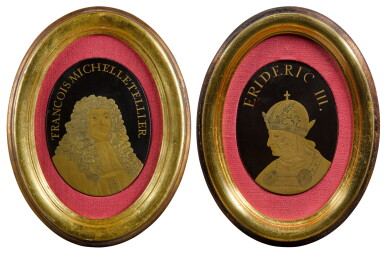
Two Japanese export lacquer portrait medallions, late 18th century
No reserve
Lot Closed
December 15, 02:22 PM GMT
Estimate
800 - 1,200 GBP
Lot Details
Description
Two Japanese export lacquer portrait medallions, late 18th century
decorated in gold hiramaki-e and kinji on a roironuri ground, one depicting Francois Michelle Tellier Marquis de Louvois (1641–1691), Secretary of State for War under Louis XIV, the other depicting the Holy Roman Emperor Frederic III (1415 – 1493), each set in a giltwood frame with a background lined with red fabric
lacquer medallion only: 12.2 x 9.3 cm.
overall: 21.5 x 16.5 cm.
The fashion in Europe for such oval medallions seems to have arisen around 1780. Each consisting of a copper panel covered in black lacquer and decorated with gold hiramakie with portraits in low relief, they provide the first evidence of European decoration on Japanese lacquer.
It is believed that their originator may have been Johan Fredrik Baron van Reede tot de Parkeler, head of the Dutch trading mission in Deshima in 1786 and from 1788-1789. Several series were produced including one which depicted famous European kings and queens, generals, scholars and artists. The subjects were copied from l’Europe illustré, a six volume work published in Paris between 1755 and 1756 compiled by Dreux du Radier which contained 593 depictions of famous people from the Middle Ages through the mid-18th century. These medallions include a text written in French with the subject’s name on the face and an explanatory text on the reverse. Another popular series shows Roman Emperors (see the following lot in this sale). Although the source of the engravings has not been traced, it was most likely a publication showing Roman coins and medals. There was also a series of Chinese rulers and notables, probably taken from Mémoires sur les Chinois published in 1778, and a series of Governors-General of the Indies taken from Du Bois’ Vies des Gouverneurs-Generaux published in 1758.
Numerous examples of medallions from these series exist in museums. Three Roman emperors from the Herbig-Haarhaus Lackmuseum in Cologne were exhibited in Ex Oriente Lux and are included in the museum Catalogue (Strässer, 1977, no. 77a, ill. p. 61). A collection of nineteen medallions, acquired before 1829 as part of the Royal Cabinet of Curiosities of King William I in the Hague, is in the Rijksmuseum, Amsterdam. See O. Impey, Japanese Export Lacquer 1580-1850, Amsterdam, 2005, pp. 48- 52 and 216-217 for a further discussion and for other known examples of similar medallions.
You May Also Like