
Ink Cakes From The Junkunc Collection
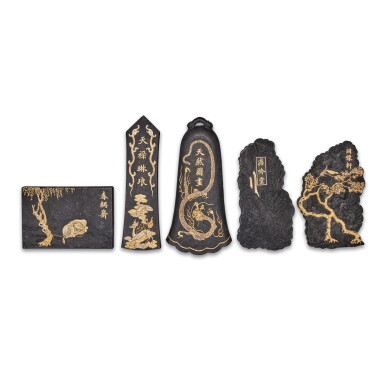
A set of five 'palace' ink cakes, Qing dyansty
Auction Closed
March 19, 05:41 PM GMT
Estimate
5,000 - 7,000 USD
Lot Details
Description
the side of each molded with a four-character Jiaqing mark, the faces gilded and molded with scenes of the Chun'ouzhai (Studio of Spring Cultivation); Tianlu linlang (Gems of Heavenly Favor [library]); Tianran tuhua (Natural Painting [beauty spot]); Danyintang (Hall of Serene Chanting); and Tongyuxuan (Pavilion of Mutual Confidence)(5)
Length of longest 4 in., 10.3 cm
Collection of Stephen Junkunc, III (d. 1978).
The following selection of ten ink cakes forms part of a rare set of sixty-four, commissioned by the Jiaqing Emperor (r. 1796-1820), entitled Yuzhi ming yuan tu mo (Ink Cakes Inscribed with Garden Scenes Made for the Emperor), each cake illustrating idyllic scenes from the various studios, halls and gardens of his vast Beijing palace complex and beyond. This group, delicately molded with vibrant scenes and accentuated with parcel gilding, is attributed to the celebrated Jianguzhai (Studio of Appreciation of Antiquity) Workshop, spearheaded by the family of Wang Jinsheng in China’s ink cake capital – Huizhou in Anhui province. Known as one of the ‘Four Grand Scholar-Inkmakers of Hui’ alongside Cao Sugong, Hu Kaiwen and Wang Jie’an, Wang Jinsheng and his family were frequently commissioned to produce large series of ink cakes for the Qianlong (r. 1735-1795) and Jiaqing courts, later recorded in a compendium of their work, the Jianguzhai mo sou [Collection of Jianguzhai ink cakes].
At least three other sets of this design are attested, likely reproduced from the same Jiaqing molds recorded in the Mo sou: the first – with gilding only to the lettering – is preserved in the Metropolitan Museum of Art, New York (acc. nos 30.76.216-279), illustrated on the museum’s website; the second, stored in nine lacquer boxes in the British Museum, London (acc. nos 1962,0425.1-9) is discussed in Soame Jenyns, Chinese Art. The Minor Arts II, London, 1965, pl. 214, in which the author notes the group may have been originated in the “Peking Palace”; and a third, from the Water, Pine and Stone Retreat Collection, sold at Christie’s Hong Kong, 28th November 2012, lot 2379.