
Ink Cakes From The Junkunc Collection
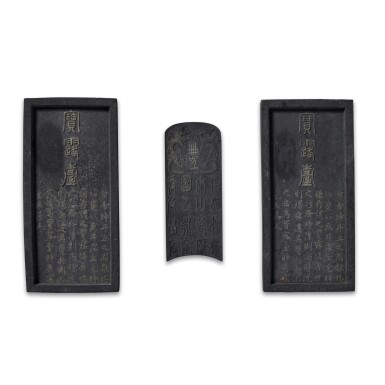
A set of three inscribed ink cakes, Qing dynasty
Auction Closed
March 19, 05:41 PM GMT
Estimate
4,000 - 6,000 USD
Lot Details
Description
the rectangular ink cakes molded on one side with a baluster jar atop a platform representing Mount Heng surrounded by a roiling sea, 'precious dew' rising from the mouth of the jar, the reverses with 58-character inscriptions describing the story of the platform, and the sides molded with 15-character inscriptions attributing them to the wuchen year of the Kangxi reign, corresponding to 1688; the smaller ink cake molded on one face with gongchen feng jue ming (inscription on the bestowal of rank to meritorious officials), the other with a sixteen-character passage from the Shiji below two confronting dragons, the side with a seven-character inscription reading Haiyang Fang Yulu zhencang (treasure of Fang Yulu from Haiyang) (3)
Length of longest 6⅞ in., 17.5 cm
Collection of Stephen Junkunc, III (d. 1978).
An inscription on the pair of ink cakes attributes them to the famous workshop of Cao Sugong (active ca. 1615-89), known as one of the ‘Four Grand Scholar-Inkmakers of Hui,’ which frequently supplied the Qing imperial court with finest ink cakes of its time. The inspiration for this imposing molded design comes from a tale recorded in the Shiji in which the people of the Cinnabar Mound (Danqiu) present to the Yellow Emperor with an agate vase which exuded a precious dew (baolu), and which was later placed on a special platform (Baolutai) on Mount Heng by the Shun Emperor. Compare another dated ink cake of this Baolutai design illustrated in Soame Jenyns, Chinese Art. The Minor Arts II, London, 1965, pl. 212, gifted to the Metropolitan Museum of Art, New York from the Irving Collection, and later sold at Bonhams New York, 16th September 2024, lot 135.
For a similar ink cake of the other ‘bestowal of rank’ design, compare a related example molded with gongchen feng jue ming and confronting dragons, preserved in the National Palace Museum, Taipei (accession no. gu wen 000129), illustrated on the museum’s website.