(Playing Cards) — "All the Bubbles"
(London: Thomas Bowles, 1720)
Live auction begins on:
October 21, 11:00 PM GMT
Estimate
40,000 - 60,000 USD
Lot Details
Description
(Playing Cards) — "All the Bubbles"
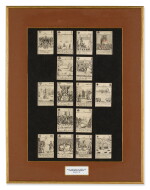
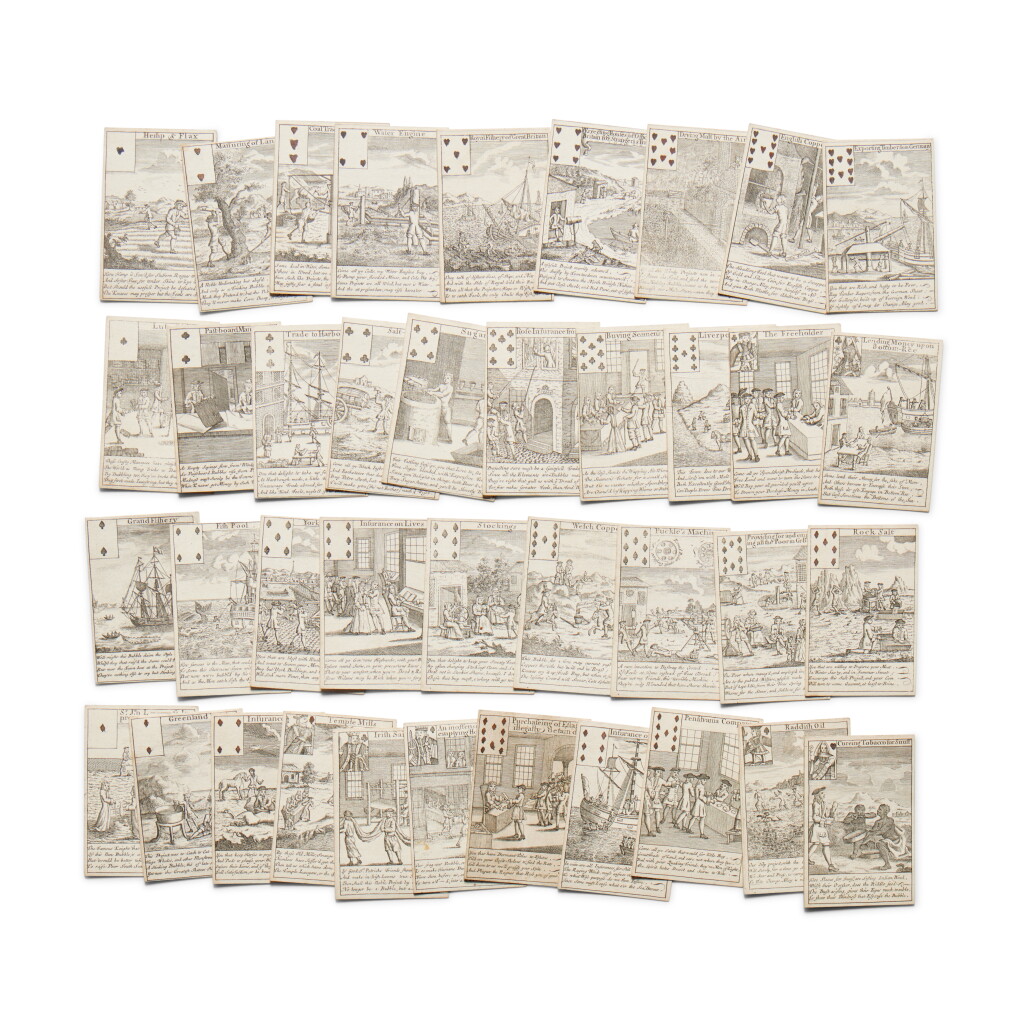
52 engraved playing cards. Laid paper backed with stiff card, red ink tax stamp on the ace of spades, plain versos; without the rarely-seen title card, a few tiny pale spots and stains, altogether an uncommonly bright and clean deck. 13 of the cards are mounted in a frame, the rest are in archival sleeves, housed in a folder attached to the back of the frame.
3¾ by 2 ½ in. (each card); 20 by 26 in. (frame)
9.5 by 6.3 cm; 51 by 66 cm
Jaime Ortiz-Patiño (Sotheby's, London, 10 December 2013, English literature, history, children's books and illustrations,
lot 233)
Acquired at the above sale by the present collector
Jaime Ortiz-Patiño Collection of Early Playing Cards, #42;
The Fournier Museum Catalogue, Volume I: British Isles, #40
This rare deck of playing cards, published soon after the South Sea Bubble stock market collapse, features a series of illustrations that satirize the recent stock market madness and the various "bubble" companies that duped gullible investors into buying their worthless shares.
In the seventeenth and eighteenth centuries, there was a vogue for playing cards that featured elaborate, themed designs, in addition to their suits and ranks. The small-sized engravings on the card faces could include imagery from a variety of sources, ranging from geography, to literature, and history. This gave the cards a somewhat disparate twofold purpose — entertainment and education.
The All the Bubbles deck was inspired by current events, namely the dubious stock market schemes that were created in the midst of the Mississippi Bubble and the South Sea Bubble crashes. These "bubbles" are often thought of as the world's first major stock market crashes and Ponzi schemes. The Mississippi Bubble, a French stock market crash, was orchestrated by the Scottish economist John Law, whose Mississippi Company held a monopoly on trade between France and its colonies. After the Company started selling shares to investors, it became the subject of rampant stock market speculation. The resulting investment mania reached all levels of society, from servants to the aristocracy. In 1720, the bubble burst, wiping out investors and sending the French economy into a period of massive inflation. The South Sea Bubble, which occurred the same year in England, was a parallel stock market crash involving shares in the South Sea Company.
Bowles' deck illustrates a variety of other risky stock market ventures that were open to investors, many of which had emerged during the South Sea Bubble mania. The companies' offerings range from the precarious to the absurd, and are ridiculed here as attempts to exploit the public's blind desire to get rich quickly. The cards feature an array of ephemeral "bubble" stock companies, both real and imagined, including the Pennsylvania Company, life, ship, and horse insurance companies, and various commodities investments, ranging from copper and brass, to rock salt and radish oil. These types of companies would soon be regulated in Parliament by the Bubble Act of 1720, which required all joint-stock companies to have a royal charter in order to issue shares.
You May Also Like