
Property of a Gentleman
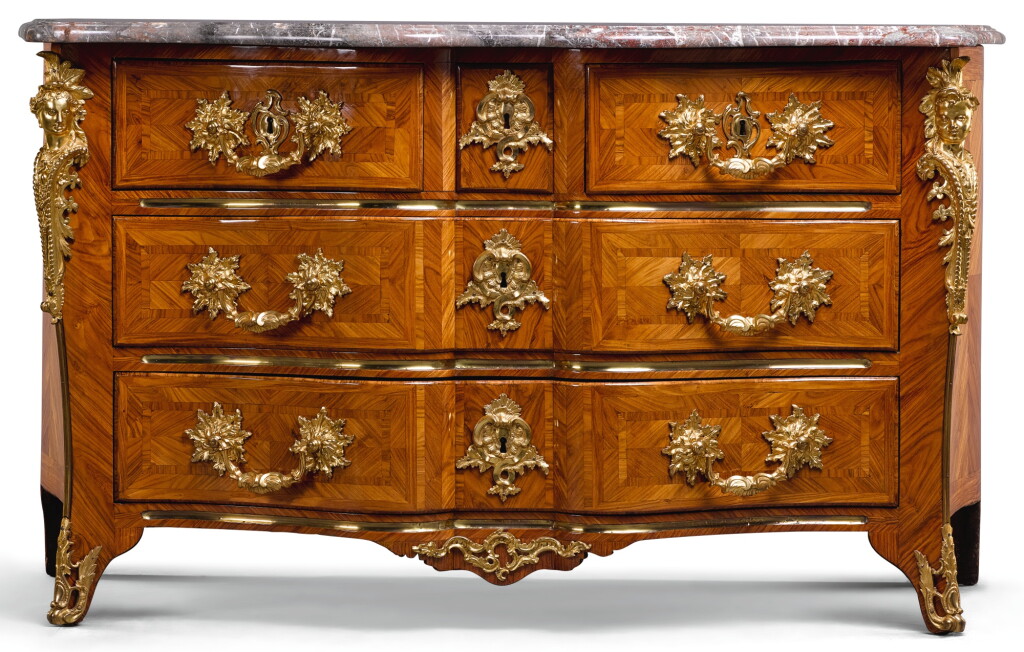
A RÉGENCE GILT-BRONZE MOUNTED AND GILT-BRASS INLAID KINGWOOD ARC-EN-ARBALÈTE COMMODE CIRCA 1720, IN THE MANNER OF ETIENNE DOIRAT
Auction Closed
November 12, 05:03 PM GMT
Estimate
15,000 - 25,000 GBP
Lot Details
Description
Property of a Gentleman
A RÉGENCE GILT-BRONZE MOUNTED AND GILT-BRASS INLAID KINGWOOD ARC-EN-ARBALÈTE COMMODE CIRCA 1720, IN THE MANNER OF ETIENNE DOIRAT
with a fior di pesco marble top, above two short frieze walnut lined drawers flanking a secret drawer and two long drawers, rear left corner of top with wooden label bearing manuscript ink inscription J.P. Sutton Place Drawing Room 1962, re-gilt
83cm. high, 146cm. wide, 68cm. deep; 2ft. 8⅝in., 4ft. 9½in., 2ft. 2¾in.
Formerly in the collection of Jean Paul Getty at Sutton Place, Surrey;
Deaccesion from the J. Paul Getty Museum (inv. no. 78.DA.114);
Christie's New York, 25 October 1991, lot 162 ($42,000).
COMPARATIVE LITERATURE
J.-D. Augarde,' Etienne Doirat, Menuisier en Ebène', The J. Paul Getty Museum, Journal, Vol 13/1985, pp.33-52.
This commode is a magnificent example of the type of commodes produced in the manner of Etienne Doirat (circa 1675-1732) in the Régence period. The relation to the work of Doirat can be made on the basis of overall form and kingwood parquetry and the gilt-bronze mounts, which are used on several occasions in his oeuvre (see J.-D. Augarde, op.cit., p.45).
There are several examples from the market of commodes attributed to Doirat with related or identical corner mounts, escutcheons and handles:
- one sold Artcurial Paris, 23 June 2010, lot 12.
- one commode sold Christie's New York, 17-18 May 2005, lot 511.
- one commode sold Sotheby's New York, 23 May 2003, lot 123.
Jean Paul Getty, Sutton Place
Jean Paul Getty, widely known as J. Paul Getty (1892-1976) was a British-American businessman who made his fortune as president of the Getty Oil Company. Dubbed as the richest man in the world, he was a renowned art collector. By the late 1940s, he began donating part of the collection to the Los Angeles Museum of Art and in 1953 he established the J. Paul Getty Museum in California. After World War II he spent little time in the United States and eventually settled down at Sutton Place, a large estate near Surrey, England. Built between 1521 and 1524, Sutton Place is one of the finest examples of English renaissance architecture. Sutton Place and the surrounding 700-acre estate was commissioned by a friend of King Henry VIII, Sir Richard Weston, and centuries later was owned by the Duke of Sutherland until 1959 when Getty acquired it.