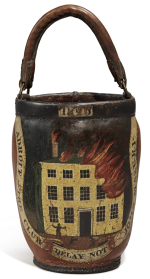

IMPORTANT JOHN MASURY ADROIT FIRE CLUB LEATHER PAINT-DECORATED FIRE BUCKET, SALEM, MASSACHUSETTS, 1820
Auction Closed
January 25, 06:44 PM GMT
Estimate
8,000 - 12,000 USD
Lot Details
Description
IMPORTANT JOHN MASURY ADROIT FIRE CLUB LEATHER PAINT-DECORATED FIRE BUCKET, SALEM, MASSACHUSETTS, 1820
inscribed Adroit Fire Club, Delay Not, John Masury
Height 19 in.
F.O. Bailey, Portland, Maine;
Joseph H. and Sue H. Keown, Rapid City, South Dakota;
Northeast Auctions, Manchester, New Hampshire, Important Americana & Folk Art, August 2, 1992, lot 667;
Marguerite Riordan, Stonington, Connecticut.
Philadelphia, Pennsylvania, Philadelphia Antiques Show, Folk Art on Fire, April 16-20, 2004.
Firefighting originated in America as a volunteer effort by predominantly men of the community. The members of fire clubs unsurprisingly received public praise and gratitude for their courage in the face of danger as well as admiration for their athleticism and manliness. As an added bonus, these clubs were also an outlet for fraternal organization, with clubs working in teams and competing against one another to be the first, fastest, and bravest. Leather painted fire buckets were a prized possession, serving many practical purposes in addition to carrying water to the site of the flames. The majority, decorated with the club’s logo and typically inscribed with the name of the club, the club’s motto, the owner’s name, and year, helped firemen easily identify their own fire bucket and return those that were misplaced in a parade or at the scene of a fire to their proper owners. They were a badge of honor and gave members the opportunity to express their patriotism.
Club logos and mottos often revolved around the theme of speed, depicting an image of a soaring eagle or leaping stag, for example, while others emphasized the fraternal bond and pledge to protect, as exemplified on the Union Fire Society buckets owned by Samuel Trask fire buckets that shows two hands shaking with a heart in between them and the motto Esto Perpetua (May You Endure Forever). This Adroit Fire Club bucket owned by John Masury and designed by S.H. Sheldon, dramatically depicts a three-story, yellow Federal-style building with red and orange flames consuming its upper floors as men in the foreground work diligently, swiftly, and in unison to extinguish the fire. The man holding the hose is half the height of the front door jamb, a ploy used by the artist to emphasize the magnitude of the task at hand.
The Adroit Fire Club was established in Salem, Massachusetts, in 1806, with more than one depicting the image of the burning house surviving. Nevertheless, it is rare to see such a highly detailed, complete composition rendered on a bucket and lends a different perspective as to how the firefighter’s duty was viewed in the early nineteenth century.
The Peabody Essex Museum has a related fire bucket from the Adroit Fire Club dated 1806 and inscribed Samuel Gray. Another closely related example is illustrated in American Antiques, Israel Sack Collection, Vol. 2, p. 296.