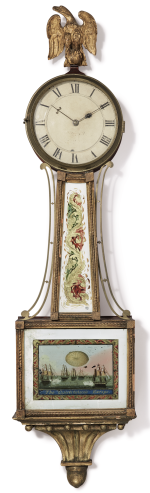

EXCEPTIONAL FEDERAL MAHOGANY, GILTWOOD AND EGLOMISE-PANELED PATENT TIMEPIECE, WORKS BY JOB WILBOUR, CASE POSSIBLY BY JOHN YOUNG, NEWPORT, RHODE ISLAND, CIRCA 1823
Auction Closed
January 25, 06:44 PM GMT
Estimate
25,000 - 50,000 USD
Lot Details
Description
EXCEPTIONAL FEDERAL MAHOGANY, GILTWOOD AND EGLOMISE-PANELED PATENT TIMEPIECE, WORKS BY JOB WILBOUR, CASE POSSIBLY BY JOHN YOUNG, NEWPORT, RHODE ISLAND, CIRCA 1823
in outstanding untouched condition with original gilding and finial; dial indistinctly inscribed J. B. Wilbour Newport; the lower painted panel inscribed THE CONSTITUTION'S ESCAPE.
Height 41 in. by Width 10 in. by Depth 3 ¾ in.
Israel Sack, New York;
Christie's New York, The Collection of Mr. and Mrs. Bertram D. Coleman, January 16, 1998, sale 8842, lot 267;
Robert C. Cheney, Brimfield, Massachusetts.
New York, Winter Antiques Show: A Benefit for East Side House Settlement, January 1960;
Providence, Rhode Island, The Rhode Island Historical Society, The John Brown House Loan Exhibition of Rhode Island Furniture, May 16 - June 20, 1965.
Israel Sack, American Antiques from the Israel Sack Collection, vol. 1, p. 93, no. 282;
Israel Sack, Inc., advertisement, Magazine Antiques, January 1960, p. 40;
Joseph K. Ott, The John Brown House Loan Exhibition of Rhode Island Furniture (Providence, RI: Rhode Island Historical Society, 1965), p. 126, no. 82;
Lita Solis Cohen, "Living with Antiques: The Bryn Mawr home of Mr. and Mrs. Bertram Dawson Coleman," Magazine Antiques, April 1966, p. 576;
Rhode Island Furniture Archive number: RIF1481.
This exceptional clock was misidentified for the past half-century as being the product of another Newport clockmaker, David Williams. Upon close examination of the dial, it is apparent that it is signed J. B. Wilbour for Job Wilbour, a Willams apprentice. The movement is of an "A-frame" design with three pillars that Williams invented likely to avoid Willard's patent.