
Property from a Collection formed by Dr Hinrich Bischoff
Workshop of Cornelis Engelbrechtsz.
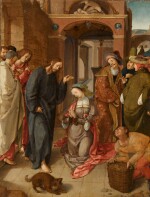
Christ and the Woman taken in Adultery
Auction Closed
July 6, 10:53 AM GMT
Estimate
30,000 - 50,000 GBP
Lot Details
Description
Property from a Collection formed by Dr Hinrich Bischoff
Workshop of Cornelis Engelbrechtsz.
Leiden 1460/65–1527
Christ and the Woman taken in Adultery
oil on oak panel
unframed: 46.8 x 36.6 cm.; 18⅜ x 14⅜ in.
framed: 60.5 x 50 cm.; 23⅞ x 19¾ in.
Probably Johann Baptist Anton Franz Ciolina-Zanoli (d. 1837), Cologne, by 1841 (as Patenir; noted by Kugler under Literature);
By inheritance to Franzisca von Clavé-Bauhaben, Cologne;
Her sale, Cologne, Heberle, 4–5 June 1894, lot 66, for 315 Marks;
Her sale and others, Cologne, Heberle, 14–15 June 1895, lot 142;
Anonymous sale, Cologne, Heberle, 14–15 May 1902, lot 90 (reproduced);
Private collection, Berlin, 1935;
Dr Heinrich Bischoff, Berlin, by 2000;
Thence by descent.
Probably F. Kugler, Kleine Schriften und Studien zur Kunstgeschichte, vol. II, Stuttgart 1854, p. 21;
G. Parthey, Deutscher Bildersaal. Verzeichnis..., vol. II, Berlin 1864, p. 231, no. 5;
M.J. Friedländer, ‘Versteigerung der Sammlung von Clavé-Bouhaben’, in Repertorium für Kunstwissenschaft, vol. 17, 1894, p. 328;
I.Q van Regteren-Altena, ‘Aertgen van Leyden’, in Oud Holland, vol. 56, 1939, pp. 79, 229, no. 20a;
E. Trautscholdt, ‘Zur Vor- und Nachgeschichte einer Kölner Gemäldeversteigerung 1894’, in Mouseion. Studien aus Kunst und Geschichte für Otto H. Förster, Cologne 1960, pp. 304–5, no. 48;
J. Bruyn, ‘Twee St Antonius paneelen en en anderen verken van Aertgen van Leyden’, in Nederlands Kunsthistorisch Jaarboek, vol. 11, 1960, pp. 95–97;
H. Kier and F.G. Zehnder, Lust und Verlust, vol. 2, Corpus-Band zu Kölner Gemäldesammlungen 1800–1860, Cologne 1998, pp. 244–45, no. 66 (as in the style of Lucas van Leyden);
J.P. Filedt Kok, in C. Vogelaar et al., Lucas van Leyden en de Renaissance, exh. cat., Leiden 2011, p. 325, no. 118, reproduced (as workshop of Cornelis Engelbrechtsz., attributed to Aertgen van Leyden).
Long associated with Lucas van Leyden, this picture was first attributed to Aertgen van Leyden by Van Regteren Altena in 1939. Recently, Jan Piet Filedt Kok has convincingly located it in the workshop of Cornelis Engelbrechtsz. in Leiden around 1520, suggesting that it may well have been painted there by the youthful Aertgen van Leyden. The figure of the Adulterous Woman recalls the figure of Martha in Engelbrechtsz.'s Christ in the House of Mary and Martha at the Rijksmuseum, Amsterdam, and the present painting is consistent with his work at the end of the second decade of the 16th century, such as The Calling of Saint Matthew in the Gemäldegalerie, Berlin.1 The question of Aertgen van Leyden's authorship was reconsidered when this painting was in the Gemäldegalerie in Berlin for conservation and study in 1998–99 and Jan Piet Filedt Kok had the opportunity to study it with other scholars.2 Aertgen Claesz., called Aertgen van Leyden, became a pupil of Cornelis Engelbrechtsz. in 1516, and was enrolled in the Leiden Guild in 1521.
Infra-red imaging conducted by Art Analysis Research reveals detailed underdrawing in chalk throughout, most likely executed in two stages, since some is done with a thicker heavier chalk.3 Tree-ring analysis conducted by Ian Tyers reveals that the panel comprises two planks of Baltic oak from the same tree, with likely plausible use from about 1507 to 1539.
Note on Provenance
Franz Ciolina-Zanoli (1800–1850) and his father Johann Baptist Ciolina-Zanoli (1759–1837) were of a generation of collectors that thrived in Cologne in the first half of the 19th century, whose collecting profited from the dissolution of the monasteries that followed the secularisation imposed by Napoleon. Their collection, much expanded by Franz, is revealed by the reconstruction of Kier and Zehnder to have been diverse in character, spanning Italian, German, Early Netherlandish and Dutch and Flemish 16th- and 17th-century art (including a number of Cologne School panels), with a handful of earlier German Gothic panels, and a pair of 18th-century vedute.4 By far its greatest picture was the Fra Filippo Lippi Virgin and Child now in the Metropolitan Museum of Art, New York. The collection passed to Franz' daughter Franziska, who in 1848 married Maximilian Clavé von Bouhaben, who predeceased her. The collection was dispersed following her death in 1893.
1 See under Literature Filedt Kok in Leiden 2011, p. 215, no. 9.1, reproduced, and p. 64, reproduced fig. 2.36.
2 Filedt Kok in Leiden 2011, p. 325, n. 3.
3 Report no. AAR0780A. A high resolution image is available on request.
4 Kier and Zehnder under Literature, pp. 232–61.
You May Also Like


