
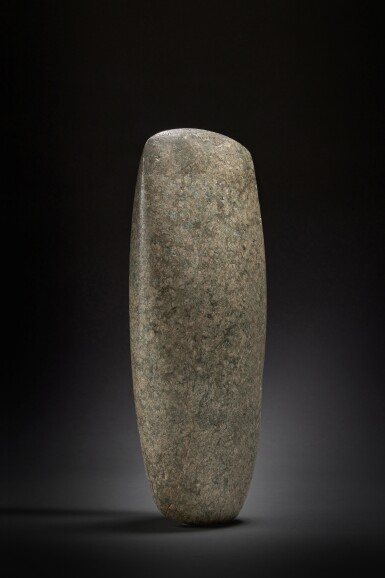
Property from the Collection of Assen and Christine Nicolov
Olmec Jade Celt
Middle Preclassic, circa 900 - 600 BC
Lot Closed
October 28, 04:10 PM GMT
Estimate
6,000 - 8,000 USD
We may charge or debit your saved payment method subject to the terms set out in our Conditions of Business for Buyers.
Read more.Lot Details
Description
Property from the Collection of Assen and Christine Nicolov
Olmec Jade Celt
Middle Preclassic, circa 900 - 600 BC
Length: 10 ¼ in (25.9 cm)
Álvaro Guillot-Muñoz, Montevideo, acquired by 1950
Gérald Berjonneau, Paris, acquired by descent from the above
Sotheby's, New York, November 24, 1997, lot 80, consigned by the above
Assen and Christine Nicolov, Seattle, acquired at the above auction
Thence by descent to the present owner
Though some celts have inscribed designs, this jade achieves a smooth exterior through a process of grinding and polishing by a skilled lapidary. The celt takes the shape of an oblong, rounded rectangle, gradually narrowing into sharp edges typical of an axehead.
The shape of the celt has a two-fold likeness: it mimics both an axe and an abstracted maize sprout. Domestic agriculture made the Olmec’s sedentary lifestyle possible, and maize became sacred for its role in sustaining the population. Celts were also cache objects, ritualistically buried to encourage a positive change to the community. The location of buried celts was believed to be an entrance to the otherworld, which was the place the Olmecs believed was the convergence of the underworld, earth, and sky. Therefore, celts acted as an intermediary between people on earth to those beyond.
Cf. For a comparable celt, see The Metropolitan Museum of Art (1989.314.4).
You May Also Like


