The Art of Pastel: A Swiss Private Collection
Maurice-Quentin de la Tour
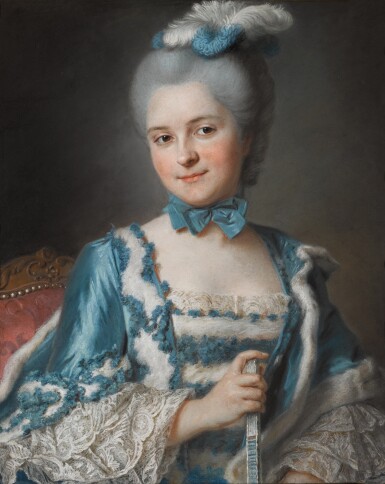
Portrait of a lady, bust-length, wearing a blue dress and holding a fan, seated on a Louis XV chair, said to be Madame Cailloux
Auction Closed
January 25, 04:44 PM GMT
Estimate
200,000 - 300,000 USD
Lot Details
Description
The Art of Pastel: A Swiss Private Collection
Maurice-Quentin de la Tour
Saint-Quentin 1704 - 1788
Portrait of a lady, bust-length, wearing a blue dress and holding a fan, seated on a Louis XV chair, said to be Madame Cailloux
Pastel on paper laid down on canvas, on a wooden stretcher
637 by 518 mm; 25 ⅛ by 20 ⅜ in.
Private Collection, England;
sale, New York, Christie's, 28 January 1998, lot 250;
Private Collection, Paris,
sale, Paris, Hôtel Drouot, Rieunier & Bailly-Pommery, 3 December 2001, Lot 60;
Private Collection, France;
with Jean-François Heim, Galerie Heim, 2002,
where acquired by Jacques-Louis Isoz
N. Jeffares, Maurice-Quentin de La Tour, London 2022 (ebook), no. J.46.1379, p. 86
Traditionally identified as Madame Cailloux1, this exquisite and engaging portrait, which Neil Jeffares dates to the 1760s, conveys all the talent and ability of which Maurice-Quentin de La Tour was capable. Famed throughout Europe during his own lifetime as the most important of all portraitists in pastels, La Tour's incredible skill and acumen in capturing the personality of his sitters is especially clearly manifested in works, like this one, of such technical bravura and virtuosity.
As Neil Jeffares has recently observed: 'His oeuvre consists almost entirely of pastel portraits, both final works and associated préparations in chalk, occasionally with some pastels..'2 (see also the two following lots). Moreover, Jeffares stresses that the artist's 'virtuosity was not achieved without struggle: La Tour was a precursor of the tortured artist of the nineteenth century, agonizing over so-called préparations in which he attempted to capture the soul of his sitter, and continuing to work for decades on portraits that did not satisfy him..'.3 The extraordinary results that La Tour achieved through this perfected and labored technique 'were achieved through an individual style that synthesizes the graphic tradition practised by artists such as Perronneau or Vigée with the stumped, painterly finish of Vivien or Nattier’.4 His great success across French society, from the royal family, the nobility and the wealthiest financiers, to intellectuals and fellow artists, gave La Tour a centre stage, where he was to remain for thirty years with a stream of commissions. La Tour spent virtually his entire career in Paris, unlike his rivals such as Perronneau and Liotard who travelled widely to secure business and establish their reputations.
Studying the present bust-length pastel, it is clear why La Tour satisfied the spirit of his own time and the pursuit of grandeur and elegance of the Ancien Régime, while also skilfully capturing the sitter's intelligence. La Tour’s ability to convey his sitters' personalities and capture their souls was remarked upon by many.5
In the present portrait of a young and beautiful lady her pose is engaging, her left shoulder slightly tilted while her head turns gently to the right. The facial features of the young woman, with a subtle smile and sparkling brown eyes, are enhanced by the richness and sheen of the surface of the bright blue silk dress, a ribbon choker in the same silk capturing the light falling from high on the left. A variety of textures are captured in the elaborate description of her striking corset: the shiny blue fabric is embellished by trimmings of white fur and the sleeves are finished with three elaborate rows of lace, cascading over her wrists. The same lace also finishes her décolleté, while over her powdered hair several ostrich feathers, blue and white, complete her headdress. Over her left shoulder a blue silk mantle can be seen, finished with the same white fur trimmings.
The artist's pursuit of perfection and his desire to achieve a seamless imitation of nature were fundamental requirements of portraiture in his time. In the present pastel La Tour cleverly allows some highlights and hatchings around the eyes, and strokes of dark red over the cheeks and touches of vermilion over her lips, to be visible, juxtaposed with the smooth and subtle finish of her flesh. The shimmer of the silk is highlighted by generous and decisive touches of white. The artist enlivens the image of the sitter through these contrasted techniques, an approach also often used by Perronneau (see lots 25, 26). As pointed out by Jeffares, La Tour’s ‘unrivalled mastery of the textures of the human face, fabric and accessories in no way detracted from the overall conception or psychological penetration of his finished works; balance is always maintened.'6
Neil Jeffares has suggested that the way the sitter holds her fan upside down could be an indicator of her high social status.7 The same way of holding the fan is seen in two earlier portraits by Latour, one, representing Marie Leszczyńska from the 1740s, and another (dated to 1756-1760) of Marie-Joséphe de Saxe – the latter apparently seated in the same red damask chair that we see here, which was probably a prop in La Tour’s studio.8
1. It has not, however, been possible to link this portrait conclusively with an identifiable sitter.
2. Jeffares, op.cit., 2022, p.15
3. Ibid.
4. Jeffares, op.cit., 2022, p.375.
5. Op.cit., p.38
6. Ibid.
7. Oral communication
8. Both Paris, Musée du Louvre, inv. 27618 and 27623 ; Jeffares, op. cit. 2022, nos. J. 46.2268, J. 46.2242
You May Also Like