
Property from the Collection of Jordan and Thomas A. Saunders III
Nicolas de Largillière
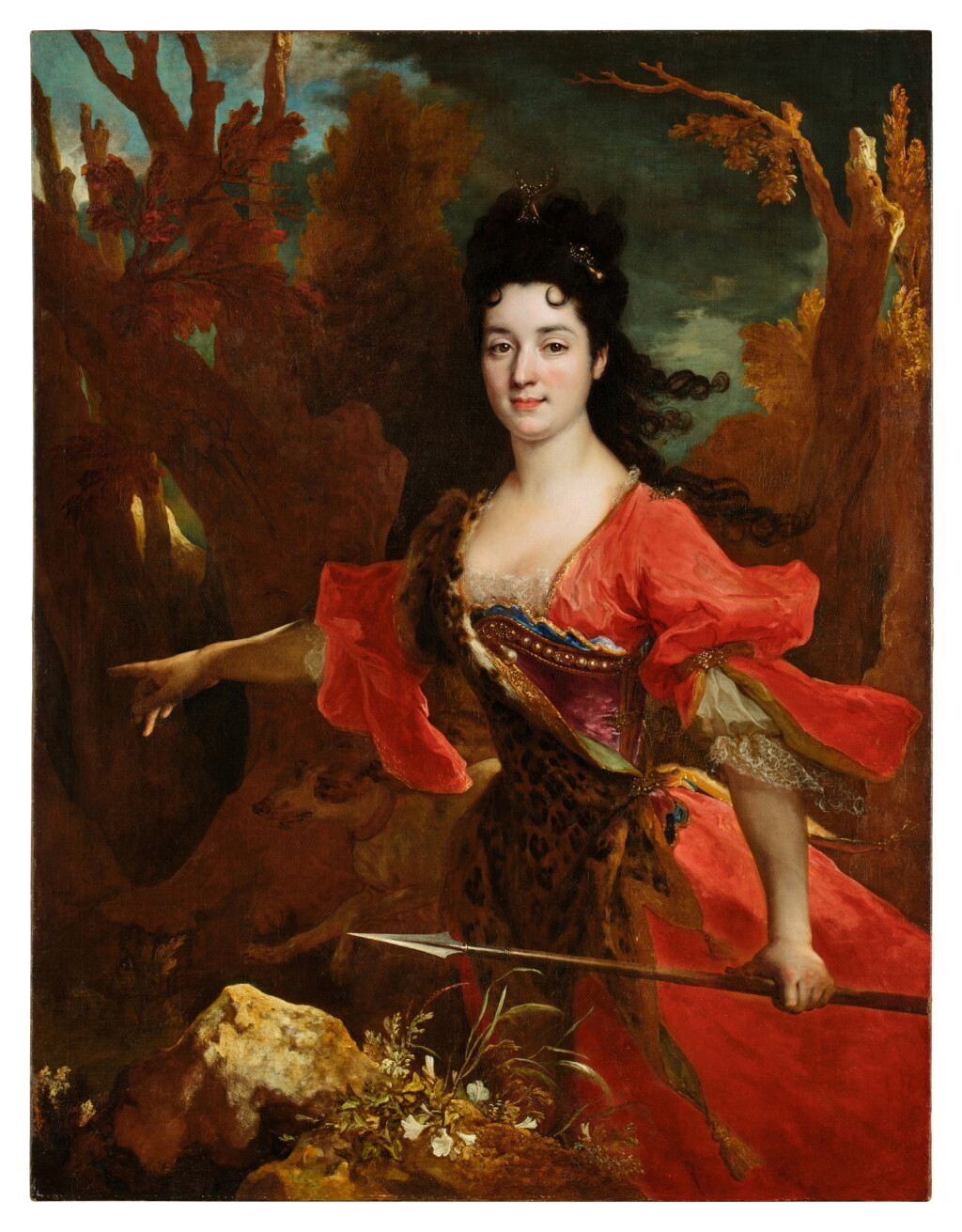
Portrait of Jeanne-Marie de Sacconin de Pravieux as Diana
Auction Closed
June 2, 05:22 PM GMT
Estimate
200,000 - 300,000 USD
Lot Details
Description
Property from the Collection of Jordan and Thomas A. Saunders III
Nicolas de Largillière
Paris 1656 - 1746
Portrait of Jeanne-Marie de Sacconin de Pravieux as Diana
oil on canvas
canvas: 53 ⅞ by 41 ⅜ in.; 136.8 by 105.1 cm
framed: 65 by 52 ¼ in.; 165.1 by 132.7 cm
Château de l'Aubépin, Saint-Symphorien-de-Laye;
Comte de Chabannes, Château de la Tourette, Éveux, Rhône, circa 1920;
Anonymous sale, New York, Sotheby's, 30 January 1997, lot 68A;
Where acquired by Jordan and Thomas A. Saunders III.
Richmond, Virginia Museum of Fine Arts, Elegance and Wonder: Masterpieces of European Art from the Jordan and Thomas A. Saunders III Collection, 20 March 2023 - 30 January 2025, no. 24.
G. Sortais, Largillière manuscript (manuscript of a catalogue raisonné of the oeuvre, begun ca. 1912), Cabinet des Estampes, Bibliothèque Nationale, Paris, dossiers Da 58, vol. II, p.14 (as Portrait de Marguerite Chappuis de Margnolas);
S. Cordier, in With Observation and Imagination: Still Lifes, Genre Scenes, Portraits, and Landscapes from the Saunders Collection, exhibition catalogue, A.K. Wheelock Jr. (ed.), New York 2021, pp. 106-108, cat. no. 24, reproduced.
Nicolas de Largillière painted this luminous portrait historié of Jeanne-Marie de Sacconin de Pravieux circa 1709, by when he had become the preeminent portraitist of the Parisian bourgeoisie and provincial nobility. Unlike some of his contemporaries who favored official court commissions, Largillière cultivated a clientele of magistrates, clergy, and aristocrats outside the immediate orbit of Versailles. Blending allegory and portraiture, Largillière frequently selected mythological or literary personas for his sitters that aligned with their aspirations and virtues. Here depicted in the guise of Diana, goddess of the moon and hunt, the sitter is presented as a paragon of beauty, virtue, courage, and feminine authority.
A Lyonnaise aristocrat, Jeanne-Marie de Sacconin de Pravieux was the daughter of Camille de Sacconin, Baron de Barbançois, Seigneur de Pravieux, and Marie Galliat. On 28 October 1722, she married François-Claude-Éléonor Dulieu, Seigneur de Chenevoux, with whom she shared two daughters; she died just four years later in 1726 at the family château in Chevenoux.1 This portrait, likely commissioned to commemorate her youthful prime, immortalizes her not merely as a noblewoman but as a symbol of elegance and valor.
Rendered with fluid brushwork, the portrait displays Largillière’s rare ability to merge psychological presence with allegorical grandeur, transforming his sitters—especially his female patrons—into icons of both personal and mythological significance. He depicts the dark-haired sitter with Diana’s traditional attributes: the crescent moon tiara, leopard shawl, hunting spear, and lunging hound. Her garments, rendered in luminous jewel-tones, stand out against the autumnal landscape beyond.
The sitter’s confident stance may derive from Hyacinthe Rigaud’s celebrated portrait of Louis de France, Duc de Bourgogne (fig. 1) that had been exhibited at the Salon of 1704 shortly before Largillière executed this painting.2 Underscoring Jeanne-Marie’s commanding presence, she gestures in a similarly authoritative manner as the young prince: left hand grasping a weapon, right arm extended. Thus, Largillière elegantly transposes the visual language of military portraiture into the feminine domain.
1 A. Vachez, Les châteaux historiques du Roannais-Chenevoux, Roanne 1892, p. 22.
2 As suggested in Sylvain 2023.