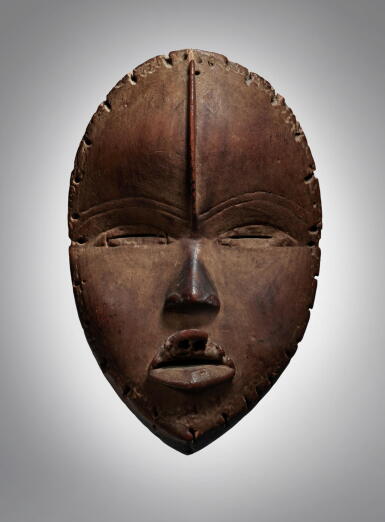
Dan-Nyor Mask, Liberia
Auction Closed
May 24, 03:58 PM GMT
Estimate
40,000 - 60,000 USD
Lot Details
Description
Dan-Nyor Mask, Liberia
Height: 9 1/4 in (23.5 cm)
Acquired from the above on December 12, 1961
With its rounded overall form, short, youthful face and pointed chin, this finely-carved mask relates closely to a group described in Fischer and Himmelheber's definitive study of Dan art, Die Kunst der Dan in 1976, originating from the Nyor Diaplé region in the western part of present-day Liberia. A ridge bisecting the forehead represents a cosmetic scarification and flows downward into the ridge of the nose, which is petite and triangular. Fleshy lips project in an inverted bow, once inlaid with animal teeth. Between 1950 and 1975, the authors observed several sculptors at work in Nyor Diaplé including Tamé, Si, and Tompiémé, who were then of advanced age; another known by his reputation was Uopié, who was known as the finest master sculptor of his generation. Though scant biographical information was available, Uopié was thought to have lived circa 1890 to circa 1950, and his work served as an inspiration to the next generation of masters. A mask attributed to Uopié today in the Brooklyn Museum is particularly close to the present mask in its overall proportions and narrow treatment of the eyes, with lids in relief (Fischer and Homberger, Afrikanische Meister: Kunst der Elfenbeinküste, Zurich, 2015, p. 113, fig. 134).
The present mask, however, was in New York by 1961, when it was acquired by Elliot and Amy Lawrence from the art dealer Mathias Komor, and it shows significant signs of gradual aging and traditional use: the inlaid teeth have been lost, and their sockets patinated over; the holes for attachment to the rest of the dancer’s costume are worn, and some have been broken through and re-drilled. The exceptionally fine aged wood patina is deep and lustrous at the high points where it has been handled. Thus by 1961 it must have been of some age, having been kept and used in situ for years. The Lawrence mask also possesses an elegance in both its balanced design and refined details which surpass the works of those mid-20th century sculptors of Nyor Diaplé. It is likely, therefore, that this mask predates the work of Uopié and his contemporaries and successors, and is perhaps the work of a preceding master who inspired these later artists. A stylistic signature not found on the later masks is the presence of an elegant linear double-brow arching above the eyes.
Herreman notes that "The mythology of the Dan peoples, who live on both sides of the border between Ivory Coast and Liberia, tells us that they received the mask, named ge, from their creator, Zlan. As an independent supernatural being, the mask serves as a tool of communication both between humans, and between humans and their ancestors, to help resolve problems of all kinds. For the Dan, the sacred mask acts as an independent character that is unpredictable and needs to be pleased and treated with respect. Otherwise, it may take revenge. Many Dan masks have idealized and stylized human features that are smoothly sculpted with a large domed forehead, a fine nose, slightly modeled cheekbones, and a small mouth with filed teeth" (Herreman, Facing the Mask, New York, 2002, p. 39).
On the ritual function of such masks, Fischer and Himmelheber note that "Deangle, also known as bonagle, is a character whose names mean 'joking or laughing masquerade', indicating that this is a friendly, attractive spirit, one who makes men joyful when he appears" (ibid., p. 11).
You May Also Like