
Property of an Important European Collection
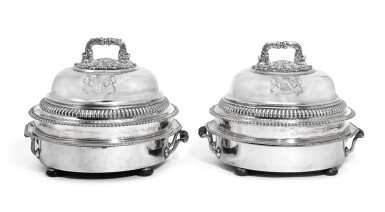
A Pair of George III Silver Serving Dishes with Domed Covers and Sheffield plate heated bases, the dishes Thomas Heming, London, 1774, the covers Samuel Hennell & John Terrey, London, 1815
Lot Closed
November 13, 02:55 PM GMT
Estimate
4,000 - 6,000 GBP
Lot Details
Description
Property of an Important European Collection
A Pair of George III Silver Serving Dishes with Domed Covers and Sheffield plate heated bases, the dishes Thomas Heming, London, 1774, the covers Samuel Hennell & John Terrey
London
1815
shaped circular dishes with gadroon rims, hemispherical domed covers, armorial engraved, dishes crested
diameter: 31.5cm; 12¼in
6110gr, 196oz 10dwt
To view Shipping Calculator, please click here.
The arms on the covers are those of King impaling Fortescue for Peter, 7th Lord King and baron of Ockham (1775-1833) who succeeded his father in 1793. On 26th May 1804 he married Hester, daughter of 1st Earl Fortescue, at St. George's, Hanover Square, London. He was a Whig politician of some note in his day and made particular contribution in the contemporary debate about currency matters. He published a pamphlet in which he deplored the excessive issue of bank notes, particularly by the Bank of Ireland, because of the the consequent depreciation of paper notes and the appreciation of Bullion. In 1811 he served notice on his tenants that he could no longer accept notes in payment of rent except at a discount. This action alarmed the Government so much that they hastily introduced a measure making notes of the Bank of England and Ireland legal tender for rents. This was followed in 1812 by a further act to make the notes legal tender in all cases.