Property from an Important American Collection
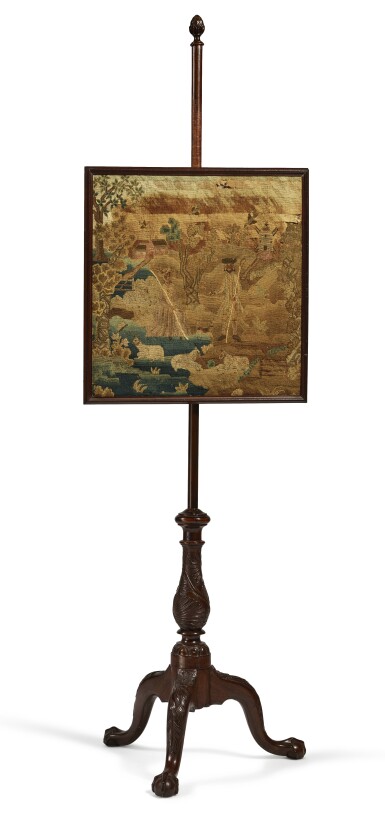
Very Fine and Rare Chippendale Carved and Figured Mahogany Pole Screen, Carving attributed to the School of Henry Hardcastle, New York, New York, Circa 1750
Auction Closed
January 24, 03:52 PM GMT
Estimate
40,000 - 60,000 USD
Lot Details
Description
Property from an Important American Collection
Very Fine and Rare Chippendale Carved and Figured Mahogany Pole Screen
Carving attributed to the School of Henry Hardcastle
New York, New York
Circa 1750
Retains original needlework. Finial replaced.
Height 59 5/8 in. by Width 18 1/2 in. by Depth 17 3/4 in.
L.P. Goulding;
Joe Kindig, Jr. & Son, York, Pennsylvania;
Private collection.
Wallace Nutting, Furniture Treasury, (Cambridge, MA: The University Press, 1928), no. 1411.
American polescreens rarely come on the marketplace. With its exceptional lavish carved decoration, the present example represents the most richly embellished of its type and can be considered a masterpiece of the form. Its carving is attributed to the school of Henry Hardcastle (fl. ca. 1750-1756), the immigrant carver who was working in New York from circa 1750 to July 1755, after which time he moved to Charleston, South Carolina. A candlestand in a private collection with closely related carving of the same pattern appears to stem from the same shop.
Likely British-trained in the 1730s-1740s and admitted as a Freeman in New York in 1751, Hardcastle was commissioned by Frederick Philipse III, the third lord of Philipse Manor in Yonkers, New York, for all of the ornate architectural carving for his house.1 His bold and naturalistic carving displayed on the first and second floor chimneypieces was inspired by stone carving in British Palladian interiors of the 1720s-1740s.2 Elements of this carving are considered to be among the earliest manifestations of the Rococo style in America.
The attribution for this polescreen is based upon shared characteristics of its carving with that executed by Hardcastle for Philipse Manor.3 He was consistent in his work, typically executing leaves with similar profiles, veining flutes, and perpendicular crosscuts in the same context, and favoring use of the same tools. His shop was apparently small, with his only known apprentice being Stephen Dwight (w. 1755 to c. 1774), who ran away in June of 1755 and opened his own shop soon after. In addition to similarities with the carving for Philipse Manor, the carving on this polescreen also relates to carving on a chimneypiece at Hampton Place and a desk-and-bookcase with a history of descent in the Peter Stuyvesant family, both carved by craftsmen trained by Hardcastle.4 Through these craftsmen, Hardcastle's shop practice was influential and enduring in New York throughout the second-half of the eighteenth century.
For two additional New York mahogany polescreens, see one retaining its original oversize needlework panel with a similar standard, acanthus-carved knees and claw feet illustrated by Israel Sack Inc. and one with a bulbous standard and angular claw feet at Winterthur Museum.5
1 Luke Beckerdite, "Origins of the Rococo Style in New York Furniture and Interior Architecture," American Furniture 1993, pp. 233-265.
2 See ibid, fig. 1 and 2, p. 234.
3 For characteristics of Hardcastle's carving, see ibid, p. 237-45.
4 See ibid, figs. 6-11, pp. 236-9.
5 Israel Sack Inc., American Antiques from Israel Sack Collection, Volume IX, P5970, p. 2417 and Joseph Downs, American Furniture, Queen Anne and Chippendale Periods, New York, 1952, no. 241.
You May Also Like