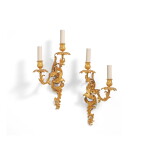
Pair of gilt-bronze wall-lights, Restauration, first half 19th century, circa 1830 | Paire d'appliques en bronze doré d'époque Restauration, première moitié du XIXème siècle, vers 1830
Auction Closed
June 23, 03:45 PM GMT
Estimate
40,000 - 60,000 EUR
Lot Details
Description
Pair of gilt-bronze wall-lights, Restauration, first half 19th century, circa 1830
after a model by Feuchère
with five lights, each with a backplate in the form of a lyre entwined with berried laurel, surmounted by a ribbon-tied floral bouquets suspending a mask of Apollo backed by rays, with five scrolled candle branches cast with acanthus and berries, with spirally fluted and gadrooned nozzles, with an entwined berried laurel and foliate finial
Height 37¾ in; width 18¾ in; Haut. 96 cm, larg. 48 cm
(2)
_________________________________________________________
Paire d'appliques en bronze doré d'époque Restauration, première moitié du XIXème siècle, vers 1830
d'après un modèle de Feuchère
à cinq lumières, le fût simulant une lyre surmontée de roses et d'un noeud à rubans, figurant un masque d'Apollon et des branches de lauriers, centrée d'une rosace
Galerie Almas, Munich, München Kunst- und Antiquitatenmesse, Novembre 1968;
_________________________________________________________________________
Acquis par un collectionneur privé puis par par descendance jusqu'au proriétaire actuel
Süddeutsche Zeitung, 7 novembre 1968, Trends und Tendezen auf den Kunstmarkten (ill.)
Hans Ottomeyer, Peter Pröschel, Vergoldete Bronzen, Munich, 1986, vol. I, pl. 4.16.16 (ill.)
Inwentarz Kosztowności, Mebli i innych Ruchomości znajdujących się w Cesarskim Pałacu Łazienki. Spisany w latach 1839 i 1842 [Inventaire des biens et meubles conservés dans le palais impérial de Łazienki, établit entre 1839 et 1842], AGAD , Zespół 214 – Zarząd Pałaców Cesarskich, ref. 2988).
Stanisław Iskierski, Bronzy Zamku Królewskiego i Pałacu Łazienkowskiego w Warszawie / Les bronzes du Château Royal et du Palais de Łazienki à Varsovie, 1929.
Francis Watson, ‘French Furniture at Woburn Abbey: Eighteenth and Early Nineteenth Centuries’, Apollo, Vol. LXXXII, No. 46, décembre 1965;
T. Monnington, France in the Eighteenth Century, exh. cat., Royal Academy, London, 1968, p.148;
The paternity of the model belongs presumably to the ciseleur Pierre-François Feuchère, who possibly first conceived this sophisticated model for Stanislas Augustus Poniatowski, King of Poland, as a commission for his palace of Łazienki in the late 18th century.
At this summer residence of the King, now meticulously restored, there were eight appliques recorded in the first half of the 19th century:“ośm kandelabrów ściennych brązowych w ogniu wyzłacanych, każdy o pięciu takichże lichtarzykach, ozdobione bronzowemi liściami i gronami, z kokardami i główkami Apollina” ("eight bronze wall candelabra gilded, each with five lights, decorated with bronze leaves and clusters, with bows and Apollo heads", Inwentarz (...), 1839 i 1842.)
Currently only two original appliques survive in situ at Łazienki. One pair formerly at the palace and bearing the inventory marks for Łazienki, was most recently sold at Christie's London, 10 July 2014, lot 39 where it was incorrectly described as from the Maximilien de Leuchtenberg’s collections.
A set of four appliques of this model are in the collection of the Duke of Bedford at Woburn Abbey (ill. T. Monnington, France in the Eighteenth Century, fig. 398), which was probably acquired in the late 18th century by Francis Russell, 5th Duke of Bedford (1765-1802).
When discussing the Bedford lights, Francis Watson mentions a set of wall lights of the model of the present lot, signed Feuchère, which belonged to the Rothschilds (Apollo, 1965, p. 482). Interestingly, F. J. B. Watson also draws attention to similar wall-lights amongst the remains of the Feuchère workshop sold off in Paris in January 1829 (Apollo, 1965). Indeed, lot 104 describes two wall-appliques with lyres and five lights: “Deux bras à lyre, cinq lumières, dorés mat.”
The present wall appliques were published by Ottomeyer and Pröschel in their seminal work Vergoldete Bronzen, although with two erroneous pieces of information, believing they were the Viennese pair Watson referred to in his article. It mentions that these are stamped, which they are not, and that they came from the Rothschild Collection in Vienna. In 1968, when shown at the Munich Antiques Fair, these were advertised as similar to the Bedford and Rothschild examples, without previous provenance, which might have led to the misunderstanding. Again, the antiquaire was drawing from Francis Watson’s Apollo article.
Furthermore, it must be noted that a monumental suite of royal wall appliques, which relate to the present lot as per the use of similar motifs, were documented as early as 1801 at the Palais de Tuilleries (one pair sold Sotheby's New York, 22 May, 1997 ; and a set of four with Galerie Steinitz -see Steinitz VI Royale, Paris, 2017, pp.118-123).
La paternité du modèle revient très vraisemblablement au ciseleur Pierre-François Feuchère qui a probablement conçu cette réalisation pour le le roi de Pologne Stanislas Auguste Poniatowski pour son palais Lazienki à la fin du XVIIIème siècle.
Huit appliques de ce modèle sont inventoriées dans sa résidence d'été, décrites en 1839 et 1842 : "huit appliques en bronze doré à cinq lumières avec des feuilles et grappes en bronze doré, avec arc et têtes d'Apollon". Seule une paire subsiste aujourd'hui à Lazienski, une autre paire a été vendue chez Christie's à Londres le 10 juillet 2014, lot 39.
Une suite de quatre appliques appartient aux collections du duc de Bedford à Woburn Abbey (reproduite dans T. Monnington, France in the Eighteenth Century, fig 398). Dans son article sur Woburn Abbey, Francis Watson évoque une paire d'appliques de ce modèle signées Feuchère ayant appartenu aux collections Rothschild à Vienne dont la localisation est inconnue. Il fait un rapprochement avec celles avec lyre vendues lors de la dispersion du stock de de l'atelier de Feuchère à Paris en janvier 1829.
Notre paire fut illustrée dans Vergoldete Bronzen, présentée comme la paire de l'ancienne collection Rotshchild, ce qui est erroné.
You May Also Like