Henry Fuseli, R.A.
A young woman with a fantastical hairstyle
Auction Closed
January 31, 05:59 PM GMT
Estimate
15,000 - 20,000 USD
Lot Details
Description
Henry Fuseli, R.A.
Zürich 1741 - 1825 Putney Heath
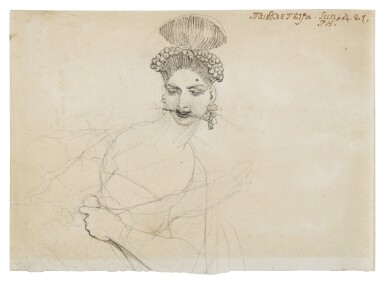
A young woman with a fantastical hairstyle
Black chalk on laid paper;
inscribed lower right in Greek 'παιδολέτειρα' [Paidoleteira] and dated 'Jun[e], 4 21. / P.H. [Putney Hill]'
131 by 186 mm; 5 ⅛ by 7¼ in.
Sir Eric Maclagan (1879-1951);
Professor Michael Maclagan (1914-2003);
by descent until,
sale, London, Bonhams, 9 July 2014, lot 1;
sale, Paris, Artcurial, 31 March 2016, lot 56;
with Le Claire Kunst, Hamburg
London, Tate Gallery, Henry Fuseli 1741-1825, no. 197;
Oxford, Ashmolean Museum, long-term loan (2003-5);
Chicago, The Art Institute, Shockingly Mad: Henry Fuseli and the Art of Drawing, 2018, unnumbered;
London, The Courtauld Gallery, Fuseli and the Modern Woman. Fashion, Fantasy, Fetishism, 2022, no. 62;
Zürich, Kunsthaus, Fuseli: fashion – fetishism – fantasy, 2023, no. 62
G. Schiff, Johann Heinrich Fuseli, Zurich 1973, no. 1603
This drawing was last seen in public in 2022-23 when it was included in: Fuseli and the Modern Woman: Fashion, Fantasy, and Fetishism, an exhibition hosted successively by London’s Courtauld Institute and Zurich’s Kunsthaus. It forms part of an extraordinary group of highly charged drawings which see Fuseli focus on the erotic, the fantastical and the macabre.
The present drawing is particularly unsettling as it shows a woman, dressed as a courtesan, with an elaborate hair-style and large earrings, clenching a sharp hair-pin between her teeth, while stabbing downwards with a knife. Fuseli has inscribed the work with the Greek word Paidoleteira, which translates as: child murderer. The drawing would seem to relate to other sheets in the series namely: Woman leaning over a small body, circa 1800-10 (Kunsthaus, Zurich) and: Half-length study of a woman turning to the left with a knife, 1814 (Hamburger Kunsthalle, Hamburg).1
Why these often sadomasochistic and erotic drawings were created is uncertain. Some have argued that Fuseli made them for himself, as a sort of act of rebellion against the social and political institutions that he is known to have disliked. Others have noted that many are inscribed with the letters QE, PC or (as with the present sheet) PH. These inscriptions would seem to refer to the locations of the homes of some of Fuseli’s closest friends, supporters and patrons: Lavinia de Irujo, the illegitimate daughter of Don Carlos Martinez de Irujo y Tacón, 1st Marques de Casa Irujo, lived at Queen Elms, Chelsea; Joseph Johnson, the influential bookseller and publisher, lived at Purser’s Cross, Chelsea, while Putney Heath was home to Susan North, Countess of Guilford, where Fuseli was a regular guest. It may be that some of these works were created as part of risqué soirées, where the artist and members of his intimate circle might explore themes from ancient and modern literary sources.
1. Ed. D. Solkin & K Gottardo, Fuseli and the Modern Woman. Fashion, Fantasy, Fetishism, London 2022, figs. 64a,b & 124
You May Also Like