
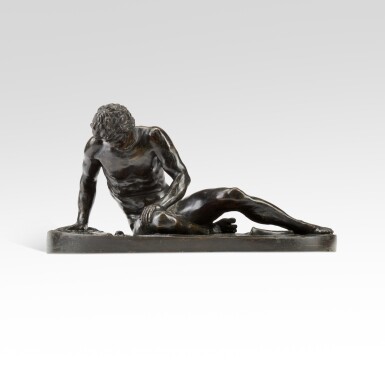
Italy, Rome, Francesco Righetti (1749 - 1819) and workshop, figure of Dying Gaul
Lot Closed
September 26, 12:58 PM GMT
Estimate
2,000 - 3,000 EUR
Lot Details
Description
Italy, Rome
Francesco Righetti (1749 - 1819) and workshop
signed and dated 1817
Figure of Dying Gaul
on the base: FR RIGHETTI.ET.ALOYS.FIL.FEC.ROM.1817
bronze
H. cm 14x27,5; 5 1/2 by 10 7/8 in.
Christie's Paris, Le cabinet de curiosités de François Antonovich, 6 October 2014, lot. 153
Collection Antonovich
Known as the Dying Gladiator, the statue was only correctly identified in the early 19th century as a Gaul, owing to its distinct barbarian features. In 1794, Francesco Righetti published a price list of works available from his workshop (Haskell and Penny 1981, p. 342), in which the Dying Gaul, still referred to as the Dying Gladiator di Campidoglio, was prominently featured at the center of the catalogue, carrying the substantial price of 16 sequins.
Francesco Righetti (1749-1819)
Francesco Righetti, one of the most successful and prolific Roman sculptors of the late eighteenth and early nineteenth centuries, began his professional career working under Luigi Valadier, the leading silversmith in Rome at the time. Valadier also produced high quality bronzes based on antique models, a business that provided Righetti with the opportunity to master his skills in bronze casting. Eventually, Righetti took over from Valadier and continued to produce replicas of Roman bronzes, including a commission for twelve full-sized lead casts of famous antique statues for Henry Hope. After a visit to his studio, Pope Pius VII became an enthusiast of Righetti's work and commissioned a number of pieces from him, including a pair of large candelabra for San Giorgio Maggiore, the Benedictine monastery in Venice where he was elected pope. In 1805 Pius VII made Righetti head of the Vatican foundry, where his son Luigi Righetti became his assistant. Righetti's works are characterized by high quality casting and finishing and even his smaller pieces, such as the present lot, are always sculptural and majestic.
You May Also Like


