
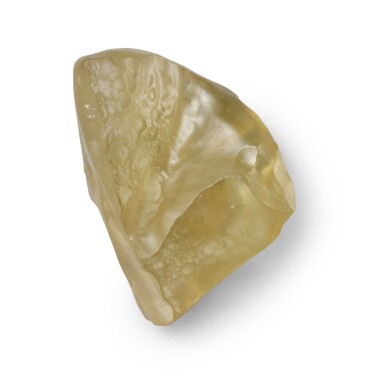
Libyan Desert Glass
When an Asteroid Collides With Earth
No reserve
Auction Closed
July 16, 06:46 PM GMT
Estimate
1,000 - 2,000 USD
Lot Details
Description
Libyan Desert Glass — When an Asteroid Collides With Earth
Tektite/Impactite
The Great Sand Sea, Sahara Desert, Egypt/Libya border region
3¼ x 2⅛ x 2 inches (8.3 x 5.4 x 5.1 cm), 5½ inches (14 cm) on stand. 85 grams (.19 lb).
Libyan Desert Glass is a tektite, or a silicated glass formation (from the Greek tektos, meaning "melted"). Tektites are named for the localities in which they are found, hence: Australites, Indochinites, Philippinites, Libyan Desert Glass, etc. They are the result of asteroids slamming into and melting the Earth's surface—the extraordinary heat and pressure liquifies terrestrial rocks, which are splashed into the atmosphere before returning to Earth as solidified glass. Tektites are terrestrial in origin, with the impact event responsible for Libyan Desert Glass having occurred approximately 28.5 million years ago in the southwest corner of the Great Sand Sea near what is currently the Egypt/Libya border.
The higher the silica content in the melted material, the lighter the color. Libyan Desert Glass is 98% silica (molten sand) and is yellow-hued whereas other tektites range from green (Moldavites) to jet black (Australites). This example is a gorgeous golden color with a matte surface that reflects light off of its many sides. Libyan Desert Glass was used as a gemstone in Pharaonic Egypt, and an especially coveted specimen was discovered in the tomb of King Tutankhamun.
In this sale, in addition to Libyan Desert Glass, we are offering tektites from three of Earth's recognized tektite strewn fields: see Lots 117, 118, & 119.