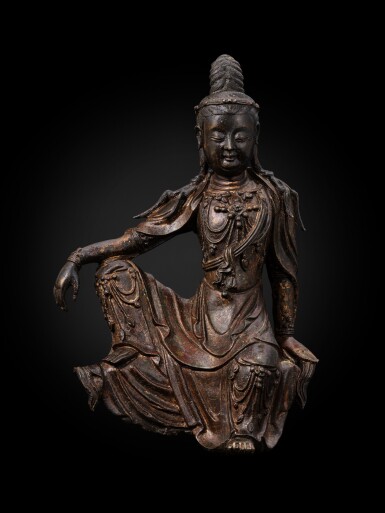
A rare copper alloy figure of Avalokiteshvara Yuan dynasty, 14th century | 元十四世紀 銅合金觀世音菩薩坐像
Auction Closed
June 10, 03:15 PM GMT
Estimate
30,000 - 40,000 EUR
Lot Details
Description
A rare copper alloy figure of Avalokiteshvara
Yuan dynasty, 14th century
seated in rajalilasna with right leg raised and the left reaching down in a position of royal ease, with the left hand behind supporting his weight and right arm resting on the raised knee, a shawl draped over the left shoulder open at the chest revealing beaded jewelry, the legs wrapped in a flowing dhoti gathered at the waist, the face with down-cast gaze, the hair swept up into a high chignon and with long tresses falling over the shoulders
33.5 cm, 13⅛ in.
__________________________________________________________________________
Rare figure d'Avalokiteshvara sous la forme de Nanhai Guanyin en alliage de cuivre avec traces de dorure, dynastie Yuan, XIVE siècle
__________________________________________________________________________
元十四世紀 銅合金觀世音菩薩坐像
33.5 公分, 13⅛英寸
The bodhisattva Avalokiteshvara is represented as Nanhai Guanyin (Avalokiteshvara of the Southern Seas) seated with right leg raised and the left reaching down in a position of royal ease (rajalilasana), with the left hand behind supporting his weight and right arm resting on the raised knee. The iconography of Nanhai Guanyin was known in China from the early fifth century with the translation of the Avatamsaka (huayan) Sutra from the Sanskrit: the text describes the bodhisattva residing at his mythical dwelling on Mount Potalaka in the southern Indian seas. The languid sculptural form of the princely bodhisattva was popular in China from around the tenth to the fourteenth century: compare the posture, the diverging hair tresses on the shoulders, the distinctive chin line of a 13th/14th century gilt bronze example in the British Museum, see W. Zwalf, ed., Buddhism: Art and Faith, Macmillan, 1985, p. 207, cat. no. 298.
__________________________________________________________________________
本像刻劃南海觀音造型,作休閒坐姿,曲右膝,左腿下垂,左手從後支撐身體,右臂擱於右膝。南海觀音之形象,自五世紀早期見於中國,當時華嚴經自梵文譯成漢語。此經描述觀音菩薩住於南印度洋補怛洛伽山。本像造型氣度不凡,姿態柔和,十世紀至十四世紀期間流行於中國,比較一例,十三/十四世紀鎏金銅作例,姿態、披肩頭髮及突出下頦線條與本品相近,現藏於大英博物館,W. Zwalf編,《Buddhism: Art and Faith》,Macmillan,1985年,頁207,編號 298。
You May Also Like