
Property from the Eric C. Caren Collection
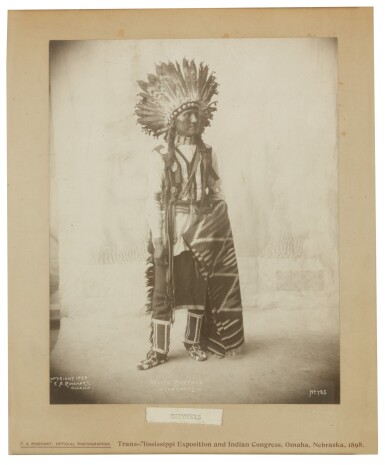
RINEHART, FRANK A. | A Little Chief, Arapahoes. No. 799 — Afraid of Eagle (Sioux). No. 766 — White Buffalo, Cheynees. No. 785. Omaha, Nebraska, 1898
Lot Closed
July 21, 05:24 PM GMT
Estimate
2,000 - 3,000 USD
Lot Details
Description
Property from the Eric C. Caren Collection
RINEHART, FRANK A.
A Little Chief, Arapahoes. No. 799 — Afraid of Eagle (Sioux). No. 766 — White Buffalo, Cheynees. No. 785. Omaha, Nebraska, 1898
Three platinum print photographs (each 9 1/4 x 7 1/4 in.; 235 x 184 mm), copyright, title, date, inventory number in the negatives, each mounted on card with imprint F. A. Rinehart, Official Photographer. Trans-Mississippi Exposition and Indian Congress, Omaha, Nebraska, 1898; some fading to backgrounds, a little soiling to mounts. Individually matted, framed, and glazed. The consignor has independently obtained a letter of authenticity from PSA that will accompany the lot.
Frank A. Rinehart's photographic record of the American Indian at the end of the nineteenth century.
Specializing in commercial portraits, Frank A. Rinehart (1861–1928) opened a studio in Omaha, Nebraska, in 1886. Commissioned by the government, in 1898 he became the official photographer of the Trans-Mississippi and International Exposition in Omaha, which included an Indian Congress. Working with his assistant Adolf Muhr (who later worked for Edward S. Curtis), Rinehart set up a studio and gallery at the exposition. Because Rinehart was occupied with recording other exposition events, it is likely that Muhr made many of the nearly 500 portraits of Indians attending the Congress. The delegates were photographed in a studio on the Exposition grounds with an 8 x 10-inch glass-negative camera with a German lens. Platinum prints were produced to achieve the broad range of tonal values that medium afforded. After the Indian Congress, Rinehart and Muhr traveled to Indian reservations for two years, portraying Native American leaders who had not attended the event, as well as depicting general aspects of the indigenous everyday life and culture.
Rinehart and Muhr's dramatic photographs are sensitive portraits of individual Native Americans, and not the impersonal ethnographic studies often produced by earlier photographers. The first issues of the portraits on the official mounts of the Trans-Mississippi Exposition and Indian Congress are much scarcer than later prints.