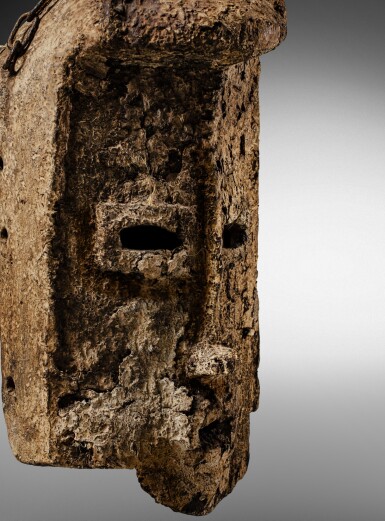
Masque, Dogon, Mali
Dogon Mask, Mali
Auction Closed
June 21, 04:43 PM GMT
Estimate
120,000 - 180,000 EUR
Lot Details
Description
Masque, Dogon, Mali
haut. 34 cm ; 13 2/6 in
---------------------------------------------------------------------------
Dogon Mask, Mali
Height. 34 cm ; 13 2/6 in
Collection Hélène Leloup, Paris, avant 1980
---------------------------------------------------------------------------
Hélène Leloup collection, Paris, before 1980
Nantes, Musée des Beaux-Arts, Dege l’héritage dogon, 21 juin - 18 septembre 1995
Paris, Musée du quai Branly - Jacques Chirac, Dogon, 5 avril - 24 juillet 2011
Bonn, Bundeskunsthalle Germany, Dogon, 14 octobre 2011 - 22 janvier 2012
---------------------------------------------------------------------------
Nantes, Musée des Beaux-Arts, Dege l’héritage dogon, 21 June - 18 September 1995
Paris, Musée du quai Branly - Jacques Chirac, Dogon, 5 April - 24 July 2011
Bonn, Bundeskunsthalle Germany, Dogon, 14 October 2011 - 22 January 2012
Rivière, Les chefs-d'oeuvre africains des collections privées françaises/African Masterpieces from French Private Collections/Die Afrikanischen meisterwerke Französischer Privatsammlungen, 1975, p. 60
Leloup, Statuaire Dogon, 1994, p. 584
Leloup, Dege, l'héritage dogon, 1995, p. 50, n° 86
Leloup, Dogon, 2011, p. 194
« DOGON - exposition au musée du quai Branly », dans voixdumasque.canalblog.com, 18 juillet 2011
Djouder, « EXPO - La grandeur des Dogons », dans lepetitjournal.com, 23 mai 2011
Demory, « La société des masques », dans Connaissance des arts, hors-série n° 490, 2011, p. 49
---------------------------------------------------------------------------
Rivière, Les chefs-d'oeuvre africains des collections privées françaises/African Masterpieces from French Private Collections/Die Afrikanischen meisterwerke Französischer Privatsammlungen, 1975, p. 60
Leloup, Statuaire Dogon, 1994, p. 584
Leloup, Dege, l'héritage dogon, 1995, p. 50, n° 86
Leloup, Dogon, Paris, 2011, p. 194
« DOGON - exposition au musée du quai Branly », in voixdumasque.canalblog.com, 18 July 2011
Djouder, « EXPO - La grandeur des Dogons », in lepetitjournal.com, 23 May 2011
Demory, « La société des masques », in Connaissance des arts, hors-série n° 490, 2011, p. 49
Masque et patrimoine
Par Lassana Cissé
Le masque est un élément matériel et immatériel fondamental de l'identité culturelle chez les Dogons et chez bien d'autres ethnies au Mali. Exhibé sporadiquement à l'occasion des rituels funéraires et de la grandiose cérémonie du Sigi, le masque est par excellence l'objet culturel qui concerne tout le monde, même si les femmes et les enfants sont censés ne pas l'approcher de trop près. Contrôlé par les vieillards et animé par les jeunes, il est un bien culturel qui appartient à tous. Créé dans et pour la société, il relève de l'âme collective et intervient dans des cérémonies qui ne sont pas sans effet sur l'identité culturelle dont il apparaît à la fois comme un révélateur et un agent d'évolution.
____________________
A l’origine des masques Dogons : le mythe d'Albarga
Porter les masques est un privilège réservé aux membres de l’awa, la société des masques. Seuls les hommes circoncis peuvent l’intégrer, en suivant une période d’initiation comprenant la production de masques. Ils dansent à l’occasion de plusieurs fêtes dont les plus importantes sont le dama, la cérémonie de levée de deuil, et le sigui, qui a lieu tous les 60 ans selon l’alignement des étoiles. Pour préparer ces fêtes, les dignitaires - les olubaru - se retirent en brousse et dans les cavernes pour recevoir l’instruction des anciens et retrouver leurs masques respectifs[1].
Le masque de la Collection Hélène Leloup est un exemplaire particulièrement rare et significatif du corpus puisqu’il appartient à la catégorie des albarga : soit le premier masque dans l’histoire de la découverte des masques par les Dogons.
Marcel Griaule, dans sa thèse sur les masques Dogons publiée en 1938, conte l’histoire de ce masque qu’il a rencontré en pays Dogon à Yougo Pilou[2]. Il tient son nom du vieillard Albarga : celui-ci aurait offert de la bière de mil à des Andoumboulou, des êtres mythiques habitants les montagnes. Pour le remercier ceux-ci lui dédient une danse avec un masque à son effigie. Mais ils sont chassés par des femmes Dogons qui récupèrent leurs attributs et les ramènent à leur village. Effrayés par le pouvoir de ces masques, les hommes les confisquent, les cachent et créent ainsi la première société de masque Dogon.
Marcel Griaule décrit la danse de l’albarga : le danseur s’appuie sur un bâton qu’il frappe au sol, et se déplace lentement. Les autres danseurs prennent alors son rythme. Griaule prend le soin de noter le chant qui l’accompagne[3] :
- albarga âna gogo simule pennay (albarga combien [de cauris] sortiront ? quatre-vingts et quarante.)
- bede àna gogo simule pennay (bede combien [de cauris] sortiront ? quatre-vingts et quarante.)
Une photo du masque de Yougo Pilou publiée dans l’ouvrage de Marcel Griaule nous permet de le comparer au masque de la Collection Leloup[4]. Les yeux en amande, l’arête nasale se prolongeant jusqu’à la bouche, un front légèrement déporté et surtout une épaisse patine à l’aspect d’écorce, en font des exemplaires très similaires. Exposé au Musée du quai Branly en 2011, ce masque témoigne de l’histoire des sorties de masques Dogons par sa rareté et son ancienneté.
[1] Cissé, Dogon, 2011, p. 189-192
[2] Griaule, Masques Dogons, 1963 (1938), p. 60-61
[3] Griaule, Masques Dogons, 1963 (1938), p. 510
[4] Griaule, Masques Dogons, 1963 (1938), pl. XVIII (B)
---------------------------------------------------------------------------
Masks and Heritage in Dogon Country
By Lassana Cissé
The mask is a fundamental material and immaterial element of the cultural identity of the Dogon and many other ethnic groups in Mali. Sporadically displayed during funeral rituals and the grandiose Sigi ceremony, the mask is the cultural object that concerns everyone, even if women and children are not supposed to get too close to the ceremony. Controlled by elders, and animated by the young, the mask s a cultural asset that belongs to everyone within the culture. Created in and for society, the mask is part of the collective soul and is used in ceremonies that have an effect on cultural identity. The mask appears to be both a revealer and an agent of evolution.
__________________
At the Origin of the Dogon Masks: the Myth of Albarga
Wearing masks is a privilege reserved for the members of the awa, the society of masks. Only circumcised men can join the society, following a period of initiation that includes the production of masks. They dance for several occasions, the most important are the dama, the mourning ceremony, and the sigui, which takes place every 60 years depending on the alignment of the stars. To prepare these festivals, the dignitaries - the olubaru - retreat to the bush and caves to receive instruction from the elders and to find their respective masks[1].
The mask in the Hélène Leloup collection is a particularly rare and significant example of the corpus, belonging to the category of the alabarga: the first mask in the history of the discovery of masks by the Dogon.
Marcel Griaule, in his thesis on Dogon masks published in 1938, tells the story of this important category of masks which he encountered in Dogon country at Yougo Pilou[2]. The category takes the name from the old man Alabarga: he would have offered millet beer to the Andoumboulou, mythical beings living in the mountains. To thank him, the Dogon dedicated a dance to him with a mask in his image. The men were chased away by Dogon women who recovered their attributes and brought them back to their village. Frightened by the power of these masks, the men confiscated them, and hid them, thus creating the first Dogon mask society.
Marcel Griaule described the dance of the albarga: the dancer leans on a stick that he hits on the ground and moves slowly. The other dancers then follow his rhythm. Griaule took care to note the song that accompanies the dance[3]:
- albarga âna gogo simule pennay (albarga how many [cowries] will come out? eighty and forty.)
- bede àna gogo simule pennay (bede how many cowrie shells will come out? eighty and forty.)
A photo of a Yougo Pilou mask published in Marcel Griaule's book bears comparison with the mask in the Leloup collection[4]. The almond-shaped eyes, the nasal bridge extending to the mouth, a slightly offset forehead, and above all a thick patina with the appearance of bark, make them very similar. Exhibited at the Musée du quai Branly in 2011, the Leloup mask bears witness to the important history of Dogon masks shown both by their rarity and great age.
[1] Cissé, Dogon, 2011, p. 189-192
[2] Griaule, Masques Dogons, 1963 (1938), p. 60-61
[3] Griaule, Masques Dogons, 1963 (1938), p. 510
[4] Griaule, Masques Dogons, 1963 (1938), pl. XVIII (B)
You May Also Like