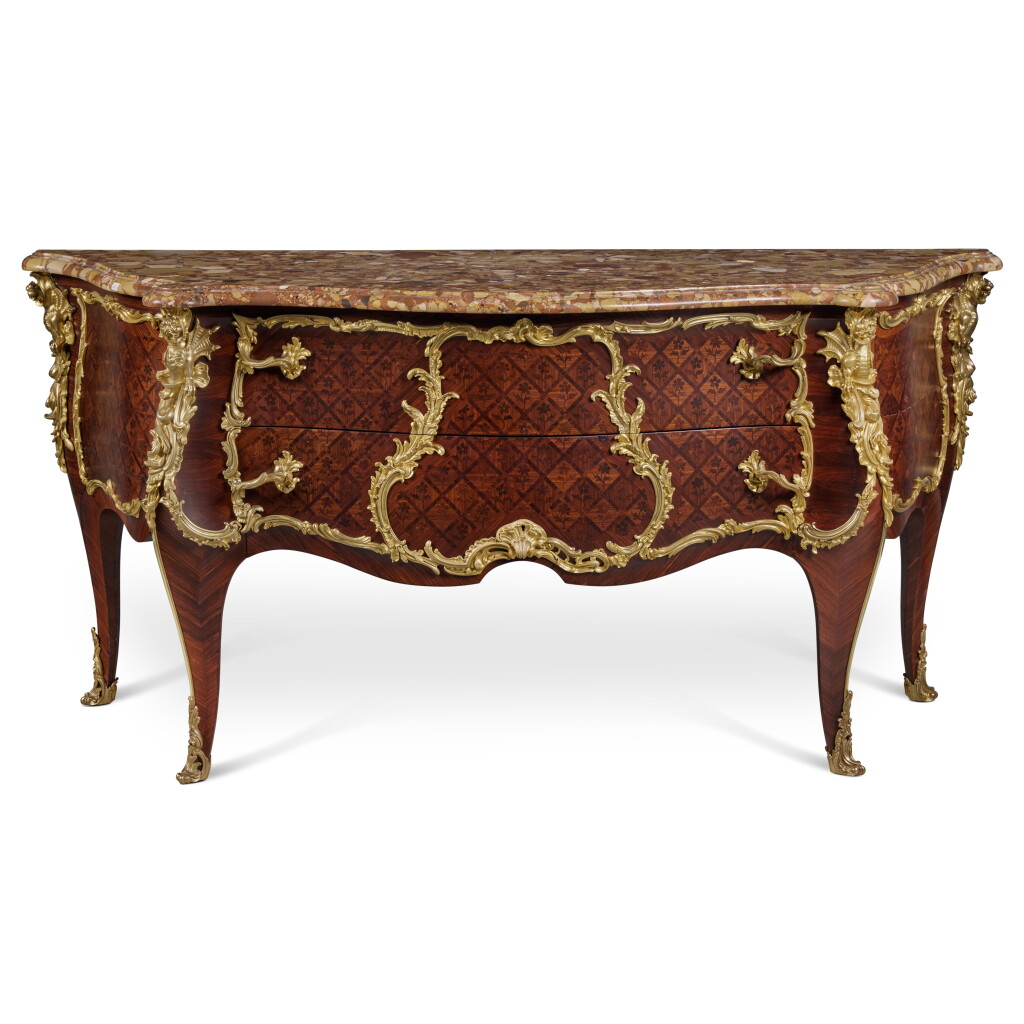
Property from a Florida Collection
Louis XV Style Kingwood, Tulipwood and Bois de Bout Marquetry Comomde by Paul Sormani, Circa 1870
Lot Closed
October 17, 03:12 PM GMT
Estimate
30,000 - 50,000 USD
We may charge or debit your saved payment method subject to the terms set out in our Conditions of Business for Buyers.
Read more.Lot Details
Description
with a brèche d'Alep marble top; top of lock plate stamped P. SORMANI PARIS 10 r. Charlot
height 36 3/4 in. width 76 1/2 in. depth 27 in.
93.5 cm; 194.5 cm; 68.5 cm
The large scale serpentine format and dragon-form mounts are inspired by the work of the royal cabinetmaker Antoine Gaudreau, seen in his masterpiece, the commode supplied in 1739 to the Chambre du Roi at Versailles and now in the Wallace Collection. This model was one of Sormani's most successful and technically accomplished re-interpretations of the high Louis XV style and confirmed his reputation as one of the leading Parisian furniture workshops of the second half of the nineteenth century. An identical commode by Sormani was acquired by Queen Pia Maria of Portugal as part of her refurbishment of the Ajuda Palace in Lisbon during the 1860s and 1870s and is still in situ (inv. 528; illustrated in Christopher Payne, Paris Furniture: The Luxury Market of the 19th Century, 2018 p. 515).
Born in Northern Italy in 1817, Paul Sormani was in Paris by 1847 and quickly became one of the leading luxury ébénistes of the Second Empire, supplying the court of Napoléon III and the Empress Eugénie and participating in the Expositions Universelles of 1855 and 1867. His workshop was located at 10 Rue Charlot in the Marais district, and after his death in 1877 was taken over by his widow and son under the name Veuve Sormani & Fils à Paris until the early 20th century when the premises were transferred to 134 Boulevard Haussmann in partnership with Thiébaux, trading until 1934.
You May Also Like