Exquisite Corpus: Surrealist Treasures from a Private Collection
Maison hantée
Auction Closed
November 21, 12:43 AM GMT
Estimate
500,000 - 700,000 USD
Lot Details
Description
Victor Brauner
(1903 - 1966)
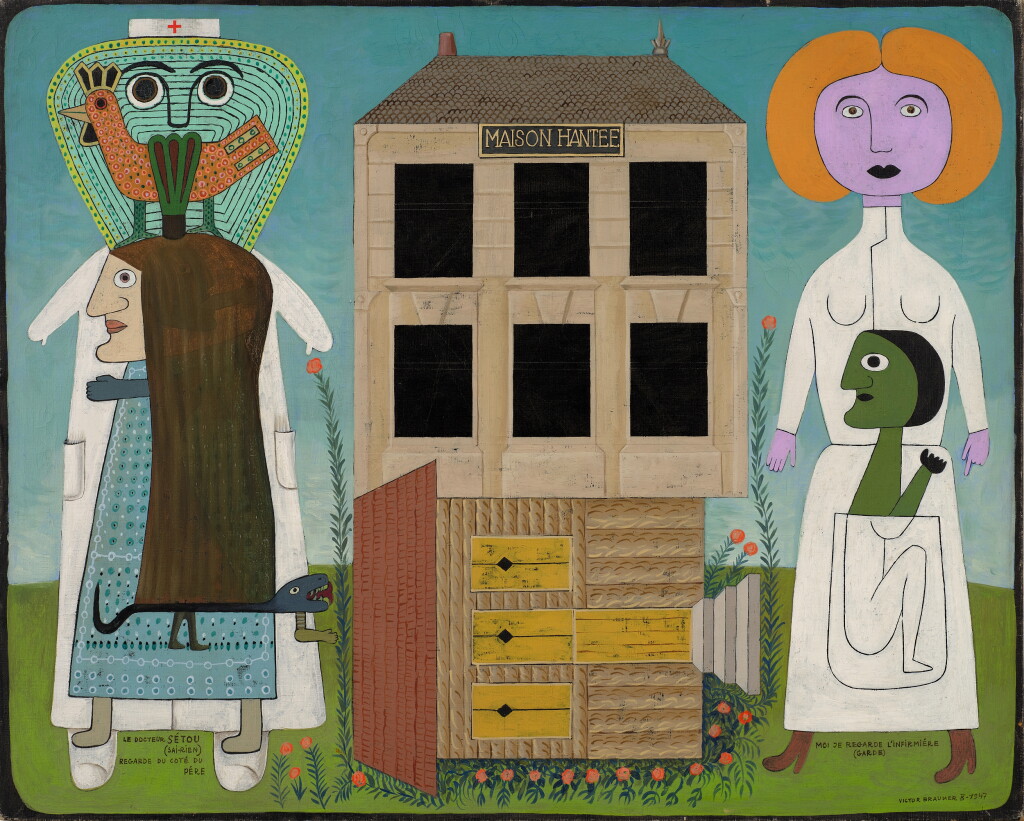
Maison hantée
signed VICTOR BRAUNER and dated 8-1947 (lower right)
oil on canvas
28 ⅞ by 36 ¼ in. 73.3 by 92 cm.
Executed in 1947.
Samy Kinge has kindly confirmed the authenticity of this work.
(possibly) Richard L. Feigen & Co., Chicago (acquired by May 1959)
Galerie Benador, Geneva
Acquired from the above by 1968 by the present owner
Chicago, Richard L. Feigen & Co., Victor Brauner: Paintings from 1932 to 1958, 1959, illustrated
New York, M. Knoedler & Co., Surrealism in Art, 1975, no. 15, p. 13, illustrated; p. 60
New York, Solomon R. Guggenheim Museum, Surrealism: Two Private Eyes, 1999, vol. I, no. 24, p. 74, illustrated in color
New York, Ubu Gallery, Victor Brauner, 2003-04, pl. 33, illustrated in color
Sarane Alexandrian, “La symbolique de Brauner,” Cahiers d’art, vol. 24, no. 2, 1949, p. 322, illustrated
Sarane Alexandrian, Dictionnaire de la peinture surréaliste, Paris, 1973, pp. 8-9, illustrated in color
Xavière Gauthier, “Le surréalisme et la sexualité,” Obliques, nos. 14-15, 1977, p. 44; p. 45, illustrated
Didier Semin, Victor Brauner, Paris, 1990, p. 186, illustrated in color; p. 311
Exh. Cat., Houston, The Menil Collection, Victor Brauner: Surrealist Hieroglyphs, 2001-02, pl. 55, pp. 45 and 124; p. 125, illustrated in color
André Breton, Écrits sur l’art et autres textes, œuvres complètes, vol. IV, Paris, 2008, p. 499, illustrated
Loaded with vibrant, eclectic imagery and bursting with bright hues, Victor Brauner’s Maison hantée forms part of the artist’s powerful body of work produced in the mid- to late 1940s, shortly after his return to Paris following the end of the Second World War. While displaying the uncanny undertones that highlight Brauner’s connection to the Surrealist milieu, the present work also foregrounds the artist’s deeply idiosyncratic visual lexicon that firmly sets him apart from other members of the Surrealist movement.
Brauner’s initial encounter with members of the Parisian Surrealist circle dates to the 1920s, when the Romanian-born artist divided his time between Paris and Bucharest, eventually settling in Paris in 1930. Through his neighbor, the Romanian sculptor Constantin Brancusi, Brauner met several leading members of the movement, including the painter Yves Tanguy and the group’s principal theorist André Breton. The latter became Brauner’s close friend and supporter, writing a preface to the catalogue of the artist’s first one-man exhibition at Galerie Pierre in 1934.
Having sought refuge in the Pyrenees and the Alps during the Second World War, Brauner returned to Paris in 1945, gradually reestablishing links with Breton and other Surrealists and participating in several group exhibitions, including the seminal 1947 show organised by Breton and Marcel Duchamp, Exposition internationale du surréalisme at the Galerie Maeght in Paris.
Yet only a year later, following accusations of ‘divisive activities,’ Brauner was ousted from the group by Breton. Viewed within the context of this watershed moment, Maison hantée, while undoubtedly paying homage to his Surrealist roots, is a work that witnesses Brauner at the precipice of a new, more personal and autonomous direction in his work.
In Maison hantée, an amalgamation of mysterious, whimsical creatures–part human, part animal hybrids–are positioned against the background of a bright blue sky. The eclectic imagery reflects a range of influences that were central to the formation of his creative imagination. As a boy, Brauner was exposed to séances regularly conducted by his father, whose diverse spiritual interests also included evangelical Christianity and the Jewish mystical tradition of Kabbalah. Such early influences and experiences fostered in him a lasting openness towards various occult and esoteric practices.
With their flattened features outlined in black, large piercing eyes and brightly coloured faces, the totemic creatures populating the two sides of the painting recall religious deities—a possible reference to Brauner’s native Romanian folk traditions or the Aztec imagery he had been drawn to throughout his career. The serpent, the bird and the childlike figure on the right (the latter conjuring themes of fertility and the divine feminine), as well as the floral patterns adorning the central house elements, are particularly evocative of the imagery found in Aztec codices.
The style and positioning of the figures is likewise suggestive of the imagery found in Tarot cards which were used throughout Europe from around fifteenth century onwards in divination practices and regularly appears in Surrealist art. Just a few years prior, in 1940-41, a group of Surrealist artists including Brauner produced their own illustrated deck of cards likely inspired by Tarot.
A further influence for Brauner during this period was the work of Henri “Le Douanier” Rousseau, whose Paris studio Brauner moved into in 1945. A year later, Brauner produced a painting La rencontre du 2 bis, rue Perrel directly inspired by Rousseau’s well-known canvas La Charmeuse de serpents from 1907. The simplified, flattened shapes and the deliberate lack of depth Brauner employs in the present work can be read as continuing in the ‘naive’ tradition pioneered by Rousseau.
In La Maison hantée, Brauner synthesizes this array of aesthetic influences with the prevailing concerns and motifs of his Surrealist contemporaries, for example the iconic nocturnal subject of a house with blackened windows set against a sky of daytime blue. His juxtaposition of night and day, the visible and the hidden, the real and the perceived, was central to Surrealist imagery—most famously in Magritte’s celebrated series L’Empire des lumières, which he begun in the 1940s. Equally aligned is the humorous play on words which Brauner employs in the inscriptions visible underneath the two central figures (“Le Docteur Sétou (sai-rien) regarde du coté du pére” and “Moi je regarde l’infirmiére (garde)”), evincing the fundamental role of play in the Surrealist ethos.
In the present work, the characteristic themes and images of Surrealism are transformed into a more personal, introspective vision. The hybrid beings and symbolic motifs no longer merely evoke the unconscious, but suggest a self-contained cosmology rooted in myth and spiritual transformation. The painting thus marks a key moment of transition—bridging Brauner’s Surrealist foundations and the autonomous, deeply individual language that came to define his mature style.
Never before appearing at auction, the present work has been held in the same distinguished private collection for almost sixty years. It has been widely exhibited in the United States, including the 1959 Brauner exhibition at Richard Feigen’s gallery in Chicago; the 1975 Surrealism in Art exhibition at the Knoedler Gallery in New York; and in 1999, the seminal Surrealism: Two Private Eyes exhibition at the Solomon R. Guggenheim Museum in New York.
You May Also Like