View full screen - View 1 of Lot 7. La Révélation du présent.

Exquisite Corpus: Surrealist Treasures from a Private Collection

René Magritte

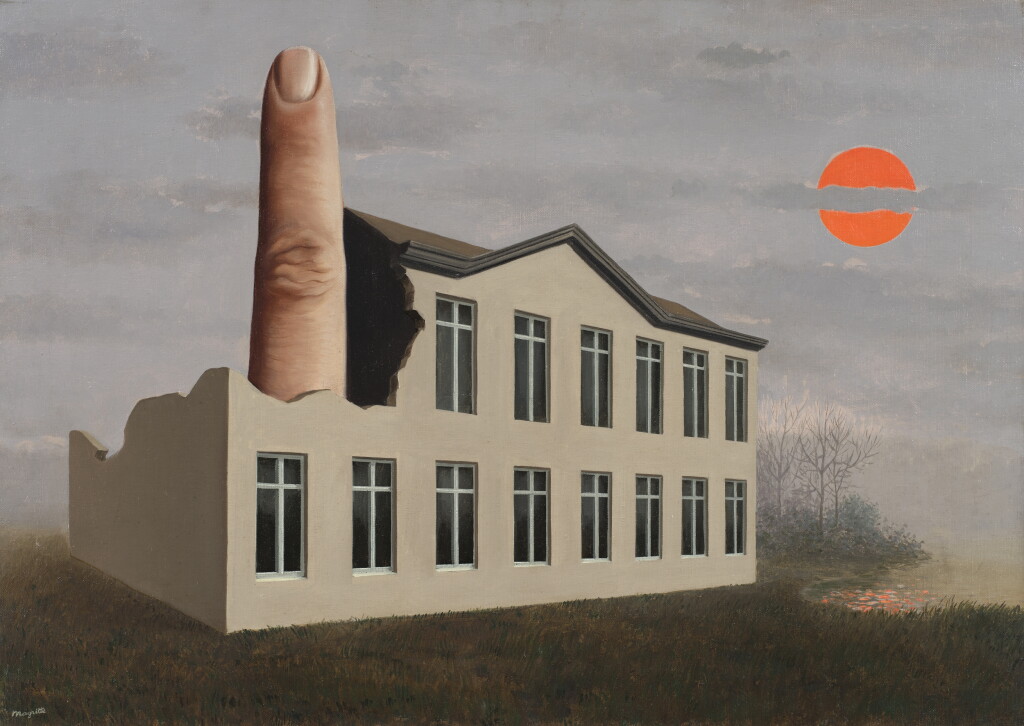
La Révélation du présent

Auction Closed

November 21, 12:43 AM GMT

Estimate

2,000,000 - 3,000,000 USD

Lot Details

Description

René Magritte

(1898 - 1967)


La Révélation du présent

signed Magritte (lower left); signed again, titled and dated 1936 (on the reverse)

oil on canvas

18 ¼ by 25 ¾ in.    46.4 by 65.5 cm.

Executed in 1936.

E.L.T. Mesens, London and Brussels (acquired by 1939 and until at least 1956)

Marc Hendrickx, Brussels (acquired by 1965)

Galerie André Petit, Paris

Byron Gallery, New York

Acquired from the above by 1968 by the present owner

Brussels, Palais des Beaux-Arts, René Magritte: peintures, objets surréalistes, 1936, no. 17

New York, Julien Levy Gallery, René Magritte, 1938, no. 10

London, The Lefevre Gallery, René Magritte, 1953, no. 12, p. 2, illustrated; p. 3

Brussels, Palais des Beaux-Arts, René Magritte, 1954, no. 52, p. 31

Charleroi, Salle de la Bourse, XXXme Salon du Cercle Royal Artistique Littéraire, 1956, no. 61, n.p.

New York, Byron Gallery, René Magritte, 1968, no. 9, p. 19, illustrated in color

Brussels, Palais des Beaux-Arts and Paris, Centre Pompidou, Rétrospective Magritte, 1978-79, no. 116, n.p., illustrated

New York, Solomon R. Guggenheim Museum, Surrealism: Two Private Eyes, 1999, vol. I, no. 133, p. 197, illustrated in color

Patrick Walberg, René Magritte, Brussels, 1965, p. 240, illustrated in color; p. 350

A.M. Hammacher, René Magritte, New York, 1973, fig. 24, p. 24, illustrated

Sarane Alexandrian, Dictionnaire de la peinture surréaliste, Paris, 1973, p. 37, illustrated in color

Alain Robbe-Grillet, La Belle Captive, Paris, 1975, pp. 104-05, illustrated

Jacques Baron, Anthologie plastique du surréalisme, Paris, 1980, p. 166, illustrated in color

René Passeron, René Magritte, New York, 1980, pp. 70-71, illustrated in color

David Sylvester and Sarah Whitfield, René Magritte: Catalogue Raisonné, vol. II, London, 1992, no. 401, p. 219, illustrated

Among the most distinctive characteristics of René Magritte’s idiosyncratic visual language is his inimitable use of the epigram. At Magritte’s hand, the rhetorical device was employed to ends beyond the mere witty recapitulation of an idea or an image, but rather, and somewhat paradoxically, as a means of understanding the original image itself. “His aim,” writes his biographer David Sylvester, paraphrasing the artist’s own assessment of his project, “was to discover the property which belonged indissolubly to an object but which seemed strange and monstrous when the connection was revealed; what preoccupied him was the shock induced when this knowledge was given concrete expression” (David Sylvester, Magritte, p. 220). Executed in 1936, La Révélation du présent marks a pivotal breakthrough within this investigation.


Magritte explained that the seminal point of departure for the broader project was a nocturnal hallucination which prompted him to become aware of the method he had been working with, and the ambition he was working towards: “One night in 1936, I awoke in a room in which a cage and the bird sleeping in it had been placed. A magnificent error caused me to see an egg in the cage instead of the bird. I then grasped a new and astonishing poetic secret, because the shock I experienced had been provoked precisely by the affinity of two objects, the cage and the egg, whereas previously I used to provoke this shock by bringing together objects that were unrelated. Ever after that revelation I sought to discover if objects other than the cage could not likewise manifest… the same evident poetry that the conjunction of the egg and the cage had succeeded in producing” (quoted in Suzi Gablik, Magritte, London 1985, p. 101). The revelations held within these “Elective Affinities,” so-named for the eponymous painting of the incendiary caged egg, were achieved through a process of tireless trial and error. One of the earliest motifs for whose “problem” Magritte endeavored to find a solution was the house.


A series of sketches which Magritte presented to his friend Louis Scutenaire and his wife, the journalist Irene Hamoir, reveal countless attempts at depicting the house in combination with different objects in order to locate the shock within the image. He eventually arrived at his first solution: L'Éloge de la dialectique. There Magritte paints a closely cropped view of the upper right corner of a house, its window open to reveal a room within which sits another house in miniature. In so doing, Magritte engages with and literalizes the notion of ‘containment’ or perhaps, more evocatively, of ‘inhabitance,’ both of which we already associate with the image of a house. It is, in many ways, the most and least obvious resolution, in that the answer turned out to be the very same as the problem itself. Such was, as Sylvester explains, the nature of the exercise: “how difficult the process of discovery was yet how self-evident the solution seemed once found” (ibid.).


Shortly thereafter, Magritte arrived at the combination which he painted in La Révélation du présent—what Sylvester describes as an “anarchic corollary” to L'Éloge de la dialectique. Here, Magritte begins with the conventional image of a house, innocuously placed at the edge of a lake within a nondescript landscape. The shock comes in the form of a grossly magnified finger which bursts through the roof from inside. In its placement, the mind draws a visual parallel to a chimney, only to be jolted into the disorienting realization that the finger is wholly out of place. The effective impact of this combination lies in the conceptual proximity of its two elements. The finger, a metonym for a person, is by that association a logical accompaniment to a house. It is in many ways an effect similar to that which is achieved in his 1938 canvas La Durée poignardée in which he depicts a steam train emerging from the fireplace, and in turn calls upon the uncanny resemblance of the fireplace to a tunnel. This visual parity enables a logical progression which does not pose an immediate disruption to either of the two elements, nor to the narrative of the composition. It is precisely the fact that perhaps, at first, the eye does not question the apparent absurdity of their combination which makes their pairing all the more mysterious.


Writing in retrospect in 1959, Magritte recalls the genesis of the imagery for La Durée poignardée, a process of ideation which, when reapplied to the elements within the present work, in many ways elucidates the impact of its imagery. “I decided to paint the image of a locomotive. Starting from that possibility, the problem presented itself as follows: how to paint this image so that it would evoke mystery… The image of a locomotive is immediately familiar; its mystery is not perceived. In order for its mystery to be evoked, another immediately familiar image without mystery [must be paired with it]…” Magritte then goes on to locate the genesis, or rather the psychology behind the source of inspiration for their combination: “I thought of joining the locomotive image with the image of a dining room fireplace in a moment of ‘presence of mind.’ By that I mean the moment of lucidity that no method can bring forth. Only the power of thought manifests itself at this time. We can be proud of this power, feel proud or excited that it exists. Nonetheless, we do not count for anything, but we are limited to witnessing the manifestation of thought. When I say ‘I thought of joining, etc…’ exactitude demands that I say ‘presence of mind exerted itself and showed me how the image of a locomotive should be shown so that this presence of mind would be apparent.’... The word idea is not the most precise designation for what I thought when I united a locomotive and a fireplace. I didn’t have an idea; I only thought of an image” (Letter from René Magritte to Hornik, 8 May 1959, quoted in Harry Torczyner, Magritte: Ideas and Images, New York 1977, pp. 81-82).


The presence of mind which Magritte describes as enabling the combination to take shape for him as artist is in many ways transitively extended onto the mode of viewership in which the audience to the work receives the composition. Though at first beguiling, it is a moment of lucidity which allows for the combination of the finger and the house, or the train and the fireplace, to reveal a mysterious affinity between two objects which we would otherwise never think to place together, let alone understand as connected. It is precisely this uncanny quality of their pairing which places La Révélation du présent as a novel expansion upon the lineage of works which, employing the same iconography, were foundational to the development of Surrealism at large. The rupture of the house by the finger has already taken place, the missing piece entirely disappeared, the surface of the water is undisturbed, the trees are still, the house empty, the windows dark, all of which is amplified by the gentle mist which encroaches on the foreground. It begs the question of what will happen next—or rather, what can happen next.