
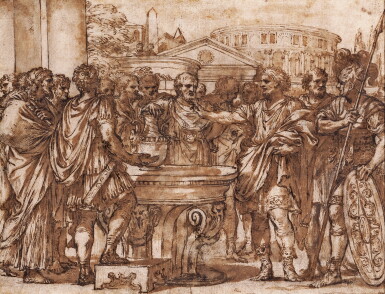
Ciro Ferri
Recto: Julius Caesar preferring his Agrarian Law Verso: A partial male figure study and a study of a kneeling child with clasped hands
Auction Closed
January 31, 08:10 PM GMT
Estimate
50,000 - 70,000 USD
Lot Details
Description
Ciro Ferri
Rome 1633 - 1689
Recto: Julius Caesar preferring his Agrarian Law
Verso: A partial male figure study and a study of a kneeling child with clasped hands
pen and brown ink and wash over black chalk (recto); pen and brown ink and red and black chalk (verso);
signed in brown ink, verso: Io Ciro Ferri
9 ¼ by 12 in.; 235 by 307 mm
Thomas Coke, 1st Earl of Leicester, his mount with attribution in pen and brown ink Ciro Ferri in Thomas Pelletier's hand (?), Holkham Hall (original mount no longer with drawing);
Sale, London, Christie's, 2 July 1991, lot 50;
With Flavia Ormond, London, Italian Old Master Drawings 1550-1800, 1992, no. 17, reproduced;
With Artemis Fine Arts Ltd, London;
From whom acquired.
London, Thomas Agnew and Sons Ltd., Old Master Drawings from Holkham, 1977, no. 78.
K. Andrews, National Gallery of Scotland Catalogue of Italian drawings, Cambridge 1968, vol. I, p. 50, under no. D. 1770;
A.E. Popham, C. Lloyd, Old Master drawings at Holkham Hall, Chicago 1986, no. 119;
B.W. Davis, The drawings of Ciro Ferri, New York and London 1986, p. 219, pl. 64.
The early fame of this impressive and appealing drawing is demonstrated by the existence of a number of copies: one is in the National Gallery of Scotland, another in the Kunstmuseum in Düsseldorf, and a third formerly in the Weld collection, Lulworth Manor, now in the Walker Art Gallery, Liverpool.1 The design was also engraved as the work of Ciro Ferri by Simon Watts in 1769, when the copy now in the National Gallery of Scotland was in the collection of Charles Rogers (1711-1784).2 Certainly the most talented and loyal of the pupils of Pietro da Cortona, Ferri began his training in Rome at a young age, around 1650. He seems to have a close relationship with his master that lasted for about twenty years, and Ferri was to become the best advocate for Cortona’'s legacy. In fact, Ferri was chosen as the artist to complete a number of important works left unfinished at Cortona's death, for instance the fresco decorations of the ceiling of the Sala di Apollo (1659-61) and the Sala di Saturno in the Palazzo Pitti, Florence (the latter carried out mostly to his own designs, in 1663-65).
The strong Cortonesque quality of the present drawing has often been noted. The sheet, signed on the verso,3 is highly finished, and washed with subtlety and delicacy; the crowded composition with its large foreground figures is skillfully punctuated by the sturdy architecture behind. The all'antica treatment of the figures witnesses the artist's focus on antique reliefs, and like his master Cortona, his devotion to studying from the Antique, which must have contributed to the formation of his early style.
The provenance of this drawing is highly prestigious, originating as it does from the collection of the famous eighteenth-century collector and patron Thomas Coke, 1st Earl of Leicester (1697-1759). Coke’s great love for Italian art was sparked by his Grand Tour, undertaken at the age of just fifteen, which lasted six years, from 1712 until 1718. For most of this time he stayed in Italy, and mainly in Rome.
1. Edinburgh, National Gallery of Scotland, inv. no. D1770; Düsseldorf, Kunstmuseum, inv. no. 1579. For the Edinburgh copy see Keith Andrews, Catalogue of Italian Drawings, vol. I, p. 50, cat. D 1770, vol. II, fig. 357
2. Prints in Imitation of Drawings, London: Printed by J. Nichols and sold by J. Boydell, 1778
3. The signature was revealed only when the drawing was lifted from the old mount (see Provenance)


