Property from a Distinguished North American Collection
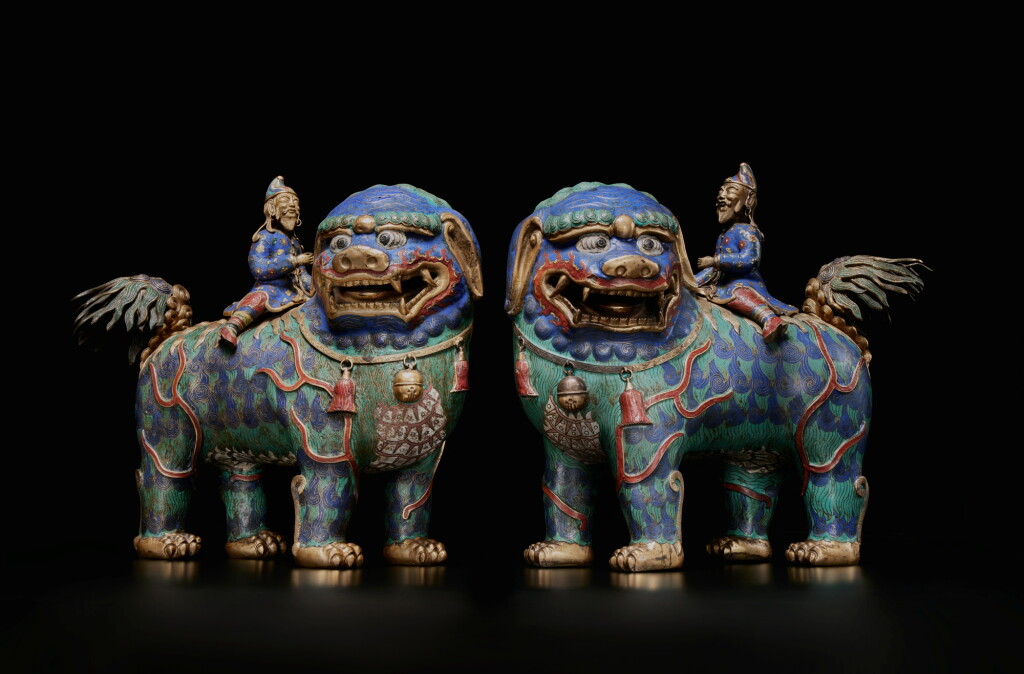
A pair of large cloisonné-enamel 'lion and foreigner' censers, Qing dynasty, Qianlong period
Auction Closed
September 18, 08:03 PM GMT
Estimate
250,000 - 350,000 USD
Lot Details
Description
wood stands (6)
Width 21½ in., 54.5 cm
Frank Caro, successor to C.T. Loo, New York, December 1960.
Collection of Mrs. Amon G. Carter, Jr. (1927-2022).
Standing guard, their tails flapping in the wind, these imposing lion figures are a rare delight. While cloisonné censers in the form of animals are rare in their own right, to find a matching pair of imperial quality together with riders is almost unprecedented. Two pairs of cloisonné lions from the Qing Court Collection are known: one in the collection of the Palace Museum, Beijing, illustrated in Gugong Bowuyuan cangpin da xi: falangqi bian / Compendium of Collections in the Palace Museum: Enamel Edition, vol. 4, pl. 80; the other in the Palace Museum, Taipei, illustrated in Enamel Ware in the Ming and Ch'ing Dynasties, Taipei, 1999, pl. 69; Compare also a third pair of a more elongated style from the collection of the late Ritter Rudolf von Gutmann, each supporting brocade spheres, sold in our London rooms, 30th October 1987, lot 385.
Lions have long been associated with Buddhism, royalty and splendor in Chinese tradition. Not indigenous to China, lions were imported as exotic gifts from as early as the Han and Tang dynasties. The symbolism associated with the lion developed with the introduction and spread of Buddhism in China after the fall of the Han dynasty and, by the Qing dynasty, became a common feature of imperial works of art. Still recognizable at the entrances to palaces in the Forbidden City and Buddhist temples across the world, pairs of lions – sometimes known colloquially in English as 'foo dogs' – are said to protect the entrance of a building from threats both spiritual and physical.
No other lion censers of this style with riders appear to have been published. Compare two closely related lion censers without riders: one in the Brooklyn Museum, illustrated in John Getz, Catalogue of the Avery Collection of Ancient Chinese Cloisonnés, New Work, 1912, pl. 66; the other – with an opening for incense on its back – was exhibited at the Victoria and Albert Museum in C.I.N.O.A Third International Art Treasures Exhibition, London, 1962, cat. no. 569 and later sold at Christie's London, 15th May 2007, lot 132. Compare also a related group of cloionné elephants ridden by foreign mahouts, including one from the estate of Lady Christian Hesketh, sold in our London rooms, 7th March 2007, lot 71; and another of an elephant with two riders holding a kalasha, sold in our London rooms, 12th March 1982, lot 199.
You May Also Like