
Property from a New York Private Collection
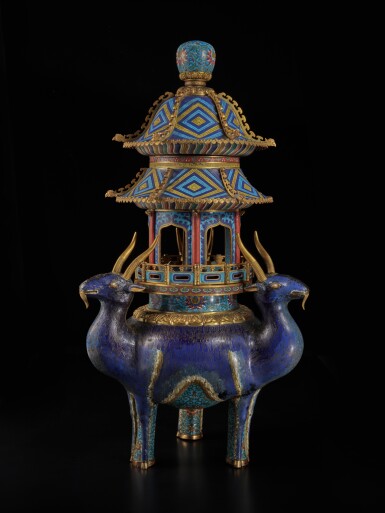
A massive and extremely rare cloisonné enamel 'sanyang' censer, Qing dynasty, Qianlong Period
Auction Closed
September 18, 08:03 PM GMT
Estimate
100,000 - 150,000 USD
Lot Details
Description
(7)
Height 46 in., 116.8 cm
Spink & Son, Ltd., London, 5th July 1965.
This massive censer is a classic example of Qing imperial cloisonné in terms of its elaborate design and scale. Its cover takes the form of a pagoda, a popular design feature at the Qing court. A pair of cylindrical censers with pagoda tops can be seen, for example, on either side of the imperial throne in the Qianqing Hall (乾清宮) of the Forbidden City, as illustrated in Chuimei Ho and Bennet Bronson, Splendors of China's Forbidden City - The Glorious Reign of Emperor Qianlong, London, 2004, pls 32 and 34, pp 47-48.
The censer is resting on feet in the form of three rams, another popular motif at the Qing court. The ram (or goat), yang, is a traditional emblem of good fortune, as it is a homophone of the term for 'sun', thus referring to the positive principle. Three rams, san yang, evoke the expression 'san yang kai tai', 'the awakening of nature in spring', which equally signifies good fortune and happiness, and therefore became a popular design conveying auspicious blessings for the new year. Compare a yellow jade zun in similar design, from the Palace Museum, Beijing, illustrated in Yang Boda, Chinese Jades throughout the Ages, vol. 12, Hong Kong, 1997, pl. 37.
A related pair of large incense burners with pagoda form covers is on display at the Wallace Collection, London, and published online (accession nos OA2367 and OA2368); and a related censer with three feet in ram form, but attributed to the Jiaqing period, sold in our London rooms, 4th May 1984, lot 465; another of smaller size, sold at Christie's London, 15th May 2012, lot 100. A pair of large cloisonné enamel incense burners in the collection of the British Museum, each resting on three feet in the form of cranes, is illustrated in Jessica Rawson, The British Museum Book of Chinese Art, London, 1992, pl. 142, p. 189.
Related censers cast in bronze can be seen throughout the Imperial Gardens of the Forbidden City, in the grounds of the Palace Museum, Beijing, as illustrated in Zhang Li, 'Qinggong tongqi zhizao kao. Yi Yong, Qian er chao weili. [Study of bronze production at the Qing court from examples of Yongzheng and Qianlong era]', Gugong Bowuyuan yuankan / Palace Museum Journal , 2013, vol.5, pl. 5:1, p. 99; another large bronze incense burner with three crane-form feet, of Qianlong six-character mark and period, is on display in the garden of Chonghua Palace, also in the Palace Museum, see Zhang Li, op. cit., pl. 7:1, p. 100.
You May Also Like


