
Diidja
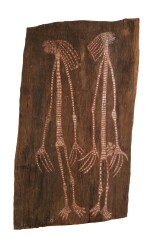
Male and Female Namorrordo, Spirits of the Shooting Star
Auction Closed
May 23, 09:01 PM GMT
Estimate
12,000 - 18,000 USD
Lot Details
Description
Diidja
circa 1900-1982
Male and Female Namorrordo, Spirits of the Shooting Star, 1966
Natural earth pigments on eucalyptus bark
37 in x 21 ¼ in (94 cm x 54 cm)
Lance Bennett, acquired from the artist at Mudjinberri (Mudjinbardi), 1966
The Thomas Vroom Collection, The Netherlands
Sotheby's, London, Aboriginal Art - Thomas Vroom Collection, June 10, 2015, lot 21
Private Collection
Lance Bennett's accompanying biographical documentation reads:
"A good-natured, friendly man with a boyish engaging grin and a keen enthusiasm for the ritual life, Diidja displayed the lively and direct sense of humour typical of so many western and south-central Arnhem Landers. Born about 1890 in the country known as Godwaliwali at the headwaters of the East Alligator River, as a young man he lived for some years near Beswick Creek, he later worked on a peanut farm near Katherine; then on a tin mine near the township of Pine Creek. He spent the war years labouring for the military in Pine Creek. After the war he worked on Goodparla cattle station, mustering bullocks. He finally retired to various bush locations in the Alligator Rivers region and in western Arnhem Land. In large holes in the vast rocky Arnhem Land plateau, which the Aborigines refer to as 'the stone country' live malicious spirits called Namorrordo. These are long-haired people with very thin bodies ('just a little muscle over their bones') and long, slender fingers tipped with long nails. Namorrordo are considered to be dangerous to humans. In the daytime, they stay quietly in their cool holes in the stone country. At dusk they begin to prowl abroad, uttering a high-pitched cry: 'Go-wed!'. After nightfall, they go on a 'sneaking walkabout' across the sky, looking for a solitary, sleeping Aborigine whose liver and kidney they will remove. This is a practice also favoured by malicious human sorcerers: when the victim awakens, there is no mark on his or her body. In three of four days the person dies. Namorrordo were sometimes glimpsed on their prowls by the 'old people' (past generations), who would subsequently paint the image on a rock face or on the inner walls of their bark huts so as to show people what a namorrordo looked like. Today namorrordo are always invisible to people except when, during their night-time prowls in the sky, they show themselves for a few seconds as a falling star diving across the heavens. Here, Diidja has shown a male and a female namorrordo. This bark was painted for Lance Bennett during one of his visits to the small Aboriginal community on Mudjinberri cattle station, between the South and East Alligator Rivers, in the dry season of 1966."
Image Credits
Diidja © Estate of Lance Bennett
You May Also Like


