Collecting Charles Dickens: From First Editions to Fine Bindings
Inside the world of rare Charles Dickens books, from the first printing of A Christmas Carol to lavishly bound limited editions of his collected works.

Charles Dickens knew how to keep readers waiting. Long before novels could be purchased in their entirety, many of his most celebrated works appeared in monthly or weekly installments, with audiences following the fortunes of his characters as each new chapter arrived. This approach helped make Dickens one of the most widely read authors of the Victorian era, but it also created a publishing history that can be surprisingly complicated to navigate. First editions, early impressions and later collected works each tell a different part of that story.
Consider A Christmas Carol. Published in December 1843, the book sold more than 6,000 copies before Christmas, prompting additional printings in quick succession. Dickens had insisted on an unusually elaborate production, complete with hand-colored illustrations and decorative cloth binding. The result was an immediate commercial success, although its expensive production left the author with far less profit than he had anticipated. Nearly two decades later, Great Expectations would present collectors with another bibliographical puzzle, as successive impressions of its 1861 three-volume edition appeared with altered title pages.
For those interested in Charles Dickens first editions and rare books, understanding these publishing details is central to collecting his work. Original Victorian editions preserve the books as their earliest readers encountered them, while later productions such as the Nonesuch Dickens demonstrate how publishers continued to reinterpret his writing through fine printing and illustration. Together, these editions offer a fascinating record of how Dickens's books were produced, read and collected across generations.
| Collecting Consideration | What Collectors Should Know |
|---|---|
| First Editions and Issue Points | Early Dickens editions can have multiple issues or impressions, distinguished by changes to title pages, text and binding details. |
| Original Victorian Bindings | Copies retaining their original publisher's cloth are often desirable, especially when the gilt decoration and binding structure remain well preserved. |
| Illustrations | Original illustrations by artists such as John Leech are integral to Dickens's publishing history. Their completeness and condition are important when evaluating a copy. |
| Early Impressions | Works such as Great Expectations appeared in rapid successive impressions, making bibliographical references essential for identifying the earliest printings. |
| Limited Editions and Fine Bindings | Later editions, including the 1937–38 Nonesuch Dickens, are collected for their printing quality, illustrations and limited production. |
| Condition and Completeness | Original cloth, intact plates, complete volumes and minimal restoration can significantly influence desirability and value |
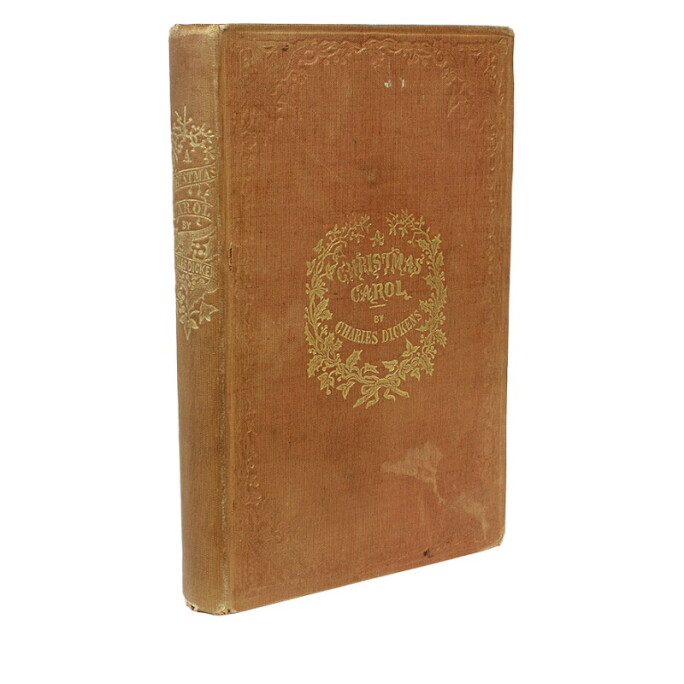
When A Christmas Carol appeared on 19 December 1843, Dickens had unusually specific ideas about how the book should look. He wanted something readers could give as a Christmas present, commissioning illustrations by John Leech and insisting on an elaborate presentation that included hand-colored plates and gilt-decorated cloth. The expense of producing the book ate into his profits, even as more than 6,000 copies sold within days. Its success prompted Dickens to publish four additional Christmas books through 1848, each continuing his interest in social inequality and the possibility of personal reform.
The distinction between early copies of A Christmas Carol is an important part of collecting Dickens. A first-edition, first-issue copy accompanied by all four subsequent Christmas Books retains the original gilt-decorated cloth bindings, with the Carol exhibiting identifying points including the “Stave I” reading and green endpapers. A separate first-edition, second-issue copy features yellow endpapers and the original rose-colored cloth, alongside Leech's four hand-colored engraved plates. Both illustrate how small production changes can distinguish copies published during the book's earliest circulation, making precise issue identification essential when evaluating Charles Dickens first editions.
Published in three volumes by Chapman and Hall in 1861, Great Expectations followed its serialization in Dickens's weekly journal All the Year Round. Unlike his earlier novels issued in monthly parts, the book reached readers in a complete three-volume format while its final weekly installments were still appearing. Demand prompted several impressions in quick succession, creating a bibliographical distinction that continues to matter when identifying early copies. Although the title pages of these printings refer to second, third and subsequent editions, the first five are generally regarded as impressions of the same edition, with differences largely confined to title-page wording and evidence of wear to the type.
A three-volume set of Great Expectations published in 1861 illustrates this distinction, comprising second, second and third impressions in contemporary half calf over marbled boards. The set lacks the publisher's catalogue sometimes found at the end of the third volume, although bibliographer Walter E. Smith noted that some copies of the first five impressions were issued without one. Such details make Great Expectations an instructive example of why collectors must look beyond the edition statement on a title page. Establishing the precise impression, checking the completeness of all three volumes and assessing the binding are essential to understanding an early copy's place in the novel's publication history.
Nearly seventy years after Dickens's death, the Nonesuch Press undertook an ambitious project: producing a definitive collected edition of his works using illustrations printed from the original engraved plates. Published between 1937 and 1938 under the editorship of Arthur Waugh and others, the edition was limited to 877 sets. Its production owed much to American publisher George Macy, whose involvement helped revive the financially struggling Nonesuch Press during the 1930s. The result was a carefully designed edition that brought Dickens's original illustrations together with a text based on the Charles Dickens Edition, the last collected edition revised by the author himself.
A 25-volume set of The Nonesuch Dickens, numbered 433 of 877, retains its publisher's varied cloth bindings with morocco spine labels. Accompanying the books is an original steel printing plate depicting Fagin in the Condemned Cell from Oliver Twist, together with a letter of authenticity from the publisher. Each set was issued with an original illustration plate, giving the edition a direct connection to the production of Dickens's illustrated works. This combination of limited production, original printing materials and carefully considered book design has made the Nonesuch edition an important achievement in 20th-century fine press publishing.
By the early 20th century, Dickens's novels had long since become established classics, and publishers increasingly produced collected editions intended for private libraries. These sets offered readers the opportunity to own his works in uniform bindings, often with illustrations drawn from earlier publications. Fine bindings became an important part of their appeal, with materials such as morocco leather and gilt decoration reflecting the craftsmanship of traditional bookbinding. Unlike original Victorian editions, these later productions were conceived as complete collections, bringing together works that had first appeared over several decades.
Published by Chapman and Hall in 1929, a 40-volume limited edition of The Works of Charles Dickens demonstrates this approach. Limited to 150 copies for Great Britain and 150 for America, the set features illustrated title pages and illustrations throughout. Its half blue morocco bindings over blue linen boards are finished with gilt-lettered spines and marbled endpapers. For collectors interested in Charles Dickens books beyond first editions, comprehensive sets such as this offer a different expression of his publishing history, with the quality of the bindings and completeness of the volumes central to their appeal.
The value of a Charles Dickens first edition depends on its printing history, condition and completeness. Identifying the correct issue or impression is essential, especially for works such as A Christmas Carol and Great Expectations, where early copies contain subtle bibliographical differences. Original publisher's bindings, intact illustrations and minimal restoration can influence desirability, while provenance or a documented association with Dickens may further distinguish a copy. Later limited editions are evaluated differently, with attention to the quality of their production, bindings and any accompanying original materials.
Collecting Dickens also means deciding which aspect of his publishing history matters most. An original Victorian edition preserves the physical form in which his earliest readers encountered the work, while a fine press production such as the Nonesuch Dickens reflects the care later publishers devoted to presenting his writing. From individual first editions to comprehensive sets, these books offer different ways to build a collection around one of Britain's most celebrated novelists.
A first edition refers to copies printed from the original setting of type, while a first issue identifies an earlier form within that edition. Bibliographical points such as textual corrections, title-page changes and binding details help establish the issue. These distinctions are especially important for A Christmas Carol.
Commonly cited first-issue points include the “Stave I” heading, green endpapers and an unbroken “D” in Dickens on the gilt-stamped front cover. Collectors should examine these alongside the title-page setting and other bibliographical details, as individual points alone may not establish priority.
The first five printings of Great Expectations are generally classified as impressions of the first edition, despite title pages identifying later printings as separate editions. Differences in type wear and other printing details help distinguish them.
Published in 1937–38 and limited to 877 sets, the Nonesuch edition includes illustrations printed from original plates. Each set was accompanied by an original illustration plate, making completeness and the authenticity of the accompanying plate important considerations.
Yes. Limited production, binding quality, completeness and condition can make later editions desirable. Sets such as the 1929 Chapman and Hall Works of Charles Dickens are collected for their craftsmanship and presentation rather than their status as original publications.
Whether you’re a seasoned bibliophile or new to the world of collecting, Sotheby’s offers a trusted, seamless way to buy and sell rare books and manuscripts on the secondary market.
Trust our worldwide network of leading book specialists from a globally renowned auction house established in 1744.