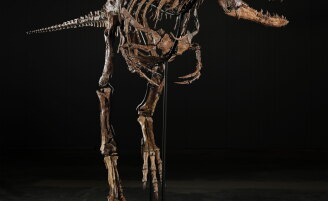
Nanotyrannus or juvenile T-Rex? For more than 80 years, paleontologists debated whether small tyrannosaurid skeletons like “Jodi” were young T-Rex or a distinct genus. Last fall, a paper by Drs. Lindsay Zanno and James Napoli resolved it.
Nanotyrannus was its own predator: fast, highly specialized, living alongside T-Rex at the end of the Cretaceous, about 67 million years ago. Adults measured approximately 18 feet to T-Rex's 40. Longer forelimbs. Larger hand claws. More teeth. Over 150 morphological differences in all.
“Jodi” is one of only three such skeletons known to science, and the first Nanotyrannus to come to market since the genus was confirmed. With a virtually complete skull, it is second only to “Bloody Mary,” one half of the celebrated “Dueling Dinosaurs.”

Rancher Jodi Pierson discovered it in 2019 in the Hell Creek Formation, on her land in Garfield County, Montana, eight miles from the “Dueling Dinosaurs” dig site. It was excavated by her cousin, commercial paleontologist Clayton Phipps, the “Dinosaur Cowboy.”
“Jodi” goes on public view at Sotheby's New York at the Breuer from 13 October, ahead of a dedicated live auction on 27 October.