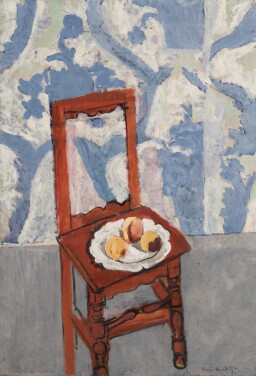
What appears at first to be a simple still life becomes, in the hands of Henri Matisse, something radically modern. In La Chaise lorraine, Matisse transforms an ordinary chair, peaches, and patterned textiles into an exploration of perception itself — flattening space, layering multiple viewpoints, and leaving behind “ghost images” that reveal earlier versions of the composition. Created in 1919, the painting emerged at a pivotal moment in modern art, as artists grappled with the revolutionary spatial ideas of Paul Cézanne and Pablo Picasso.
Matisse approached the challenge differently from his contemporaries: not through abstraction, but through emotion, color, and lived experience. He turned a chair into one of the most psychologically charged and formally inventive paintings of the 20th century. Coming to auction this May from the legendary collection of Josef Mueller and the Barbier-Mueller family, La Chaise lorraine stands as a masterclass in how Matisse transformed ordinary objects into emotional and perceptual experiences.
Sotheby’s is proud to present this work by Matisse, as a part of the Modern Evening Auction, presented by CELINE, on 19 May at the historic Breuer building in New York.