
Dinmore Manor, Herefordshire
S otheby’s is delighted to present a distinguished private collection from the historic estate of Dinmore Manor. Offered across a series of upcoming sales, the collection brings together English and Continental furniture, sculpture, and paintings, reflecting a broad range of collecting interests and spanning several centuries of artistic production.
Set within one of Herefordshire’s most historic country houses, the collection offers a rare glimpse into an estate whose rich architectural and cultural legacy provides an exceptional backdrop for these works.
Highlights



Auction Calendar
On View
On View
Treasures | 3-7 December
19th & 20th Century European Art | 3-9 December
Old Master & 19th Century Paintings Evening Auction | 3-9 December
Hours
Monday-Friday | 9:00 AM–4:30 PM
Saturday-Sunday | 12:00 PM–5:00 PM
Location | 34–35 New Bond Street, London W1A 2AA, UK

Dinmore Manor
S et amidst the rolling hills of Herefordshire, Dinmore Manor traces its origins to the late twelfth century, when it was established as a commandery of the Knights Hospitaller of St John of Jerusalem. Like other Hospitaller foundations, it served both as an administrative centre and a place of hospitality, offering shelter to travellers and assistance to the sick and poor. The estate remained with the Order’s ownership until the Dissolution under Henry VIII, after which it reverted to the Crown before being granted in 1559 to John Wolrych. Thereafter, it passed through remarkably few hands, remaining successively with the Wolrych, Fleming and St John families.


The manor's architecture reflects this layered history. Although largely rebuilt in the late sixteenth century and altered during the nineteenth century, the house retains significant evidence of its medieval origins, including twelfth-century doorway fragments and a fourteenth-century stone arch in the cellar. The hall preserves early Jacobean panelling and a contemporary mantelpiece, while nineteenth-century restoration campaigns revealed and conserved several earlier features. Adjacent to the manor stands the Chapel of St John of Jerusalem, the most important surviving element of the medieval commandery. Founded in the twelfth century and rebuilt around 1370, it remains a powerful reminder of the site's Hospitaller past.
A significant new chapter began in 1927, when the estate was acquired by Richard Hollins Murray, a Manchester businessman, inventor and officer of the Order of St John. Best known for his pioneering work on reflective road markers, an innovation that contributed to the later development of the famous ‘cat’s eyes’, Murray undertook an ambitious programme of restoration and enlargement. Between 1930 and 1936, working with the Hereford architects Bettington & Son, he added cloisters, a music room and stained-glass installations inspired by medieval precedents, while carefully restoring the chapel and its surroundings. Rather than attempting a literal reconstruction of the medieval commandery, Murray sought to create a sympathetic twentieth-century interpretation of its legacy, shaping much of the appearance of Dinmore seen today.


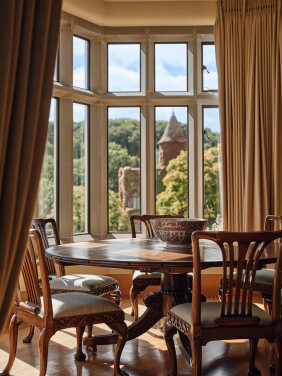
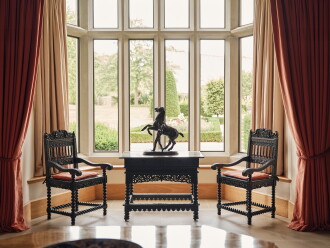
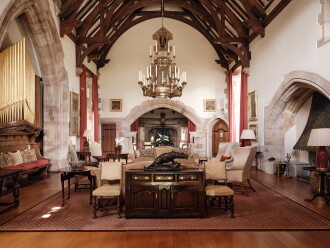
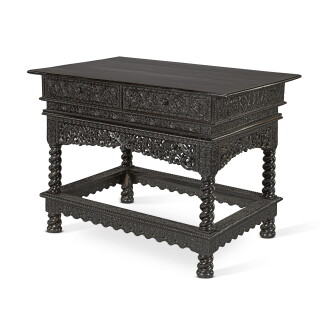
The most recent owner assembled an exceptional collection, furnishing the manor with a discerning eye and a deep appreciation for craftsmanship, provenance and historical resonance. Offered across multiple sales, the collection encompasses great English furniture, including a pair of Kentian eagle tables from Noseley Hall and an elegant set of George II dining chairs, juxtaposed with Chinese lacquer furnishings and a rare Ceylonese ebony table reputedly from Mentmore. Offered in Treasures, the Longleat House ebony chairs are amongst the most important examples of the Antiquarian taste and important examples of cross cultural contamination between Europe and Asia.


These works were complemented by a distinguished group of animalier bronzes offered between the Noble & Private Collections and 19th Century Sculpture sales. Artists such as Antoine-Louis Barye, Jean-Baptiste Clésinger and Isidore-Jules Bonheur, whose spirited depictions of the natural world brought vitality and movement to the interiors.
Together, these pieces compose a collection of considerable breadth and character, perfectly suited to a house whose architectural fabric embodies more than eight centuries of history.
Photo credit © Jake Curtis